 Retro Replay Retro Gaming History, Reviews & Emulation
Retro Replay Review
Gameplay
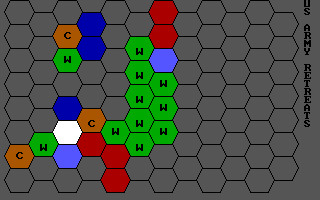
The opening turns put pressure on both sides immediately. The Soviet player has six Red Army units and a clear job—take and hold two of three cities before turn ten—while the American player has only four units to arrange into a defense that cannot be everywhere at once. That imbalance is a good fit for the scenario: the attacker must make progress, but the defender can turn a misplaced advance into a retreat or a lost unit.
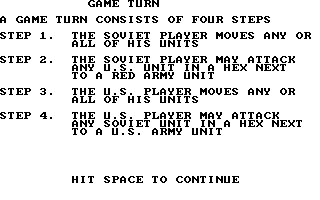
What starts to click is the value of the hexes around the objectives. Woods and cities grant defensive bonuses, so movement is not simply a race in a straight line. You need to consider where an enemy can attack from, whether a defended position is worth challenging, and whether a retreat helps the other side more than an elimination would. With movement and attack handled in separate phases each turn, planning an approach matters as much as choosing the fight.
The game is at its best as a face-to-face tactical puzzle with a rival who enjoys thinking a few moves ahead. It is also unforgiving. Ten turns do not leave much time for the Soviets to repair a stalled offensive, and the Americans cannot casually trade away defenders when two captured cities decide the game. That tightness makes victories feel earned, though anyone wanting a long strategic campaign or a wide range of scenarios may find the single confrontation slight.
Graphics
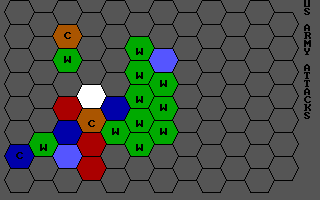
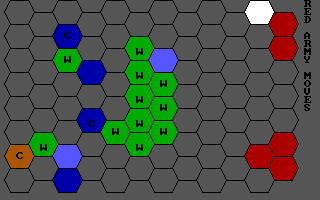
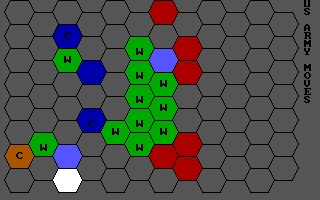
The action is seen from above on a hex-grid battlefield, with cities and woods serving as the key terrain landmarks. That simple map view suits the game: you can focus on unit positions, the routes into the cities, and the defensive ground that may decide an attack.
Story
There is no character-driven drama here; the story is the familiar Cold War flashpoint created by the map. Soviet forces are on the offensive, American forces are trying to hold a triad of cities, and the outcome turns on whether the defenders can prevent a second city from being occupied and held.
That narrow framing works because it gives each side a distinct emotional role. As the Soviets, you are trying to create the breach that makes the deadline irrelevant. As the Americans, every turn spent denying ground feels like progress, even if you are forced backward.
Do not expect plot twists or a historical narrative to carry the match. The tension comes from the changing battlefield: a city that looked secure a turn ago can become the whole war once enemy units close in and the clock keeps moving.
Overall Experience
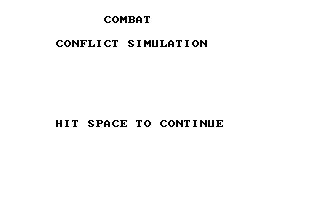
Combat: Conflict Simulation is a small, focused wargame built around one clean question: can an outnumbered defense stop an offensive in ten turns? It does not need much more than its hexes, terrain modifiers, and asymmetric objectives to make that question interesting. The best moments come when a seemingly obvious attack turns into a dangerous commitment because the defender has chosen the right ground.
Its biggest practical hurdle is that it is explicitly a two-player game, and it requires PCjr Cartridge BASIC to run. If you can meet those conditions, the compact ruleset makes it an approachable choice for a short competitive session rather than a game that demands a weekend of study.
Give it a chance if you like old-school, turn-based hex warfare stripped down to decisive positioning and direct opposition. Skip it if you need solo play, broad strategic scope, or a richly told Cold War setting. For the right pair of players, the attacker-versus-defender setup has enough bite to make a ten-turn match worth replaying.


Reviews
There are no reviews yet.