 Retro Replay Retro Gaming History, Reviews & Emulation


Retro Replay Review
Gameplay
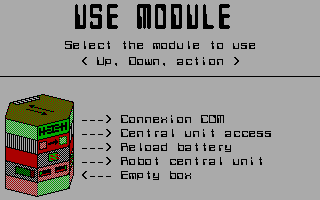
The first stretch of Hexsider makes you think differently about what a unit is. Each of the six robots is a vertical stack of up to six hexagonal modules, and its capabilities come from the pieces currently attached. A Central Unit keeps it alive; rollers at the bottom let it move; other modules open routes through robot interfaces and the building’s security network. That makes rearranging a machine more than inventory busywork. You are continually deciding which robot should carry which role into the next section.
Freely transferring control among the detachment is the heart of the game. One Hexsider may be positioned to reach a system while another has the useful module layout, and the puzzle becomes figuring out how to make both facts matter. The level system adds another good layer of planning: higher-level robots can grant access by interfacing, while doors, teleports, and network functions are gated by level. Progress feels earned because the route forward is often tied to understanding how these restrictions fit together.
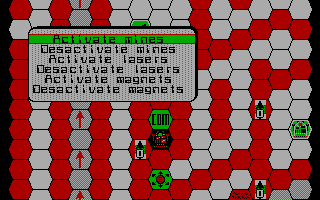
The security network is where Hexsider becomes properly tense. Lasers, mines, and electromagnets can obstruct a route, but access to the network can let you disable or enable them. That last detail is important: hazards are not merely locks to remove, but pieces you may need to place differently to solve an intricate situation. The game asks you to read the whole board, not simply find the nearest switch.
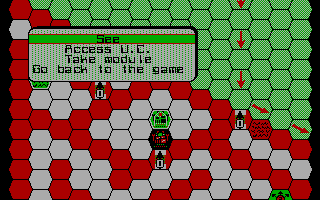
Its harshest idea is also its best. The replacement unit for the main computer is unique and irreplaceable, so you cannot treat it like ordinary cargo. Carrying it through a hostile compound gives your planning weight. Frustration will set in if you want brisk action or simple trial-and-error solutions; Hexsider is deliberately maze-like and methodical. Yet the payoff is the rare satisfaction of untangling a problem through your own careful arrangement of machines, permissions, and defenses.
Graphics
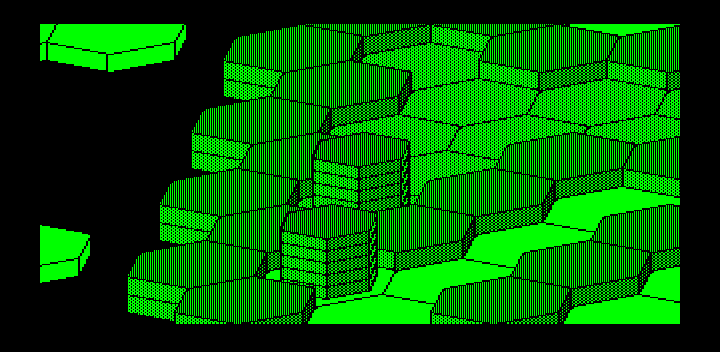
Hexsider is built around a top-down hex-grid map, with a rotating isometric 3D view available whenever you want another angle on the compound. The robots themselves are visibly non-humanoid stacks of hexagonal modules, which suits the game’s focus on rebuilding them piece by piece. The alternate view is especially welcome when you want to get a clearer sense of a crowded route through the facility.
Story
The story gives the puzzle machinery a clean, urgent reason to exist. In this future, humans have handed their dangerous work to adaptable Hexsider robots, only for a rebel faction to sabotage the defense command center and leave its security systems active. Six surviving robots outside the compound are all that remain to reach the damaged computer.
That setup is compact, but it fits the game well. You are not asked to juggle a sprawling cast or a pile of competing motives; the mission is immediate: infiltrate, survive the automated defenses, and repair the central computer. The hostile facility turns the premise into a practical objective every time you confront another blocked passage.
The robot rebellion also gives the modular design more flavor than a generic science-fiction maze would have had. These machines are tools built to adapt, and their ability to add, remove, and rearrange modules becomes the exact means by which the crisis can be solved. It is a straightforward premise, but a strong match for the play.
Overall Experience
Hexsider is a smart, unusually tactile strategy-puzzle game whose central idea carries it: your units are configurable machines, not fixed chess pieces. Once the module layouts, robot levels, and security controls start clicking together, the compound feels less like a maze and more like a system you can gradually learn to manipulate.
It demands the right mood. You need to enjoy stopping to consider access requirements, hazardous routes, and which robot should be carrying an essential component before committing to a plan. Anyone after fast combat will likely find its deliberate turn-based problem solving dry. Anyone who likes the old-school pleasure of mapping out a solution will find plenty to chew on.
The result is memorable precisely because it refuses to make its futuristic premise superficial. The robots’ modular bodies, the shifting control between the six units, and the network-controlled defenses all feed the same tactical question: how do you reconfigure what you have to get one irreplaceable object safely to the center? That is a strong question, and Hexsider gets real mileage from answering it.



Reviews
There are no reviews yet.