 Retro Replay Retro Gaming History, Reviews & Emulation
Retro Replay Review
Gameplay
The first hour is less about “beating” Learning with the PooYoos: Episode 2 than letting a child poke around a cheerful digital nursery and discover what catches their attention. That is the right instinct for this age group. The Whole Workshop menu branches into activities rather than pushing a rigid lesson order, so a child can move from plants to music, sky-themed play, mini-games, dancing, or presents without feeling as if they have failed a test.
The two interaction levels, Young PooYoo and Big PooYoo, are one of the smarter choices here. A three-year-old and a six-year-old rarely need the same degree of challenge, and the option to match activities to a child’s developmental stage makes this more flexible than a one-size-fits-all preschool disc. It also means an adult can start simply, then raise the challenge when basic colours, shapes, or sounds begin to feel familiar.
Music Workshop looks like the likeliest repeat-play draw. Children are asked to follow rhythms while the PooYoos play instruments, which turns listening and timing into something active instead of a passive sing-along. Dance Mode follows the same useful philosophy: get up and move rather than stare at the screen. For energetic kids, that physical break may be more valuable than another numbers exercise.
The activities cover a broad early-learning spread—numbers, letters, names, colours, shapes, objects, sounds, rhythm, and spatial ideas—without requiring reading ability. That matters. A child can engage with the prompts before they can decode written instructions, and a parent does not need to hover over every moment translating menus or objectives. If you want the earlier outing first, Learning with the PooYoos: Episode 1 lays the foundation for this follow-up.
Graphics
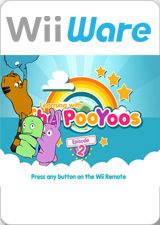
The PooYoos are colourful baby-animal characters: pandas, rabbits, pigs, elephants, cats, tortoises, and more. That direct, friendly imagery is well matched to toddlers and preschoolers, and the workshop framing makes the menu feel like a place for play rather than a dry lesson selector.
Story
There is no grand narrative pulling you from one chapter to the next, and that is sensible for a game aimed at pre-readers. The throughline is simply spending time with the PooYoos across a set of playful learning activities. It gives the game a familiar, low-pressure structure: return to the same friendly group, try something new, and gradually recognize the ideas being introduced.
Present Mode adds the clearest little reward loop. The PooYoos need help opening gift boxes, and each box reveals a new toy or treasure, including a magical tree. For a young child, that small mystery—what is in the next box?—can be enough motivation to keep exploring without turning the experience competitive or stressful.
The social angle is modest but appropriate. Helping the characters with presents nudges children toward sharing in the excitement of giving and receiving, while the familiar animal cast supplies a gentle companion through the lessons. Do not expect a plot with dramatic turns; expect a series of warm prompts built around curiosity and recognition.
Overall Experience
Learning with the PooYoos: Episode 2 is strongest when you treat it as a guided play space, not as a substitute for a full curriculum. It offers enough different activities that a child can follow their interests—music one day, movement the next, then shapes or objects—and that variety should help prevent it from becoming another forgotten educational game.
Its biggest strength is its age awareness. The game is made for children who have not learned to read, and the adjustable Young PooYoo and Big PooYoo levels recognize that early learning does not happen on a fixed schedule. Parents looking for screen time with a clearer purpose than random videos will find a more thoughtful fit here.
The payoff is quiet rather than dramatic: recognition, repetition, a little confidence, and the pleasure of discovering another present or joining in with a rhythm. It is worth a look for families with preschoolers, particularly children drawn to animal characters, musical play, and short self-contained activities. The multilingual European and American releases are another practical plus for homes using English, French, Spanish, Dutch, German, or Italian.



Reviews
There are no reviews yet.