 Retro Replay Retro Gaming History, Reviews & Emulation
Retro Replay Review
Gameplay
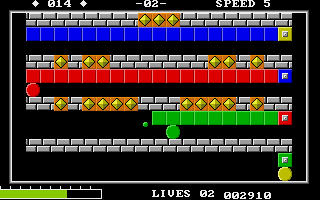
The hook is immediate: the ball bounces on its own, and all you control is its sideways movement. That restriction gives Diamond Ball III a distinct rhythm. You are not merely steering around blocks; you are judging where the next bounce will carry you, trying to line up a safe route before momentum turns a promising gap into a mistake.
Color matching is the idea that keeps the mazes from becoming routine. Your ball only clears blocks of its own color, so special blocks that change that color matter as much as the ordinary blocks themselves. A route that looks open can be useless until you alter the ball’s color, and the satisfying part is recognizing which blocks you should leave alone until later.
Hazards give that planning real stakes. Death blocks punish careless movement, while barriers and their switches make the route feel less like a straightforward cleanup job. Clearing the colored blocks only unlocks the diamonds; then you still need to remove those to advance. That extra final step is a smart bit of tension, because it asks you to finish a level rather than assuming the hard part is over.
Graphics
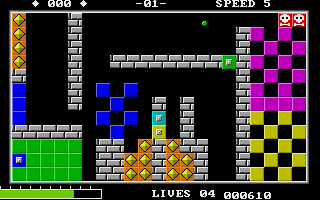
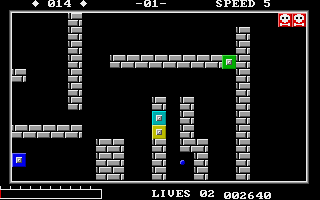
The side-view mazes are built around colored blocks, a bouncing ball, barriers, switches, and diamonds. That direct visual language fits the game well: you can quickly tell which blocks match the ball and which objects demand a more careful approach.
Story
Diamond Ball III treats each maze as its own tiny arcade scenario rather than building toward a character-driven tale. The immediate goal is always concrete: remove the blocks your current color allows, unlock the diamonds, and clear them to move on.
That stripped-down structure suits the game’s premise. Instead of stopping to explain why the diamonds are there, it lets the changing layouts and hazards create the sense of progression. The next level is the reward, and the puzzle is the point.
If you need a plot to carry you through an action game, this is unlikely to grab you. If you are happy to make your own little drama out of a dangerous route, the right color change, and a last diamond sitting behind an obstacle, its simplicity has a certain purity.
Overall Experience
Diamond Ball III is a compact, disciplined arcade puzzle-action game built around one constraint and a handful of variations on it. The first hour’s pull comes from learning to think in bounce paths rather than free movement; once that clicks, color changes and switches turn each board into a more deliberate problem.
Frustration is part of the deal. Because you cannot directly control vertical movement, bad positioning can feel costly, especially near death blocks or when a barrier interrupts the route you wanted. Still, that same limitation is what gives successful clears their snap. You are working with a stubborn tool, not simply gliding wherever you please.
Give it a chance if you enjoy old-school games that ask you to learn a tight ruleset and improve through repeated maze solving. Its payoff is modest but genuine: the pleasure of turning a bouncing ball, colored blocks, and a locked set of diamonds into a route you can finally execute cleanly.



Reviews
There are no reviews yet.