 Retro Replay Retro Gaming History, Reviews & Emulation
Retro Replay Review
Gameplay
Da Zhanlüe opens with the kind of problem that immediately makes tactical strategy fans lean forward: you have a scenario map, a headquarters to place, a limited military force, and no room to waste any of it. The action plays out on hexagonal grids in turns, so every move is an argument with the map. Put a unit somewhere useful now, or hold it back because the next few turns may matter more? That familiar tension is the game’s best quality.
The Daisenryaku influence is easy to feel in its abstract, military-board-game approach. Tanks, infantry, and supply trucks are not there to decorate a battlefield; they are the tools you are trying to arrange into a workable plan. Headquarters placement adds meaningful pressure before the fighting has even settled in, because deployment is part of the command problem rather than a formality.
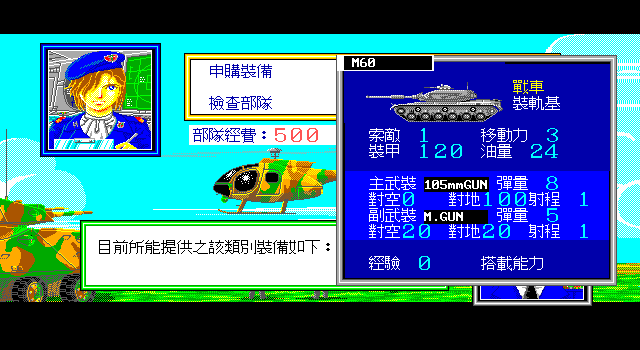
What gives the game some welcome momentum is the reward loop between missions. Success pays out money, and that money can go into purchasing and customizing troops. You are not simply checking a scenario off a list; you are building toward a stronger force. That progression should make victories feel practical as well as satisfying, while a poor outcome can sting because it affects what you can afford next.
The trade-off is that Da Zhanlüe is unapologetically narrow. Its name promises “Grand Strategy,” but its interest lies in tactical battles rather than managing a vast war. If you want diplomacy, sprawling nation management, or a broad political simulation, this is the wrong kind of strategy game. If you want to study a hex map and extract a win from finite resources, the focus is a virtue.
Graphics
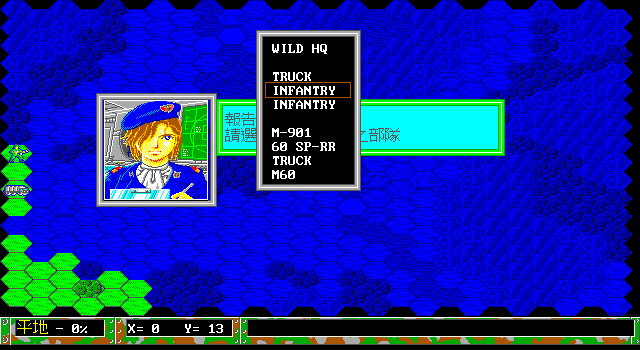
The game uses a top-down view of hexagonal battlefields, with military units such as tanks, infantry, and supply trucks occupying the map. That clear board-game perspective suits a tactics game: you are looking at positions, routes, and the shape of the battlefield rather than being asked to admire a cinematic war zone.
Story
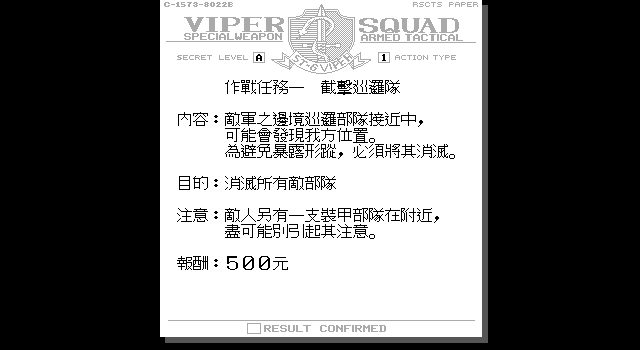
Da Zhanlüe frames its missions with a fictional near-future aftermath of the Soviet Union’s dissolution. Independent peacekeeping organizations have emerged, and you command Viper, one of those groups. It is a clean premise for sending a compact force into military scenarios without pretending this is a historical simulation.
The story’s real purpose is to put you in the commander’s chair. You are not a spectator to a detailed drama; you are responsible for where Viper establishes its headquarters, what it deploys, and how it spends the money earned from successful operations. That makes the setting feel functional and appropriate, even if the tactical layer is clearly the main attraction.
The peacekeeping angle also gives the campaign a slightly different flavor from a straightforward conquest fantasy. You are operating in an unstable world reshaped by political collapse, where private or independent military organizations have a place. It is enough context to make the missions feel connected without getting in the way of the map-level decision making.
Overall Experience
Da Zhanlüe is a lean, tactical DOS strategy game with a good sense of consequence. The first hour’s pull comes from setup and scarcity: you are asked to make sensible choices before you can rely on a larger, richer army. Once the purchasing and customization loop starts to click, winning missions becomes about improving your options as much as finishing the current map.
Its clearest weakness is also its honesty. This is not grand strategy, regardless of the title. The game lives or dies on your enjoyment of turn-based hex combat and abstract unit management. That can become frustrating if you came expecting a wider war to run, but it also means Da Zhanlüe does not dilute its strongest idea with unrelated systems.
Give it a chance if Daisenryaku-style tactics, limited deployments, and persistent military spending sound more exciting than intimidating. The payoff is a concentrated command game where each completed mission can directly strengthen the next one. It may be modest in scope, but its tactical priorities are clear, and they are well chosen for a player who enjoys thinking several turns ahead.

Reviews
There are no reviews yet.