 Retro Replay Retro Gaming History, Reviews & Emulation


Retro Replay Review
Gameplay
G-stones III understands the immediate pleasure of Breakout. You begin with the paddle, the ball, and a wall of bricks, then spend every second judging angles and trying not to let a return slip past the bottom of the screen. It is a simple loop, but it asks for focus in the right way: one clean hit can set up a satisfying clearing run, while one sloppy position can erase your momentum.
The boards have more going on than plain disposable bricks. Some hits destroy gems, some release bonus items or another ball, and switches can turn certain bricks on or off. Indestructible bricks also force you to work around the layout rather than merely carve a direct path through it. Once several balls are moving, the game becomes a lively scramble. Up to four balls can be active, and that can be exhilarating when you are catching everything—or aggravating when the action spreads wider than your paddle can sensibly cover.
Its strongest replay hook is the registered version’s random choice of 20 levels from 100 possibilities. You are not simply memorizing one fixed sequence, so a new game has room to surprise you. Each session lasts five levels, with three difficulty settings plus adjustable game and mouse speed. Individual settings for as many as six players are also a thoughtful touch for a household taking turns, even though everyone is not playing simultaneously.
The catch is its no-save structure. A five-level game is not an enormous commitment, but you must finish the run in one sitting. That makes G-stones III a better fit for a focused arcade break than for someone who wants to slowly chip away at a campaign over several nights. Stick with it if you enjoy recovering from chaotic bounces; walk away if multi-ball disorder feels more punishing than exciting.
Graphics
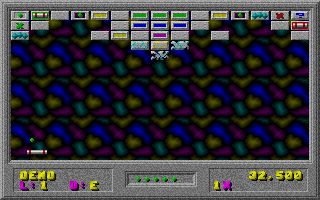
The view is classic side-on Breakout: bricks occupy the top of the screen, your paddle hugs the bottom, and balls travel through the open space between them. Eleven backgrounds and 43 gem types give the boards more variety than a bare single-screen brick wall, while keeping the important action easy to locate.

Story
G-stones III is built around arcade rounds, not narrative momentum. You are here to clear brick arrangements and keep the ball alive, with no story detours between the action.
That absence suits the format. A brick-breaker benefits from getting you back into the next volley quickly, and this game does not pretend that its gems need a larger dramatic purpose.
If you need characters, stakes, or a reason to see the next level beyond the challenge itself, this will feel thin. Its motivation is entirely mechanical: survive the current board, handle the surprises it throws at you, and see what the next random pick looks like.
Overall Experience
G-stones III is a worthwhile take on Breakout when you want a familiar arcade foundation with enough board behavior to create sudden trouble. Extra balls, bonus items, switches, and unbreakable bricks make the moment-to-moment play less predictable than simply knocking down a uniform wall.
The random level selection is the feature that gives it legs. A pool of 100 possible levels, sampled into 20-level selections, means the game can feel fresh across repeated starts instead of becoming a rote exercise. The five-level session length keeps it approachable, and the speed controls let you decide whether you want calm practice or a sharper reflex test.
Still, this is not a forgiving game for everyone. The same multi-ball moments that create its best arcade stories can make failure feel abrupt, and no saving means you cannot preserve a good run for later. If you enjoy old-school paddle games with a little more chaos and variety than the standard formula, G-stones III is an easy recommendation. If you prefer steady progression and low-pressure play, its one-sitting, bounce-or-die rhythm may wear you down.


Reviews
There are no reviews yet.