 Retro Replay Retro Gaming History, Reviews & Emulation

Retro Replay Review
Gameplay
The first few minutes of Galleons are a lesson in patience. You can see the other ship looping around you, but a broadside only matters if you have turned the correct side toward the target and released your shot at the right range. Holding the fire button to build toward the desired distance, then letting go for the volley, gives each shot a small but welcome moment of commitment. A missed salvo is not just bad luck; it often means you fired too early, too late, or failed to put the ship where it needed to be.
The wind keeps this from becoming a simple circle-and-shoot game. Sail level, rudder choice, and wind direction all affect how readily the ship handles, so you are always weighing sharper maneuvering against the need to maintain useful speed and positioning. Ramming is an alternative to gunfire, but getting close enough without exposing yourself to a punishing broadside makes it a risky answer rather than an automatic tactic.
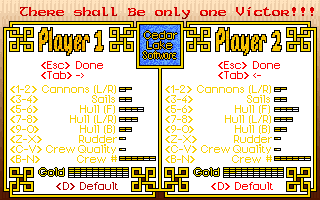
Damage gives the duel a strong escalation. A hit is reflected in the ship schematic, and the practical consequence is that a battered vessel becomes harder to steer. That creates a convincing downward spiral: once you lose control of the engagement, recovering can be difficult. Before battle, equipment and crew settings let you tune the ships, with tougher or better-equipped choices affecting the score. The game is at its best when two humans are learning its rhythm together on a split keyboard or joysticks; computer opponents still make sense for practice, but the direct rivalry is the real hook.
Graphics
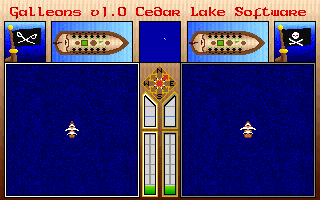
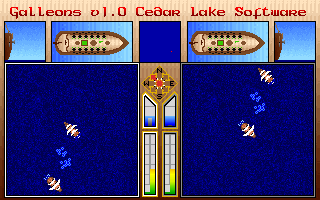
The action is shown from above in split-screen, each player’s view centered on their own galleon while the opponent circles nearby. A small map at the top tracks both ships as dots, while central range stripes, sail-and-speed bars, a compass rose, and the damage schematic keep crucial battle information in sight. When a ship loses, broken masts and a sinking animation give the final blow a proper visual finish.
Story
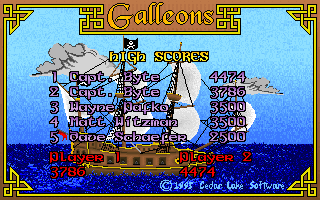
There is no campaign narrative to carry Galleons along. Its story is the duel itself: one ship flies the Jolly Roger, the other Crossed Sabers, and only one is meant to remain afloat.
That stripped-down setup works because the match produces its own little naval drama. An early hit changes the mood, damaged steering turns confidence into panic, and a bold ram can either end things or leave you badly placed. You supply the rivalry, particularly when another person is sitting beside you.
If you want characters, missions, or a developing plot, this will feel bare almost immediately. Galleons is interested in the tense final minutes of a sea battle, not in explaining why the ships met or what comes after the sinking.
Overall Experience
Galleons is a focused, old-school duel game that asks you to learn its timing rather than overwhelm you with options. The map, wind indicator, range markers, and damage display give you enough information to make deliberate decisions, and the changing handling of a damaged ship ensures that a fight rarely stays static.
Its limitations are also plain. Every match revolves around the same two-ship confrontation, and the satisfaction comes from improving your command of that scenario. If the measured pace of lining up broadsides sounds tedious, no amount of score chasing will transform it into a faster action game.
Give it a chance if you enjoy head-to-head games with a little simulation in their bones, especially if you have someone nearby for local competition. The payoff is not scale; it is the sharp satisfaction of reading the wind, swinging into range, and landing the volley that leaves the other galleon limping toward the bottom.


Reviews
There are no reviews yet.