 Retro Replay Retro Replay gaming reviews, news, emulation, geek stuff and more!



Retro Replay Review
Gameplay
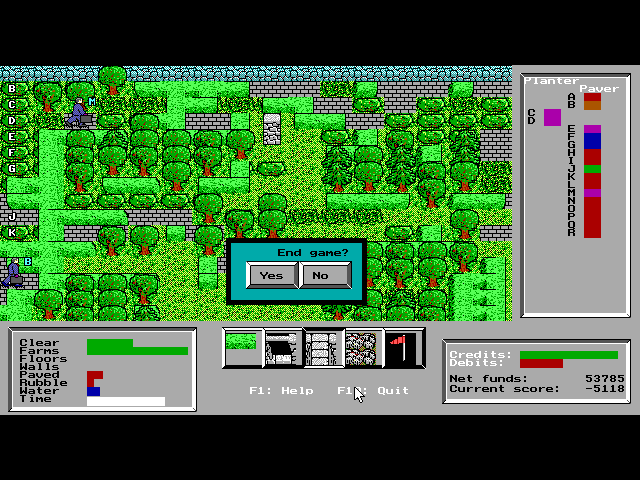
Green gets its hook from a pleasingly combative reversal of city planning. You are not expanding an empire or beautifying the countryside; you are trying to stop planners from covering an idyllic rural area in pavements. At first, drawing walls to catch them sounds almost too slight to sustain a game. Then a planner slips through an opening, another pathway appears, and the score starts moving the wrong way. That is when the board stops feeling static and starts demanding attention.
The central decision is simple but worthwhile: commit walls to trapping the planners you can reach now, or shape the map to deny them room to spread later. Points for immobilising planners give every successful enclosure a satisfying little payoff, while the penalty for laid pathways keeps you from treating each move as an isolated puzzle. You need to watch where the pressure is building, not just chase the nearest target.
Its mouse control fits the map-based action neatly, and the function-key help is welcome in a game that expects you to learn through repeated attempts. Green does not hide behind a pile of systems. That directness is its strength, although it also means your enjoyment rests almost entirely on whether trapping moving opponents with walls sounds like a good use of an evening. If it does, the score pressure gives you a reason to come back and try for a cleaner result.

Graphics
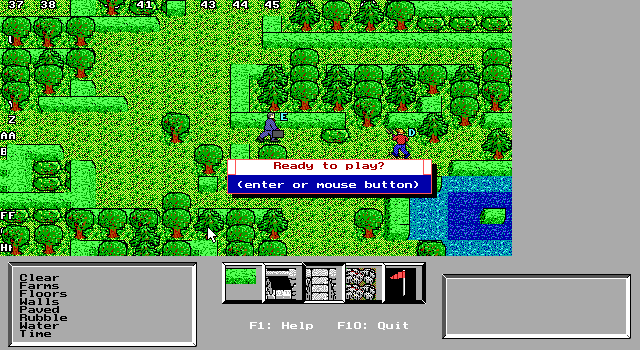
The isometric map frames the rural area as a compact board, with planners, pathways, and your walls sharing the same visible space. That viewpoint is a good match for the game: you can follow the spreading pavement and judge where a barrier might close off movement without losing track of the whole area.
Story
Green’s story is its conflict: an idyllic rural landscape is under attack from pavement-building planners, and you are the person putting up resistance. It is a clean premise, immediately understandable and unusually pointed for such a compact strategy game.
There is no need for a grand plot when each match creates its own tiny struggle. A planner caught behind a wall feels like a win for the countryside; a fresh pathway feels like ground lost. The scoring turns that environmental theme into something you actively protect rather than a label pasted onto the action.
That framing also gives the game more character than a purely abstract enclosure puzzle. You are still chasing points, of course, but the points have a readable meaning: fewer active planners and fewer new paths are better outcomes. It is modest storytelling, but it keeps the objective from feeling arbitrary.
Overall Experience
Green is a focused strategy game built around one sturdy idea, and it understands the value of getting to that idea quickly. The first hour is likely to be a mix of easy confidence and sudden annoyance as planners exploit gaps you did not think mattered. That frustration is fair rather than fussy, because the rules are clear: walls stop them, pathways hurt your score, and better positioning is the answer.
The payoff is not a sprawling campaign or a stack of tactical subsystems. It is the satisfaction of gradually reading the map better, anticipating movement, and turning a threatened area into a set of traps. If you enjoy compact DOS strategy games that ask you to improve through practice, Green has enough bite to justify a look.
Its narrow focus will not suit you if you want elaborate management or a long-form strategic arc. But as a one-player score-driven contest, it has a sharp theme and a sensible loop. Green is worth trying for the pleasure of solving a simple problem under growing pressure, especially if you like strategy games that make every newly closed route feel earned.


Reviews
There are no reviews yet.