 Retro Replay Retro Gaming History, Reviews & Emulation
Retro Replay Review
Gameplay
The first hour of Horde feels recognizable if you have spent time with Warcraft II: establish a base, harvest materials, train troops, and push outward. Then it starts asking more of you. Population is not merely a cap to work around; it feeds growth, supplies workers and soldiers, staffs most new buildings, and produces taxes. Farms therefore matter because they grow the settlement over time, not because they instantly unlock a larger army. That makes an early settlement feel like something you have to nurture rather than simply optimize.
Its construction rules are a smart compromise between convenience and constraint. Buildings construct and repair themselves once ordered, so you are spared the busywork of assigning builders, yet the castle’s building radius keeps your town compact. Barracks and factories can extend that reach, but moving the castle is a serious decision: structures left outside the new radius are abandoned and eventually crumble. Mines also need to be placed over deposits before ore or gold can flow. These rules give expansion real consequences without turning every order into a chore.
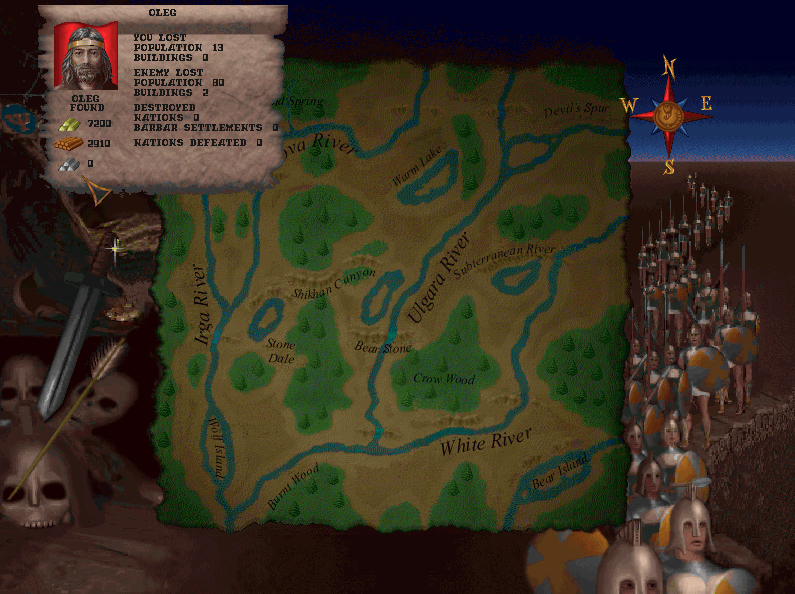
The nine connected maps are where the game becomes much more interesting than a mission-based RTS. You can move the leader between adjacent maps whenever the route is open, while the AI takes over the settlement you leave behind. That creates a feeling of running a small realm rather than clearing one prescribed scenario after another. Forests are useful shortcuts but slow infantry down, and inexperienced troops can be mauled by wolves or bears. Exploration also turns up items, imprisoned creatures, engraved hints, and scrolls, so wandering is not just a search for the next enemy base.
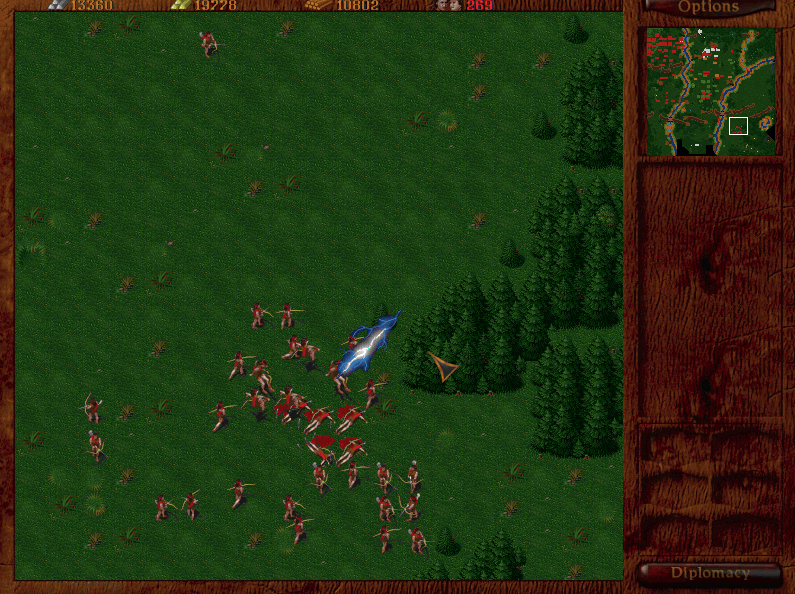
Combat is the weak spot. You can select up to 400 units and quickly remove whole unit types from a group, which helps when organizing a mixed army. Veterans grow tougher and can heal, giving survivors value. But large battles are described by chaos for good reason: units may ignore orders in the thick of it. You can plan an attack carefully and still watch control slip away at the moment precision matters. Fire adds welcome tactical danger, though. Flaming arrows and ballista bolts can ignite buildings, wind can carry the blaze to neighboring structures, and even forests can burn.
Graphics
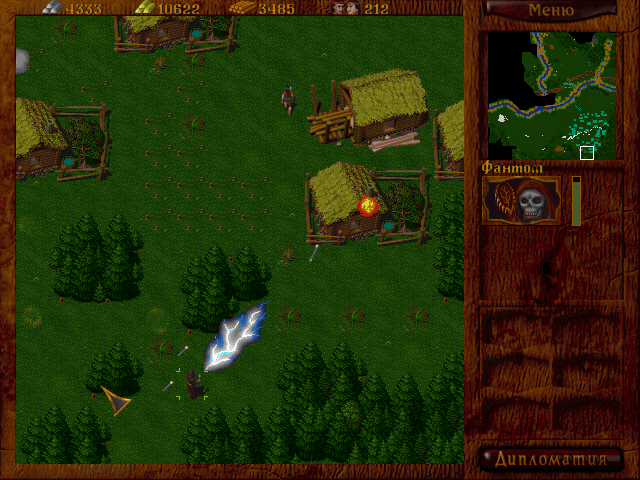
Horde pays unusual attention to small battlefield details. Flags on buildings shift with the wind, troops leave tracks on sandy riverbanks, and fires behave like actual spreading flames rather than a generic damage marker. Watching a burning structure threaten the buildings beside it gives the maps a lively, physical quality.
Story
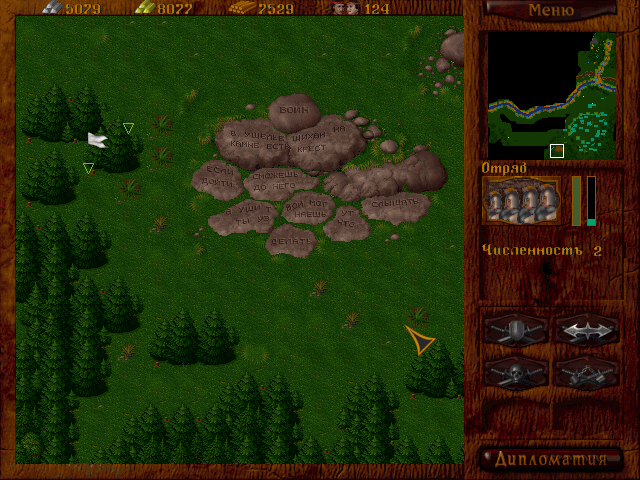
The broad objective—find and slay a dragon—is intentionally not handed to you as a neat checklist. Instead, the game asks you to uncover what matters through exploration, cryptic stone inscriptions, ancient scrolls, and special items. That non-linear structure makes the story feel more like a local legend you are piecing together than a campaign briefing delivered between missions.
Semirechye’s medieval fantasy world, loosely drawn from Slavic folk tales, is a good fit for this approach. The wizards, magical allies, hostile beasts, and mysterious finds give your travels texture without displacing the strategy layer. You are not simply conquering a map; you are trying to understand a land full of competing factions and half-explained dangers.
Diplomacy gives the journey some welcome flexibility. Newly encountered nations begin neutral, and you can choose war, alliance, or vassalage when facing a stronger power. The options are limited, but they matter because outright annihilation is not always a practical answer. Experimenting with a faction’s response becomes part of solving the wider problem, especially when your own settlement is still fragile.
Overall Experience
Horde is at its best when it lets strategy emerge from overlapping pressures: keep a population growing, protect an exposed settlement, decide whether the next neighbor deserves a treaty or an attack, and venture into another map because a clue might finally point toward the dragon. The absence of a conventional mission ladder gives it a welcome sense of freedom. You are allowed to poke around, make an imperfect decision, and see where it leads.
That freedom asks for patience. The economy takes longer to understand than simpler RTS resource loops, and unreliable behavior in large fights can make a hard-earned army feel less responsive than it should. Going in with the expectation of crisp competitive micromanagement is a mistake. Treat battles as messy clashes where positioning, experience, and preparation matter, rather than as situations you can command down to every last unit.
For the right strategy fan, the payoff is real. The settlement systems have enough teeth to stay engaging, the map-to-map world gives exploration purpose, and the dragon hunt supplies a long-term mystery that ordinary skirmish-driven RTS games rarely offer. Give Horde a chance if you enjoy older real-time strategy games that are willing to be untidy, demanding, and a little strange in exchange for a more adventurous campaign.


Reviews
There are no reviews yet.