 Retro Replay Retro Gaming History, Reviews & Emulation
Retro Replay Review
Gameplay
Icy Metal gets to the point fast. You have a ball, a moving target arrangement, a countdown, and a score that can go up or down just as quickly. That directness gives the first few minutes a nice old-school arcade bite: there is no long setup between an error and the next attempt, so you can immediately test whether your last miss was bad timing or bad aim.
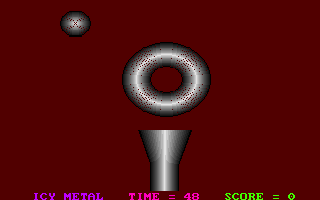
The first game is the most tense of the set. You drop the ball toward a horizontally movable funnel while a magnetic torus bounces side to side above it. The funnel asks you to track a falling object, but the ring makes a routine-looking shot dangerous. Let the ball stray near it and the magnetic capture costs you a point. It is a clean little risk calculation, and the kind of challenge where a single successful drop feels more satisfying than it has any right to.
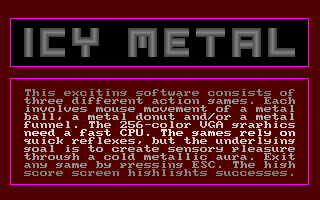
The second and third variants shift the pressure toward throwing. In one, two vertically moving funnels sit on opposite sides of the screen and can reverse orientation, so you need to choose the right side and hit the large opening rather than fling the ball at a bad angle. In the other, you throw from a funnel through two independently moving tori. Both can frustrate when the targets drift out of a favorable position, but the time limit keeps you from overthinking any one shot.
Because failures subtract points, Icy Metal has a sharper edge than a casual toy-box game. That will either push you into “one more run” mode or make the losses feel needlessly punishing. The separate top-three high-score tables are a smart fit for its short-form structure. Give it a chance if you enjoy chasing precision in brief mouse-driven arcade games, especially when the rules are easy and the execution is not.

Graphics
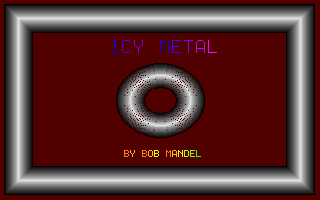
The game is built around metallic-looking balls, tori, and funnels rather than busy scenery. Those simple objects are the whole focus, and that suits challenges based on following a ball, watching moving rings, and lining up an opening under time pressure.

Story
There is no narrative detour here. Icy Metal frames its action around the sensation of handling metallic objects, then leaves the rest to your score, the clock, and the immediate problem in front of you.
That sparse approach is appropriate for a three-event arcade game. You are not being asked to invest in characters or a larger journey; the small drama comes from whether a ring intercepts the ball, a funnel turns the wrong way, or two moving targets finally line up.
It also means the game’s personality has to come from the physical oddness of its objects. The magnetic torus is particularly effective in that respect: it gives the ball a threatening pull that makes an otherwise plain drop feel like a contest with an unruly piece of metal.
Overall Experience
Icy Metal is a narrow concept, but it understands that narrowness. Three compact variations prevent the central ball-and-target idea from becoming entirely repetitive, while the countdown and score penalties give every round a little urgency. It works best as a short challenge you revisit when you want to improve a run rather than as something you settle into for hours.
The strongest moments come when the motion of the objects forces a quick decision. You have to react to a moving funnel, avoid magnetic interference, or wait just long enough for two rings to pass into a possible line. When you succeed, the point is small but tangible; when you fail, the deducted score makes the next attempt feel personal.
Its limitations are equally clear: the game lives and dies on whether these three scoring tests hold your attention. There is little room for someone who needs variety beyond repeated attempts at precision. But if a stripped-down DOS arcade experiment with a mouse, a ticking clock, and a stubborn high-score target sounds inviting, Icy Metal has enough tension in its moving metal puzzles to be worth a look.

Reviews
There are no reviews yet.