 Retro Replay Retro Gaming History, Reviews & Emulation



Retro Replay Review
Gameplay
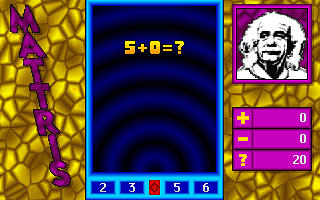
Matmania earns attention by borrowing the rhythms of puzzle games rather than asking you to stare at a page of sums. In Mattris, an incomplete mathematical operation is highlighted and you select its missing piece from four answers along the bottom of the screen. A correct pick clears that selection; a wrong one stays put. That tiny bit of consequence gives even straightforward arithmetic a welcome sense of urgency.
Mattris is also the clearest expression of the collection’s idea. You are not stacking conventional bricks, but resolving the operations that take their place, including digits and comparison symbols such as “less than.” The percentage display at the right gives you a blunt running measure of how well you are doing. It is a useful nudge for practice, though it may make repeated errors feel more like a report card than a satisfying puzzle recovery.
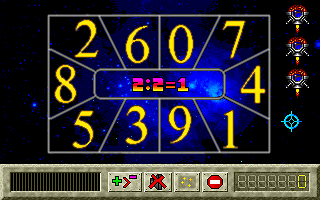
Astro changes the tempo. A math operation sits in the centre while ten digits or characters surround it, so you need to track down the correct target rather than merely choose from a short list. Wrong choices cost energy, while correct answers restore some of it. That makes it the more tense of the three, but the learning goal remains direct: identify the answer accurately before haste gets the better of you.
Klocki slows everything down into a matching game, pairing a card that shows an equation with another card holding its missing element. It is the least flashy mode, yet it may be the best fit when you want repetition without pressure. Across all three, Matmania works as a compact set of arithmetic drills with different wrappers. If you already know the material cold, the formats can run out of surprises quickly; if you need the practice, their repetition is exactly the point.
Graphics
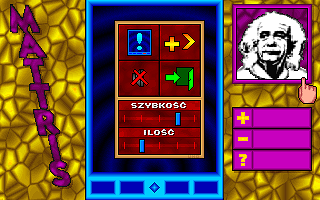
The game is built around functional math screens: Mattris places answer options along the bottom and a correctness percentage on the right, Astro puts the problem in the middle with possible characters around it, and Klocki uses equation and answer cards. These layouts keep the question in front of you and make each mode easy to distinguish at a glance.
Story
There is no narrative thread pulling the three games together. Matmania is concerned with questions, answers, and your accuracy, not characters or a larger goal beyond improving at the operations in front of you.
Astro uses a space-themed frame, but its role is to add pressure to the calculation exercise rather than launch a plot. Your attention stays on the central operation and the targets surrounding it.
That absence is appropriate for a short educational compilation. You do not need to sit through setup before practising, although anyone wanting a reason to continue beyond beating their own accuracy will find little narrative momentum here.
Overall Experience
Matmania is at its best when it catches you making arithmetic decisions almost before you have time to call it studying. The first hour has enough variety to show why the three modes exist: Mattris supplies quick four-choice decisions, Astro adds a more demanding search, and Klocki gives you a calmer memory-based alternative.
Frustration sets in when a miss leaves Mattris unchanged or drains Astro’s energy, especially if you are learning rather than reviewing. Still, that resistance gives right answers some weight. The game does not disguise the fact that it wants you to practise, but it makes a credible effort to make that practice active.
Give it a chance if you want basic mathematical operations packaged as brief DOS puzzle sessions, particularly for a younger learner who responds better to immediate feedback than worksheets. Do not expect a deep falling-block game, a sweeping space adventure, or a card game with much strategic depth. As an educational sampler, it is modest but purposeful, and its strongest idea—answering maths problems through familiar game structures—still has a little pull.


Reviews
There are no reviews yet.