 Retro Replay Retro Gaming History, Reviews & Emulation

Retro Replay Review
Gameplay
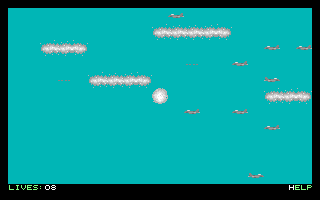
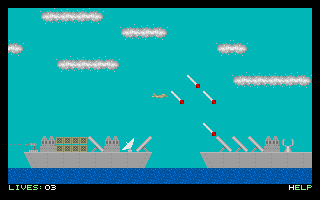
Navjet gets to the point almost instantly. You begin above the ocean in an attack aircraft, enemy planes and naval forces advance from the right, and your job is to fire, bomb, and keep the whole situation from getting away from you. Unlimited ammunition is a smart fit for this kind of arcade game: shooting feels like a constant response to pressure, not a resource-management puzzle.
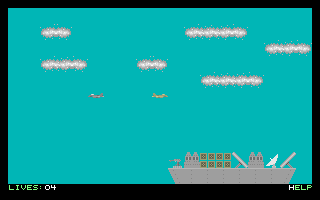
The first useful lesson is that the center of the screen is not truly safe. Enemies launched from carriers move left, turn around at your starting point, then come back at you from behind. Since you can fly right to meet them or retreat to clean up anything that slipped through, the action asks you to keep reassessing where the danger is. You cannot travel left of your original position, however, so recovery has a firm limit. That constraint gives the otherwise open four-direction movement some teeth.
Gunfire and bombs give you two straightforward ways to deal with targets, while stars left hanging in the air can become extra lives if you fly into them. There is a pleasing bit of restraint in the rule that shooting a star destroys it: when the screen gets crowded, you need enough control to stop firing long enough to collect the reward. With eight starting lives, Navjet is not stingy about giving you a chance to grasp that balance.
Each level ends with a concrete target: reach the end of the map and destroy the enemy nuclear missiles. That goal gives the shooting a welcome sense of forward movement instead of making every wave feel interchangeable. Passwords for reached levels are also a major convenience. You can return to a later stage without repeatedly replaying the opening, which makes a difficult arcade structure much easier to live with.
Graphics
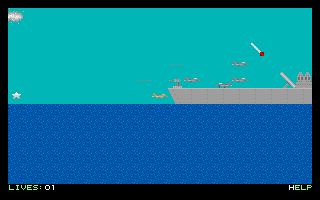
The action uses a 2D side-scrolling view: your jet flies over the sea as enemy aircraft arrive from the right and carriers send out waves. The fixed starting boundary and the enemies’ turn back toward you make the battlefield easy to understand, even as the action begins to come from both directions.
Story
Navjet keeps its conflict blunt and functional. You are defending against the air and naval forces of a neighboring country, and the level-ending objective is to destroy its nuclear missiles. It is a premise designed to put you in the cockpit quickly, not to slow the game down with narrative detours.
That directness suits the format. The escalating implication is clear enough: each completed map pushes you further into hostile territory toward another missile target. You are given a military objective, an invading force, and a reason to keep moving right; for an arcade shooter, that is enough structure.
Do not come to Navjet for character drama or elaborate world-building. Its story works as a clean frame for the action, and the password system quietly reinforces the sense that you are advancing through a larger campaign rather than only chasing a single high score.
Overall Experience
Navjet sounds simple, but its enemy routing is the part that can make it stick. A shooter where foes can get past you, reverse course, and return from your rear forces you to pay attention to the whole space instead of treating the screen as a one-way firing lane. Once that rhythm clicks, flying back to correct a mistake and then pushing forward again becomes the core pleasure.
Frustration is most likely to set in when you are too eager with the trigger. Stars are valuable extra lives, yet careless fire can erase them before you collect them, and the no-left-of-spawn rule means you cannot always drift away from trouble forever. These are fair pressures rather than arbitrary ones, but they demand a steadier hand than the basic controls initially suggest.
This is worth a look if you enjoy compact, objective-driven shooters with a little more spatial awareness than their premise first reveals. Navjet does not bury its strengths under complication: it gives you a jet, endless shots, bombs, incoming waves, and a clear destination. The passwords make the payoff of reaching later levels attainable, and the unusual backtracking threat gives its arcade action a welcome edge.


Reviews
There are no reviews yet.