 Retro Replay Retro Gaming History, Reviews & Emulation

Retro Replay Review
Gameplay
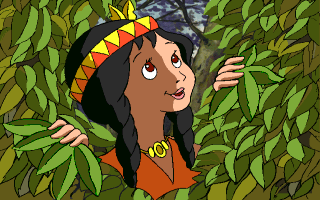
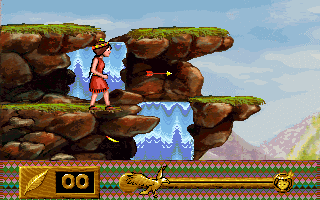
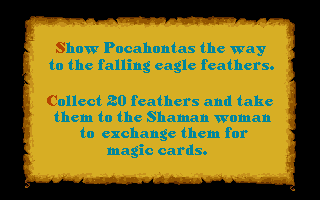
The first hour of Pocahontas has the restless energy of a game that does not want you settling into one routine. Pocahontas handles the familiar side-scrolling work—running, climbing, jumping, and swinging—but her early missions are built around distinct goals, from collecting feathers for magic cards to making it through the forest and escaping a pursuer. It is a simple foundation, yet the shifting objectives stop the platforming from becoming completely automatic.
John Smith’s levels pull the game in a different direction. His hunting and fishing tasks ask you to aim with the mouse at animals or fish moving on separate planes, with a quota to meet before darkness in the hunting stage. These sections are a sharp change of pace from the platform stages, and whether that feels refreshing or distracting will depend on how much you enjoy a game changing genres between missions. The visible cursor helps point out possible actions, while left and right clicks can produce different results, so it pays to watch the screen rather than blindly hammer keys.
The more traditional traversal returns when Smith is leaping ravines and crossing rivers, and the game’s strongest idea arrives late: controlling both characters as they cooperate to cross a lake and catch a bear. That structure gives the finale a reason to exist beyond simply adding another obstacle course. The puzzle elements are minor, with items selected from the bottom of the screen, but they add a little thought between jumps; the progress bar is especially useful when a mission’s finish line is not just “reach the right edge.”
Frustration is most likely to come from the constant switching of expectations. You might be enjoying a clean platforming rhythm and suddenly be asked to aim, react to targets, or interpret cursor-led interactions instead. Still, the game is short enough in structure, and varied enough in objectives, that the experimentation has a certain charm. Treat it as a string of small challenges rather than one seamless platform adventure.

Graphics
The game uses a 2D side-scrolling view for its platforming missions, taking Pocahontas and Smith through forest paths, rivers, ravines, a canoe sequence, and the white man’s camp. The on-screen mouse cursor is always visible and doubles as an action guide, making the interactive parts of the screen easier to identify.
Story
This is a game built around the Pocahontas and John Smith pairing, but it tells its story chiefly through objectives rather than long narrative detours. Pocahontas begins with tasks tied to a Shaman woman, the forest, and the approach to the camp, while Smith’s missions focus on feeding his men and making his way through the landscape.
That mission-based approach means the plot has a practical, game-first shape. Each character gets separate work to do before they meet, and the later co-op tasks give their connection a more active role than a simple cutscene reunion would. You are not just told they need one another; the final stretch asks you to manage both of them.
The material is necessarily uneven in tone. A forest escape and a lake-crossing partnership sit beside missions where Smith shoots animals for food or catches fish from a canoe. If you want a deep retelling, this is not where the focus lies. It is a compact adaptation that uses the characters and broad situation as a frame for a run of varied action scenarios.
Overall Experience
Pocahontas is most interesting when you accept its willingness to be a little scattered. It is not content to remain only a platformer: it mixes traversal, mouse aiming, simple item puzzles, and two-character cooperation across seven missions. That makes it more memorable than a generic left-to-right trek, even if some of those detours will land better than others.
The best audience is someone with patience for mid-1990s DOS design and an appetite for bite-sized challenge changes. You will get more out of it if you enjoy learning what each mission wants from you, then moving on before the idea wears thin. The cursor guidance and progress bar soften that adjustment period, but they do not remove the abruptness of the genre shifts.
Its payoff is modest but real: by the end, the separate character sections finally build toward shared tasks, giving the game a clearer sense of progression than its early grab bag suggests. The result is an uneven licensed platformer with enough unusual structure to be worth a look for retro fans, especially if a conventional platform game sounds less appealing than one willing to take a few odd turns.

Reviews
There are no reviews yet.