 Retro Replay Retro Gaming History, Reviews & Emulation
Retro Replay Review
Gameplay
Schoolhouse gets to its point quickly. You and an opponent take turns placing subject-related items into lists where each entry must come before the next, then race to empty your own item box. A correct choice gets an item out of your way; a mistake adds a new one. That little penalty gives even basic practice some bite, because a careless answer does more than simply stop your progress—it makes the finish line farther away.
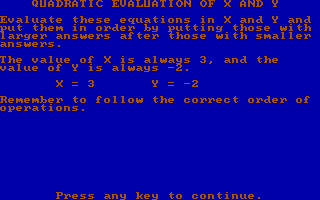
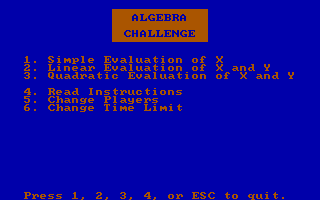
The first hour has a nice pick-up-and-play pull, especially with another person in the room. You do not need to learn a separate ruleset for Beginner’s Alphabet, Math Master, World History, or U.S. Geography; you learn the central ordering game and apply it to different school topics. Once that clicks, the changing subject matter becomes the draw. Alphabetical order, arithmetic, time, algebra, chemistry, and history all ask you to bring different knowledge to the same head-to-head framework.
That consistency is also where frustration can set in. Every topic is filtered through the same list-making contest, so success depends on enjoying that structure as much as enjoying the lesson itself. A wrong answer that adds another item can be a useful nudge to slow down, but it may feel punishing if you only wanted low-pressure review. Use the short, medium, or long time setting to match the mood: shorter sessions suit a quick challenge, while longer ones give the contest more room to swing back and forth.
Solo play still has an opponent, with Dr. Genius, Ava Ridge, or E.Z. 2Beat filling the second seat, while two humans can play hot-seat. The human-versus-human option is the better reason to return. Taking turns over the same machine turns a dry school question into a small bragging-rights battle, and that friendly rivalry is what keeps the format from feeling like homework.
Graphics
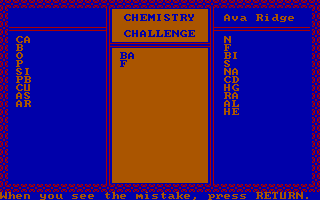
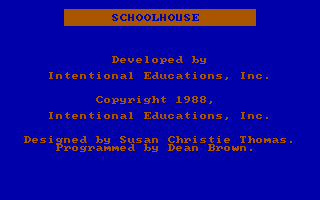
The on-screen focus is functional and easy to understand: each side has an item box to clear, and the ordered lists show the decisions that are shaping the race. That direct layout suits a game built around comparing answers and watching mistakes add to your workload.
Story
Schoolhouse does not build a narrative around its lessons. The subjects themselves are the point, moving from early alphabet work to more demanding algebra, chemistry, and history challenges without a plot tying them together.
The closest thing to cast is the trio of computer opponents. Dr. Genius, Ava Ridge, and E.Z. 2Beat give solo sessions a little more character than a faceless computer challenger, even though the real drama comes from whether you can clear your box before they clear theirs.
That stripped-down approach fits the game. You are here to test recall and ordering under a bit of competitive pressure, not to follow an educational adventure. Anyone wanting a story-led way into school subjects will find this bare, but the lack of detours keeps the focus on the questions.
Overall Experience
Schoolhouse is a smartly focused piece of educational design. It takes a broad set of classroom themes and gives them one understandable competitive hook, making it easy to sit down for a round without relearning the whole game each time. The payoff is not variety in rules; it is seeing how far one simple rule can stretch across different subjects.
Its best audience is a child studying alongside a sibling, parent, or friend, or anyone who remembers when educational software was happy to be blunt about drilling knowledge. The race to remove items creates enough tension to make correct answers feel earned, and the hot-seat setup makes even a small victory immediate and social.
Do not expect every subject to feel equally fresh after the underlying routine reveals itself. Still, Schoolhouse earns credit for turning practice into an actual contest rather than dressing up a quiz with empty distractions. If the idea of competing over alphabetical order, arithmetic, history, or geography sounds pleasantly nerdy, it is worth a look; if you need a richer game wrapped around the lesson, its narrow structure will wear thin.


Reviews
There are no reviews yet.