 Retro Replay Retro Gaming History, Reviews & Emulation


Retro Replay Review
Gameplay
The first few minutes of Self Control are wonderfully direct. You are collecting every heart and floppy on a top-down level before the timer expires, and that single objective gives each move immediate weight. It has the quick-restart, one-more-try energy associated with Boulder Dash-style puzzle games: you scan the room, choose a route, and find out whether your plan was smart or merely fast.
What keeps that basic chase from becoming routine is the growing collection of level elements. Electricity, amber, bombs, stars, grass, and other obstacles or objects complicate your path, while jaws let you chew through walls and hourglasses add precious time. The best moments should come when you stop treating collectibles as a simple sweep and start working out when to open a route, when to grab extra time, and when not to disturb part of the board too early.
Thirty levels is a sensible length for this kind of focused challenge. The clock is the source of both its urgency and its irritation: if you like testing a route, learning from a failed attempt, and improving it, the pressure gives the game bite. If you prefer puzzle games that let you inspect every option at leisure, Self Control can feel less like a brain teaser and more like a race against your own previous mistake.
Graphics
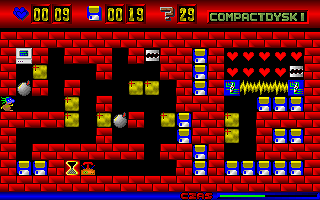
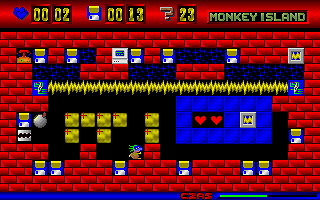
Self Control uses a top-down puzzle view built around immediately recognizable board pieces: hearts and floppies are the targets, while electricity, bombs, stars, grass, amber, jaws, and hourglasses give each level a busier game-board look. That overhead angle is a natural fit for plotting routes through walls and around threats.
Story
Self Control is not interested in telling a grand tale before putting you to work. Its context is the stage objective itself: clear the hearts and floppies before time runs out, then move on to the next puzzle.
That spare approach suits the game’s arcade-puzzle rhythm. There is no need to wait for plot momentum when the tension comes from a shrinking timer and a board that asks you to make better decisions.
If you want characters, drama, or a reason to care about anything beyond finishing the current level, this will feel thin. If a puzzle game’s story is the route you gradually learn to execute, Self Control has a clear enough hook.
Overall Experience
Self Control sounds modest, but its mix of collection, environmental interactions, wall-chewing jaws, and time bonuses gives it more texture than a straight scavenger hunt. It is at its strongest when the timer pushes you to commit to a plan without making the solution feel arbitrary.
The recommended audience is narrow in a useful way: give it a chance if compact DOS puzzle action and Boulder Dash or Heartlight-style stage solving already speak to you. You need to enjoy pressure as part of the puzzle, because the countdown is not background flavor; it is the force shaping every route.
It is not a sprawling adventure, and it does not need to be. As a 30-level test of quick planning and repeat attempts, Self Control earns its name: success depends on staying calm, using the helpful objects well, and resisting the urge to grab every nearby item before you understand the board.


Reviews
There are no reviews yet.