 Retro Replay Retro Gaming History, Reviews & Emulation
Retro Replay Review
Gameplay
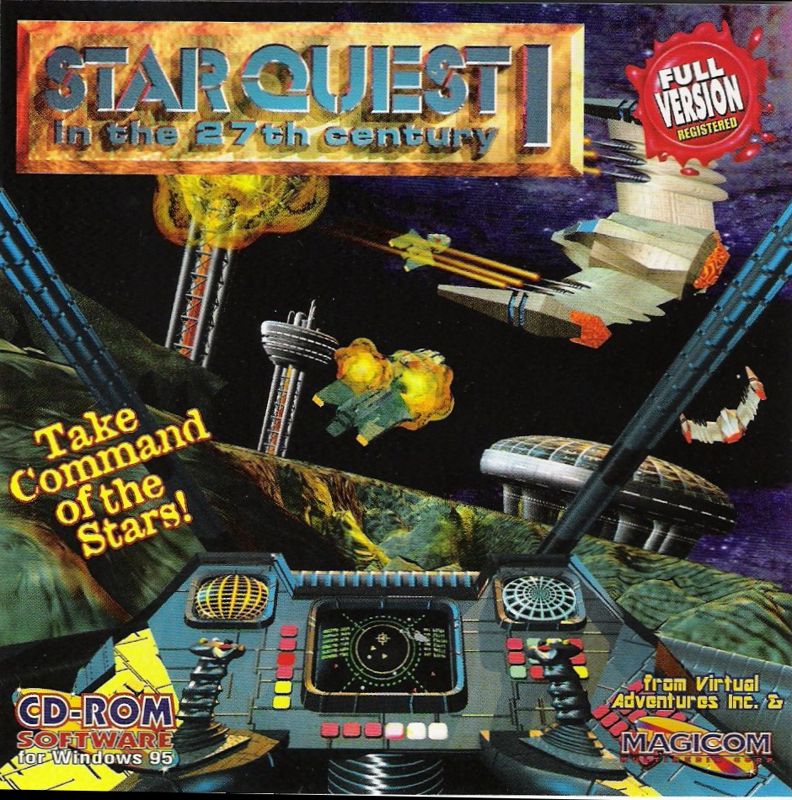
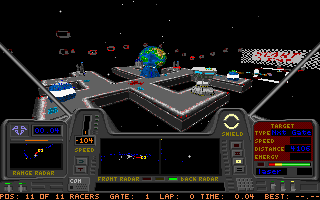
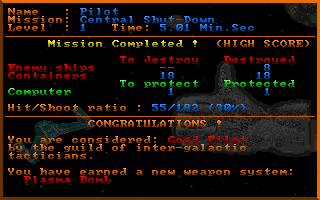
The first hour has a useful sense of choice: rather than funneling you into a campaign, Star Quest I lets you pick from a set of missions and discover which kind of pilot work you enjoy. Straight shooting is the immediate draw, but the mix goes further than simple space combat. One assignment may ask you to protect friendly ships or ground structures, while another puts you in charge of allied attack formations. The races are a particularly welcome change of pace, because they let the flight model carry a mission without making every sortie about destroying an enemy.
That freedom comes with a trade-off. With no campaign to create a steady dramatic climb, the game’s progression is built around your willingness to revisit missions, raise the difficulty, and work toward newly unlocked jobs and better engines, weapons, and ship upgrades. If you enjoy mastering discrete challenges, this can be a satisfying loop: replaying is not just a score-chase, since it feeds into your available hardware. If you need a strong authored sequence to pull you from mission to mission, the structure can feel scattered.
The customization is a serious strength. Being able to tune ship controls and behaviour to your own preference gives Star Quest I more patience than many flight games of its era, and its layered difficulty system lets you choose how hard you want to push. The exploration mode is even more practical: previewing a level without combat or objectives can save you from learning under pressure. Start there if a mission’s layout is unfamiliar, then return when you are ready to tackle its real demands.
Graphics
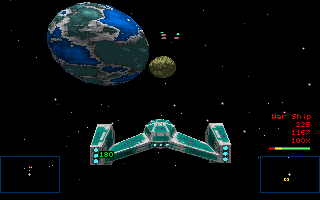
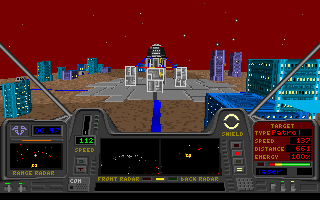
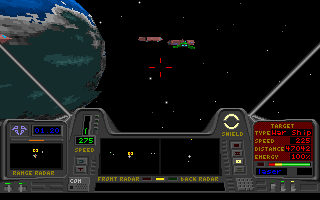
Star Quest I moves between open space and planetary atmospheres without a hard break, so a fight can shift from a starfield into an atmospheric backdrop during the same mission. That changing scenery gives its combat environments more movement than space-flight games locked entirely to one type of arena.
Story
The setup is classic space-war material, but it has a neat wrinkle. Humanity and its sentient alien allies have largely given up space travel after teleportation replaces it, only to face a renewed Centurion threat. Since the Centurions rely on remotely controlled drone ships to offset their dwindling population, the conflict begins from a civilization that has to relearn the kind of warfare it thought it had left behind.
You are a volunteer pilot in that renewed defense effort, which fits the mission-based format well. Fighting hostile craft, shielding allies and installations, and directing friendly formations all read as pieces of a larger war, even when the game does not bind them into a campaign. The manual carries the background in detail, so the story is more of a framework for your sorties than a tale that unfolds through a fixed sequence of missions.
That will either be enough or it will not. The premise gives the action a clear enemy and a credible reason for the broad mission mix, but Star Quest I does not sound built to reward you with a tightly paced narrative arc. Come for the pilot’s progression and the variety of jobs; treat the lore as welcome context rather than the main payoff.
Overall Experience
Star Quest I is most enjoyable when you treat it as a flexible flight-combat box of challenges. Pick a mission, tailor the craft to your taste, learn the space with exploration mode if needed, and return later with sharper skills or stronger gear. Its races and tactical objectives stop the game from becoming nothing but a string of dogfights, and that variety gives repeat play genuine value.
Frustration is most likely to come from the self-directed format. Unlocking more missions and upgrades gives you a reason to continue, yet the game asks you to make your own path through its roster rather than carrying you forward with a campaign. That is a feature for a tinkerer and a drawback for someone who wants a clear beginning-to-end journey.
Give it a chance if you like older space-flight games that let you experiment, replay, and gradually improve a ship around your own handling preferences. The payoff is a broader mission selection than its premise first suggests, backed by thoughtful learning tools and progression. It is less compelling as a story-first adventure, but as a customizable set of space sorties, it has real range.


Reviews
There are no reviews yet.