 Retro Replay Retro Gaming History, Reviews & Emulation
Retro Replay Review
Gameplay
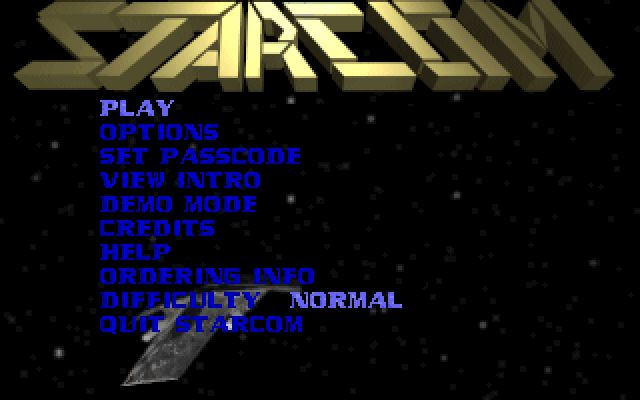
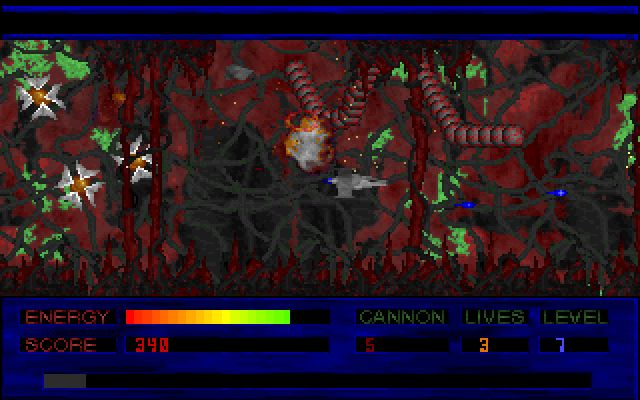
Starcom opens with a clean, familiar promise: take a fighter into hostile space and survive whatever pours onto the screen. The first few encounters are easy to understand because the objective never gets buried under setup. Enemy craft arrive in waves, sometimes pressing down from the top and sometimes attacking from the side, so you are always judging your position as well as lining up shots. That constant change in attack direction gives its scrolling action more variety than a shooter that commits to a single lane.
Your fighter carries a cannon and guns, and the upgrade loop is the part that starts to click. Collecting power-ups makes survival feel less like a fixed test of reflexes and more like a scramble to preserve a growing advantage. You want the next upgrade not simply for a bigger number, but because it can make an incoming wave feel manageable. The small helper ships are an especially nice reward: they latch on and fire alongside you, briefly turning your ship into a much more dangerous target.
There is a useful sting to those helpers, too. They do not last forever; once their power runs out, they fall away. That prevents the action from settling into a permanently powered-up cruise and puts the focus back on movement and shooting. If you enjoy the no-nonsense rhythm of older arcade shooters, Starcom’s priorities are easy to appreciate. If you need a deep mission structure or a long list of goals beyond blasting aliens and surviving, its directness may wear thin.

Graphics
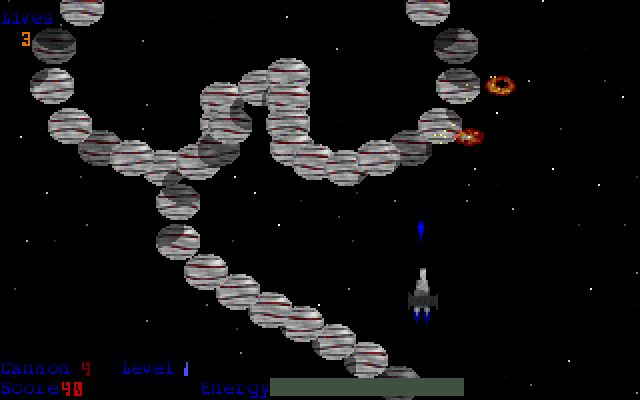
Starcom uses a scrolling space-shooter view that shifts between vertical and horizontal movement. The clearest on-screen drama comes from enemy craft entering from the top or sides while your fighter and any attached helpers return fire, making the immediate threat easy to read.
Story
The setup is brisk science-fiction pulp. Orion’s small, uninhabited planets have been seized by a hostile force, and the Federation initially refuses to interfere. After years of silence, a Starcom pilot takes it on themself to investigate by jumping through a wormhole into Orion.
That is a solid excuse to put you in the cockpit, rather than a story that competes with the shooting. The Federation’s refusal to answer Orion’s calls gives the pilot’s decision a bit of independence, and the wormhole jump supplies a clean point of no return. Once you arrive, though, the game keeps its attention where it belongs: alien ships, incoming waves, and survival.
Do not come to Starcom expecting a sprawling space opera. Its narrative works because it gives the action a clear reason to exist without slowing the pace. You are not negotiating peace; you are investigating a threat that has already made the galaxy dangerous.
Overall Experience
Starcom is a compact, sincere shooter from the era when a strong loop could carry the whole experience. Its best moments come when you have built up your weapons, picked up a few helpers, and are trying to keep that advantage alive as attacks switch direction. The game understands that temporary power is more exciting than guaranteed power.
The keyboard controls suit its quick arcade focus, while joystick configuration is welcome if that is how you prefer to play this sort of shooter. Sound and sound effects round out the action without distracting from its central demand: keep moving, keep firing, and do not let the next wave box you in.
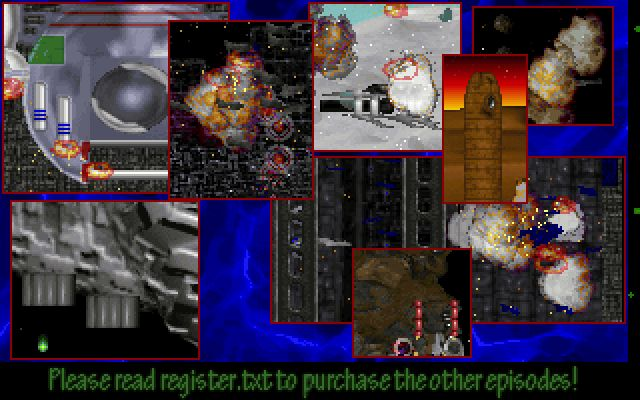
The shareware version offers six levels, while the registered release expands the run to twenty-one. That makes the shorter edition a fair test of whether its stripped-back pressure is for you. Give Starcom a chance if you want an uncomplicated DOS shooter with shifting scroll directions and a satisfying power-up chase; skip it only if you need the genre to offer more than sharp, repeated combat.


Reviews
There are no reviews yet.