 Retro Replay Retro Gaming History, Reviews & Emulation
Retro Replay Review
Gameplay
Super Star Trek is a turn-based hunt in which every command advances the contest. The goal is simple—eliminate the Klingon battle force before the assigned stardate—but the route to that goal requires steady control of the Enterprise’s position, energy, defences, and offensive options.
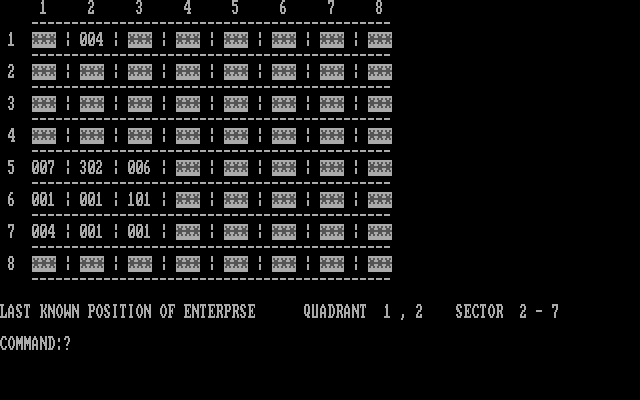
The galaxy’s eight quadrants, each divided into eight sectors, create a useful strategic scale. Long-range and short-range scans help narrow the search, while course setting and warp travel turn that information into movement. Because Klingons, starbases, and stars are randomly placed at the start, each campaign asks you to reassess where to go and what resources can be reached safely.
Combat rewards different kinds of judgment. Phasers are easier to use because they do not require aiming, although their effectiveness falls with distance. Torpedoes offer heavier damage but demand accurate targeting and can miss. The added rule that shields must be lowered before firing gives each encounter a sharp risk-reward rhythm, particularly because Klingons can attack and reposition after your turn.
Graphics
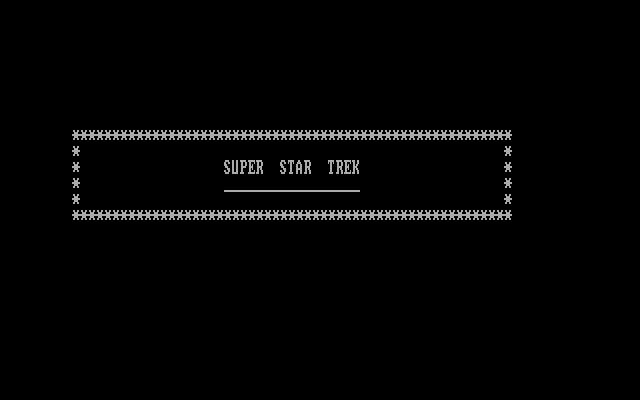
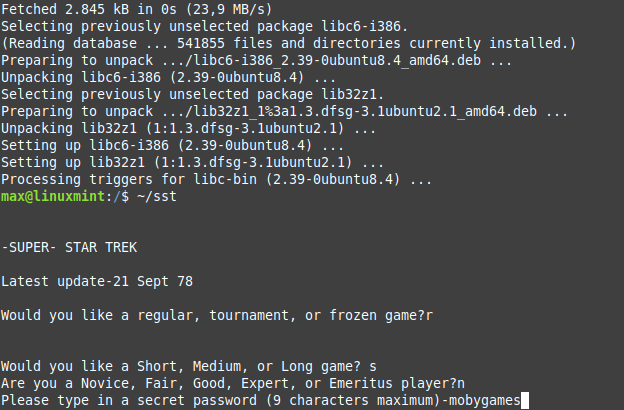
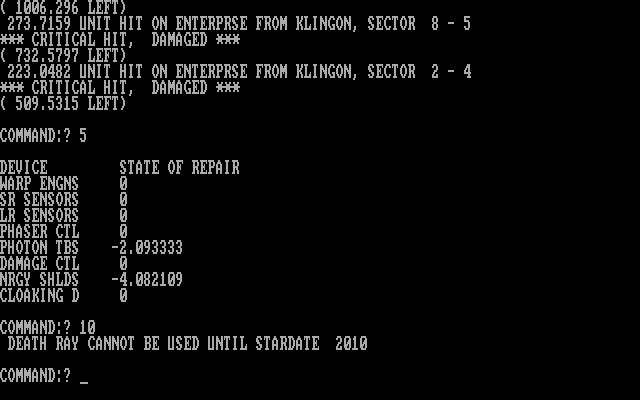
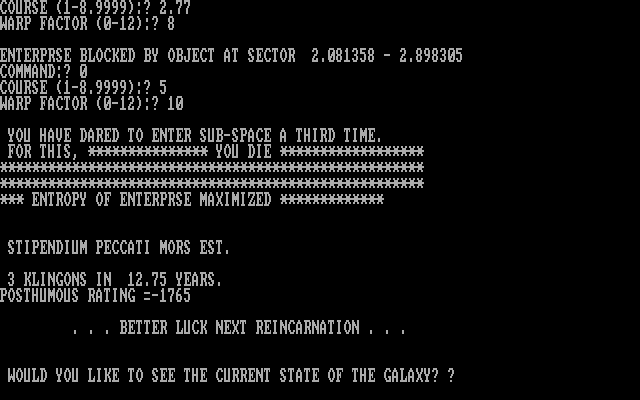
Presentation is built around a concise command-driven interface rather than visual spectacle. You select one of 15 commands by entering a number, then supply further information when needed for actions such as plotting a course or setting a warp factor.
That stripped-back approach fits a game focused on tactical interpretation. Scanner use, damage control, shield settings, and weapon selection are presented as operational decisions, keeping attention on the state of the ship and the wider mission instead of decorative detail.
Players looking for cinematic space combat will find the format severe. Players who appreciate clear systems and are comfortable working through prompts will likely find that restraint an advantage: the interface keeps the consequences of each order central.
Story
The premise gives you the familiar responsibility of commanding the Starship Enterprise against a Klingon battle force. Rather than building through scripted plot developments, the game frames its drama through a deadline and a galaxy-wide military objective.
The specified stardate is more than background flavour. It turns the campaign into a race, forcing you to weigh detours for safety, repairs, or fuel against the need to locate and destroy the remaining enemy cruisers.
Random placement supplies the game’s changing narrative texture. One mission may make friendly starbases convenient lifelines, while another can make their locations and the distribution of Klingons more consequential. The story is therefore one of command pressure and problem-solving rather than authored character drama.
Overall Experience
Super Star Trek is a focused adaptation of the classic mainframe-style Star Trek formula. Its strength is how many interlocking concerns it places behind a compact set of commands: reconnaissance informs travel, travel consumes precious time, and combat exposes the Enterprise to retaliation.
The pacing is deliberate but not passive. A turn spent scanning, moving, firing, repairing, or refuelling can alter the next decision, and the time limit prevents cautious play from becoming consequence-free. The game is most satisfying when you are planning several moves ahead while still adapting to Klingon movement and damage.
This is an easy recommendation for fans of turn-based tactical games, old-school computer strategy, and Star Trek command scenarios. It is less appealing for readers who want immediate action or a richly illustrated adventure, but its disciplined systems give the captain’s role real weight.


Reviews
There are no reviews yet.