 Retro Replay Retro Gaming History, Reviews & Emulation
Retro Replay Review
Gameplay
TurboGo understands that Go does not need extra decoration to become absorbing. You place stones one at a time on the intersections of the board, trying to claim territory while cutting off opposing stones and taking them as prisoners. That basic loop creates the familiar Go sensation: a move that looks modest now can decide an entire corner much later.
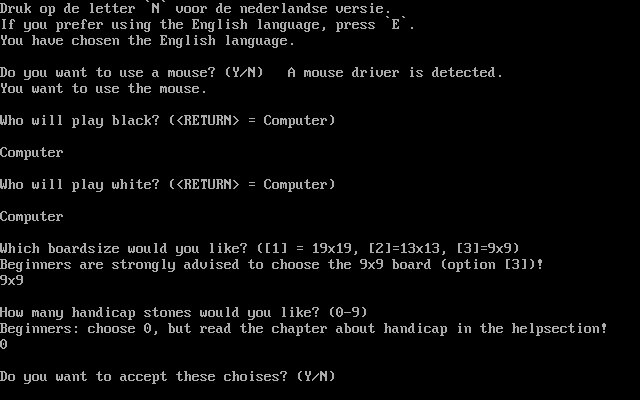
The choice of 9×9, 13×13, and 19×19 boards gives the game a sensible learning curve. Start with 9×9 if you are new, because games reach a meaningful conclusion quickly and mistakes are easier to trace. The 13×13 board asks for more planning without becoming overwhelming. A 19×19 match is the real commitment, with enough room for local fights to distract you from a weak edge elsewhere.
Letting either side be controlled by a human or computer is practical. You can play against the computer, set up a two-human game at one machine, or use computer control on either color. That flexibility suits a rules-heavy board game well, especially when you want to examine the consequences of playing from black or white.
The larger-board pace will be the dividing line. Go rewards patience, and TurboGo does not pretend that a tournament-size board is a quick diversion. Saving a game to disk is therefore more than a convenience: it lets a long 19×19 struggle remain a thoughtful ongoing match instead of a session you abandon halfway through.
Graphics
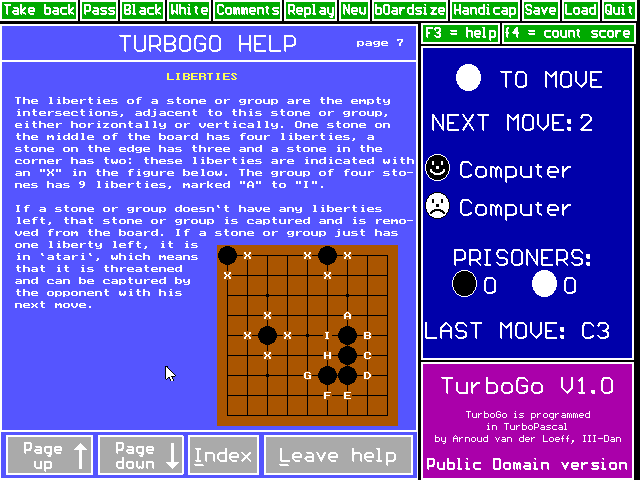
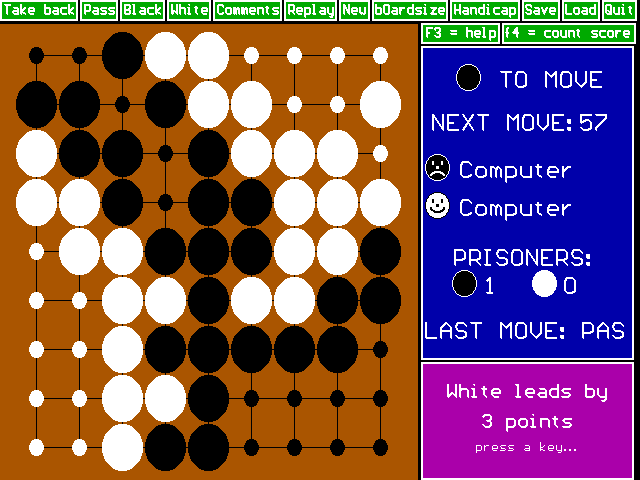
The view is built around the square line grid and its cross-points, where black and white stones accumulate as the match develops. On a board game this abstract, that direct top-down layout is exactly what you need: you can concentrate on shapes, borders, and threatened groups rather than fight a busy screen.
Story
There is no authored story to carry TurboGo forward. Its drama comes from the board itself: a loose line of stones turns into a wall, a group loses its escape routes, and territory that seemed safe becomes contested.
That makes each game its own small narrative of confidence and correction. Early moves establish intentions; the middle game exposes whether those intentions actually connect; the endgame asks whether you counted space carefully enough. You supply the stakes, whether that means beating the computer or proving a point to the person beside you.
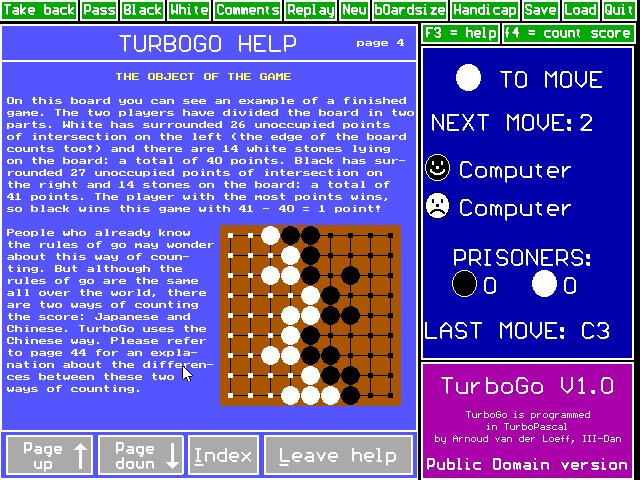
The Chinese scoring rules give the conclusion a concrete focus on enclosed territory and captured prisoners. For newcomers, that can make the final result feel less immediately obvious than simply counting captured pieces in chess. Spend time with the manual before judging the game too harshly; once the scoring logic clicks, the board’s quiet tension becomes much easier to appreciate.
Overall Experience
TurboGo is a strong fit if you want to learn or play traditional Go on a computer without turning it into something else. Its best quality is its restraint. It puts the enduring contest of territory, connection, capture, and sacrifice at the center, then offers board sizes and save support that respect how differently a short teaching game and a full 19×19 match can feel.
Newcomers should not mistake the simple rules for a gentle game. The frustration is real when you discover too late that a group cannot live, or when an opponent’s quiet stone has ruined a large area of your planned territory. Yet that sting is also why Go keeps pulling you back: you can usually identify the moment where your thinking went wrong and try a sharper answer next time.
The built-in manual makes TurboGo more welcoming than a bare board would be, and the option to play either color against human or computer opposition gives it useful longevity. It is not a game for someone craving rapid action or elaborate theatrical framing. Give it a chance if you enjoy strategy that gets deeper the longer you stare at it, and especially if you want a patient place to take your first serious steps in Go.


Reviews
There are no reviews yet.