 Retro Replay Retro Gaming History, Reviews & Emulation


Retro Replay Review
Gameplay
The first hour is likely to feel less like heroic fantasy and more like being handed a knife, some bad weather, and a problem you cannot solve by swinging harder. You need food and warmth, and winter turns both into serious concerns. That friction is exactly why UnReal World works. Everyday tasks—picking berries, fishing, gathering wood, cooking, shelter building, and preserving what you kill—aren’t filler between adventures. They are the adventure.
Start with the tutorial-like game course unless you already enjoy deciphering deep simulation-heavy roguelikes on your own. Its small tasks teach the essentials, but the real moment of discovery comes afterward, when you realize there is no campaign rail to lean on. You decide whether your character becomes a settled farmer, a solitary fisher, a wandering hunter, a fur trader, or a raider with companions. The random map, with forests, lakes, rivers, mires, mountains, and inhabited farm areas, gives those decisions room to breathe.
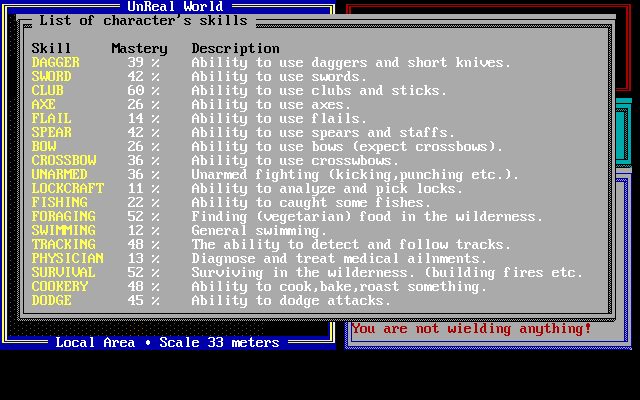
The two map scales make travel and close work feel meaningfully different. At the wider 100-metre scale, you are charting a route and committing to a journey; at two metres per tile, you are doing the careful labor that keeps you alive. Skills matter across that whole loop, from survival and timbercraft to swimming, climbing, and weapon use. Character creation also matters because tribe, attributes, skill choices, and starting scenario shape the kind of hard beginning you are signing up for.
Combat is where the game’s patience turns ruthless. Wounds are tracked separately, fatigue and carried weight reduce performance, and a damaged leg can change a fight rather than merely subtracting a few abstract points. Tracking a wounded animal through its prints and blood trail sounds thrilling because it is: a hunt can become a long, nervous pursuit rather than a clean victory screen. But human fights are dangerous enough that you should treat raiding as a considered choice, not a default pastime. With permanent death deleting the character, the wise play is often to leave, recover, stockpile food, and live to make a better decision tomorrow.
Graphics
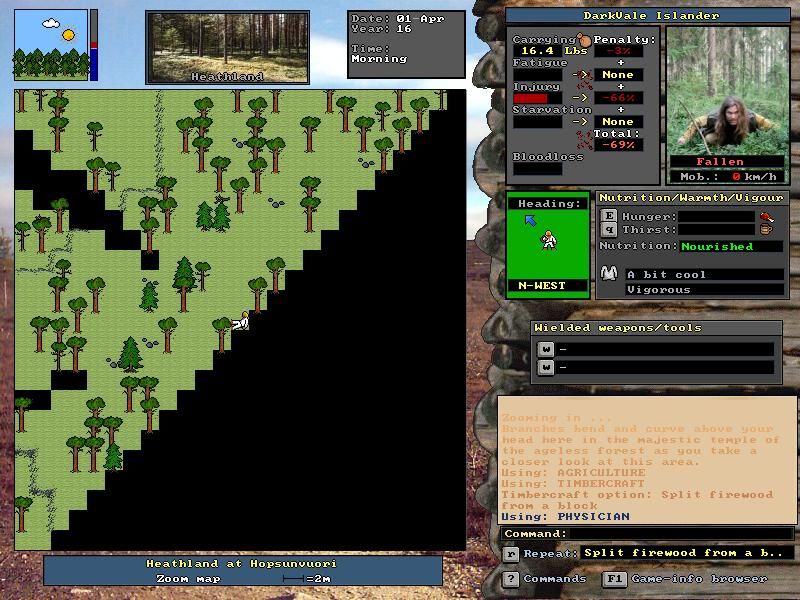
UnReal World uses tile graphics and a top-down, diagonal-down view. The wider map lays out rivers, lakes, mountains, mires, forests, fields, and settlements, while the close scale puts your character among individual trees, animals, shelters, and work sites. It is functional old-school imagery, built for watching where you are and what is nearby rather than for flashy detail.
Story
There is no ready-made storyline waiting to carry you along, and that absence is a strength if you want a survival story that belongs to your own character. The setting—pagan tribal Finland around 1000 A.D.—gives ordinary choices weight. Fishing for dinner, tanning a hide, or finding a safe place to recover from an injury feels rooted in a particular way of living rather than pasted onto a generic fantasy map.
Starting scenarios add a useful first chapter. Leaving home as a young wanderer creates one kind of tale; beginning as an enslaved youngster trying to escape creates another. Neither promises a string of authored twists. Instead, the story emerges from the chain of consequences you create: a successful hunt before winter, a reckless fight, a long recovery, or the gradual transformation of a camp into a permanent home.
That open structure will frustrate anyone who needs quests, a villain, or a final destination to stay engaged. Yet it gives the game an unusual emotional payoff. A simple accomplishment can become memorable precisely because nobody arranged it for you. You survived because you prepared well, noticed the risks, and did the work.
Overall Experience
UnReal World is an unusually committed survival RPG. It asks you to respect time, weather, injuries, supplies, and the limits of one vulnerable person in a huge wilderness. In return, it makes practical knowledge feel powerful. Learning how to feed yourself reliably or how to avoid turning a manageable wound into a fatal disaster is more satisfying here than ticking off another routine quest objective.
The rough edge is obvious: this is not instant-gratification adventuring. A bad start, a cold season, or an ill-judged battle can be punishing, and permanent death makes setbacks final. The complexity can overwhelm you before its logic clicks. Give it a fair run through the learning scenarios, set modest goals, and resist treating every encounter as a fight. That is the path to seeing why its systems are so absorbing.
Give it a chance if you want a roguelike where survival is the whole point and freedom means accepting responsibility for every meal, trip, and risk. Skip it if you need a directed plot or quick rewards. For more background on its long history, the UnReal World history is worth a look; in play, though, its lasting achievement is how convincingly it turns a blank wilderness into a personal life story.



Reviews
There are no reviews yet.