 Retro Replay Retro Gaming History, Reviews & Emulation


Retro Replay Review
Gameplay
Waterputer turns pipe-fitting into a small emergency. Water pours in from above from the moment a level begins, and every bad connection has a cost: leakage collects at the bottom, then rises upward and wipes out rows of boxes. You are not calmly assembling a tidy network; you are trying to avert a flood while the board steadily becomes less forgiving.
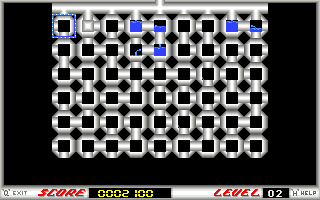
The basic action is easy to understand. Individual pipe sections can be rotated, and sections range from one to four openings, so you quickly learn to watch every edge. An open end at the side or bottom is not a harmless imperfection. It accelerates the flood, making sealed routes as important as routes that fill the grid. Watching filled boxes turn solid white gives each correct connection a satisfying bit of confirmation amid the panic.
What keeps the puzzle from becoming a routine pipe-rotation exercise is the ability to rotate pieces in groups of four, which is also how you rearrange their positions. That constraint asks you to plan a few moves ahead. A pipe may be facing the right direction but sitting in the wrong place, and moving it can disrupt several nearby connections. Early on, this is the moment the game starts to click: you stop chasing every leak one at a time and begin looking for a larger pattern.
Frustration comes from the same place as the thrill. Since water is always advancing, a messy board can feel like it has slipped beyond recovery before you have fully mapped a solution. Still, that is the intended tension, and the clean completion of a level before the water reaches the top is a strong payoff. Later levels add more boxes, so the pressure scales naturally rather than relying on a totally different trick.

Graphics
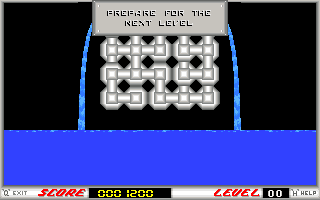
The view is a fixed side-on puzzle screen built around a grid of boxes, pipe pieces, and descending water. White-filled boxes make completed parts of the network easy to spot, while the rising pool at the bottom gives the board a clear, visible danger line. It is plain, functional DOS-era puzzle art, but it communicates the state of a hectic level well.
Story
Waterputer does not need much narrative framing to create a situation you understand instantly: the pipes are wrong, the water is coming, and the board is going under unless you put it right. Its drama comes from that immediate problem rather than from characters or plot detours.
Each level creates its own tiny arc. At first you are reacting to falling water and obvious gaps. Then a workable route appears, more boxes turn white, and the scramble shifts into a final push to seal the remaining loose ends before the rising water catches you.
That stripped-down approach suits the game. There is no reason to wait for a larger story payoff when the real motivation is already on the screen: finish the network, survive the clock, and earn a larger, nastier grid.
Overall Experience
Waterputer is a focused real-time puzzle game with a better tension curve than its simple premise first suggests. The falling water creates urgency, while the four-piece rearrangement rule prevents the puzzle from being solved by thoughtless turning. It asks for quick decisions, but not empty reflexes; the best saves come from recognizing how several pipes must move together.
You should give it a chance if you like compact puzzle games that make you work under pressure. It is less suited to a relaxed, meditative session, because even a small mistake can hasten the flood and turn a promising layout into a scramble. That severity is also why a successful board feels earned.
For a 1991 DOS game, Waterputer remains a neat example of how one escalating threat can carry an entire puzzle structure. The rules are direct, the stakes are always visible, and the move from small grids to larger ones gives it a satisfying sense of progression. It is lean rather than lavish, but the core challenge has real bite.



Reviews
There are no reviews yet.