 Retro Replay Retro Gaming History, Reviews & Emulation

Retro Replay Review
Gameplay
The first few turns ask you to accept Schwarzschild on its own terms. You are not personally steering a fighter through a battle or barking out fresh orders every second. Instead, you build up Sankuri’s position, acquire and deploy ships, decide where they should go, and select their general tactics. Then the turn resolves and you watch whether your preparation was good enough. That distance between decision and outcome is the game’s central thrill.
Once that rhythm clicks, the large-scale focus becomes its strongest feature. A ship’s route and tactical posture matter because you cannot simply rescue a shaky plan through fast reactions in a separate battle screen. Changing movement trajectories or tactics gives you meaningful levers, but it also makes every commitment feel final enough to be interesting. You are thinking like a commander trying to shape a campaign, not like an action-game pilot trying to win a single encounter.
The downside is obvious: the menu-driven interface takes up a large part of the screen, and the game’s methodical pace can feel dry when you want immediate feedback. Diplomacy offers alternatives to pure military expansion, yet internal political management is not where Schwarzschild spends its energy. Go in for fleet preparation, territorial ambition, and the satisfaction of making a long-view decision; do not go in expecting dense state administration or tactical micromanagement during combat.
Graphics
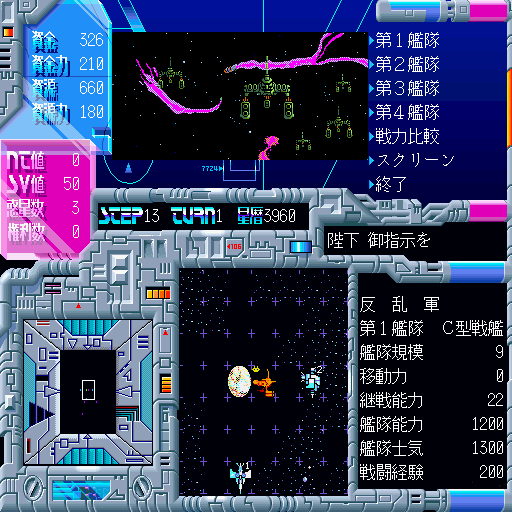
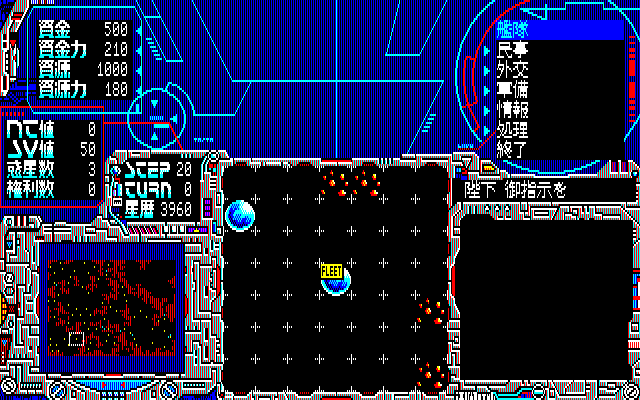
The screen is divided around the work you need to do: a sizeable menu interface, a map of the Jiro star cluster, and windows showing ships and their battles. It is a functional layout for a strategy game built around checking the wider map and then following the fleets you have committed to it.
Story
Schwarzschild starts from a broad, useful conflict rather than a narrowly personal one. Humanity has spread across almost all of the Milky Way, and seven centuries later the Jiro cluster has become a knot of competing political powers. That backdrop gives your expansion a clear purpose: Sankuri is weak, surrounded by rivals, and meant to become the force that unifies the cluster.
What works here is the scale. The goal is not merely to win an isolated war; it is to alter the balance of power across a whole region of settled space. Diplomacy fits naturally into that premise, since unification does not have to be framed only as a procession of battles.
Still, the narrative is primarily a strategic frame for your decisions. The game puts its attention on the struggle for dominance, fleet deployments, and the consequences of your chosen approach. If you like science-fiction strategy that lets the campaign map carry much of the drama, Sankuri’s climb from weakness has enough built-in momentum to keep each new decision pointed somewhere.
Overall Experience
Kyōran no Ginga: Schwarzschild is rewarding when you enjoy the uncomfortable pause after issuing orders: your ships are committed, the turn is about to end, and now you have to see whether your reading of the situation was right. Its hands-off battle resolution is not a compromise to tolerate; for the right player, it is exactly why the game has tension.
It can also be frustrating in a very specific way. Because combat unfolds from pre-defined commands rather than active battle inputs, a poor outcome may leave you wishing you had more control at the decisive moment. The answer is not faster reflexes, but better planning before the turn resolves. That makes setbacks feel harsh, though also instructive if you enjoy learning a strategy game through the consequences of your own calls.
Give it a chance if the idea of growing a fragile interstellar nation through careful fleet planning, map awareness, and occasional diplomacy sounds more satisfying than direct combat. Skip it if you need battles to be interactive or want a strategy game centered on domestic political systems. For patient commanders, Schwarzschild’s slow burn and campaign-scale stakes are worth the investment.


Reviews
There are no reviews yet.