 Retro Replay Retro Gaming History, Reviews & Emulation

Retro Replay Review
Gameplay
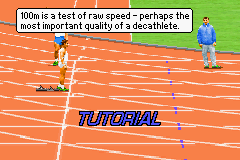
Fila Decathlon starts with the immediately recognizable rhythm of a Track & Field-style sprint: hammer A and B in alternation and try to keep your athlete moving. That is satisfying for about five minutes on its own. What gives the game some substance is the way it keeps adding jobs for your other hand. You need the d-pad to rise at the start and dip at the finish in running events, so success is not purely a matter of who can mash hardest.
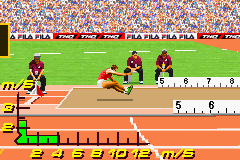
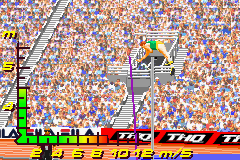
The field events are where the game becomes more demanding. Long jump and pole vault ask you to choose a starting position, then hit down and up in quick succession for the jump; getting that snap right matters to height and distance. Shot put and discus split speed between rapid B presses and an A input, with an overstep waiting for anyone who holds A too long. Javelin is more deliberate still, asking you to draw back, preserve speed, and commit to the throw with a precise sequence. These are simple controls on paper, but they give each discipline a distinct little learning curve.
That complexity is both the reason to play and the source of frustration. You can understand what an event wants from you and still lose a good attempt to one late or early press. The 1500 metres changes the routine by using the d-pad for lane changes and a fast rush, which helps the final event avoid feeling like another identical sprint. Practice mode is essential rather than optional: use it to learn the motions before taking on the championship, where the events arrive in their proper order.
Multiplayer fits the format nicely, because these games are at their best when a near miss or a reckless burst of speed gets an immediate reaction from someone beside you. Solo play has a more methodical pull. You are not uncovering deep tactics; you are refining timing, cleaning up an approach, and trying to put together a better overall championship. If that loop sounds exhausting rather than compelling, the button work will wear thin fast.
Graphics
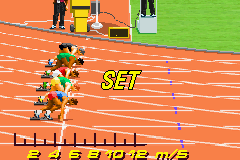
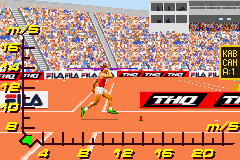
This is a 2D, side-view athletics game on Game Boy Advance, built around scrolling event screens rather than a broad stadium simulation. The side-on view suits sprinting, hurdles, and the approach to jumps because you can judge forward movement and the timing of the line in front of you at a glance.
Story
Fila Decathlon does not need a traditional story to create a sense of progression. Its championship gives the session a sporting arc: you work through the disciplines in sequence, carrying the pressure of an all-around competition instead of treating every event as an isolated challenge.
That structure matters because decathlon is inherently about recovery and consistency. A mistake in one event does not end the day; it becomes part of the larger attempt. The game’s most convincing drama comes from trying to keep your performance together as the required inputs change from running to jumping to throwing.
Practice mode supplies the quieter side of that arc. You learn an event on its own terms, then return to the championship hoping the muscle memory holds when it counts. It is a modest competitive framing, but it gives repeated attempts a purpose.
Overall Experience
Fila Decathlon is better when you treat it as a timing game with ten-event ambitions, not as a mindless endurance test for your thumbs. Its controls borrow the genre’s button-mashing foundation, then make you manage starts, finishes, jumps, lane movement, and throwing sequences with enough care that practice pays off.
The rough edge is unavoidable: heavy A-and-B alternation is physically demanding, and the game can feel unforgiving when a single input ruins an attempt. Some gamers will find that old-fashioned intensity amusing in short bursts; others will be done long before they master the nuances. It is much easier to recommend for quick competitive sessions than for marathon play.
Give it a chance if you enjoy score-chasing sports games and like seeing a familiar formula ask a little more of you. The championship and practice modes make a sensible pair, while multiplayer supplies the immediate rivalry the genre thrives on. It is not a reinvention, but its event-specific control ideas give the decathlon format enough texture to make a solid performance feel genuinely satisfying.


Reviews
There are no reviews yet.