 Retro Replay Retro Replay gaming reviews, news, emulation, geek stuff and more!

Retro Replay Review
Gameplay
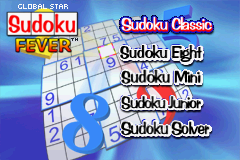
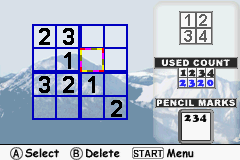
The first few minutes of Sudoku Fever are about choosing how much brainpower you want to spend. A 4×4 puzzle is a friendly way to get moving, while the standard 9×9 boards are there when you want the full, methodical Sudoku session. That range matters on a handheld: you can fit in a short grid during downtime or save a tougher board for when you are ready to concentrate.
What makes the game more than a bare-bones number grid is its willingness to handle the fiddly parts. Pencil marks let you track possible answers without relying entirely on memory, and error highlighting can catch a bad entry before one mistake contaminates the rest of the board. Purists may choose to lean less on that safety net, but it is a welcome option when you are learning or simply playing in short bursts.
Undo and redo are essential comforts in a game built around testing deductions, and save/restore means a difficult puzzle does not demand one uninterrupted sitting. The automatic solving options are useful when a board has stopped being satisfying and started becoming a wall. Better still, the solver accepts puzzles you enter yourself, so Sudoku Fever can help with grids from outside the cartridge as well.
The limitation is inherent to the genre: if Sudoku itself does not grab you, extra board sizes and convenience options will not change your mind. But if you already enjoy slowly narrowing possibilities until one number finally clicks into place, the unlimited-puzzle structure gives you a lot to return to.

Graphics
Sudoku Fever keeps its visuals centered on the grid, with multiple backgrounds and symbol sets letting you alter the look to your taste. That is a modest touch, but welcome in a puzzle game you may stare at for long stretches; switching the symbols or backdrop can make a familiar board feel a little less samey.

Story
This is Sudoku without a narrative wrapper, and that is the right call. You are not being asked to sit through setup before reaching the puzzle; the grid is the whole point from the moment you begin.
Its sense of progression comes from your own improvement: starting on smaller or easier boards, recognizing patterns faster, and eventually working through a more demanding 9×9 puzzle with fewer corrections. The tension is personal and quiet, built from the fear that one confident-looking number might be wrong.
That makes the game easy to revisit. There is no plot thread to remember after a break, only an unfinished puzzle waiting in a saved state and the next deduction waiting to be spotted.
Overall Experience
Sudoku Fever is a smart fit for the Game Boy Advance because it respects the way handheld games get played. You can make a little progress, put it away, and come back without losing the thread. Its difficulty choices, board sizes, and unlimited supply of puzzles make it more durable than a one-note diversion.
The quality-of-life options are the deciding factor. Pencil marks and undo/redo make serious solving far less cumbersome, while error highlighting and automatic solving keep frustration from turning a stubborn grid into dead time. You can use as much help as you want, which gives the cartridge room to serve both casual number-fillers and committed Sudoku regulars.
If you want a portable Sudoku game with a deep well of boards and sensible tools, this is an easy recommendation. It will not convert you if the basic puzzle leaves you cold, but it gives fans a flexible, long-lived way to play. For release background and history, see Sudoku Fever’s game history.


Reviews
There are no reviews yet.