 Retro Replay Retro Replay gaming reviews, news, emulation, geek stuff and more!
Retro Replay Review
Gameplay
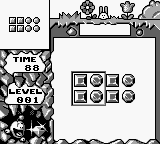
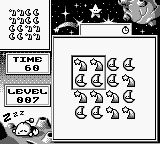
Brain Drain starts with the kind of puzzle rule that makes you want to try one more board immediately. A target arrangement sits in the corner, while the main field is full of the same symbols in the wrong places. You move a frame around four adjacent symbols and rotate them clockwise with a button press. That is the whole basic conversation between you and the game, and it is a strong one: each turn looks small, yet it can disturb a part of the board you thought you had already fixed.
The time limit gives every decision a pulse. In the first hour, you can get by with direct corrections—spot an apple or heart that is out of place, rotate a nearby group, and hope the rest follows. Soon enough, that instinct stops being reliable. Better runs come from noticing how one rotation can advance several symbols at once and from resisting the urge to repair every local mistake as soon as you see it. It is a compact puzzle game, but it asks you to think a move or two ahead while your attention is being pulled toward the clock.
Higher difficulty adds disruptions that make the game more demanding rather than merely faster. Question-mark blocks can conceal symbols, pieces can rotate without your input, and reversed controls can make a familiar move suddenly treacherous. These effects will frustrate anyone who wants a calm, purely methodical grid puzzle, especially when they hit during a close finish. But they do create a useful shift in priorities: you have to adapt, protect a promising arrangement, and know when a board is slipping away.
The power-ups are a sensible safety net rather than a substitute for solving. A clock stops time for 20 seconds, flash lets you skip the current level, and credit grants another attempt after time expires. Since clocks and flashes must be activated manually, there is a real choice between spending help now and holding it for a nastier puzzle. Brain Race also gives the formula a welcome competitive edge by asking you to clear a difficulty-dependent number of levels as quickly as possible. If you enjoy improving a route and shaving seconds off a run, that mode has more staying power than the straightforward level progression.
Graphics
The Game Boy screen is built around clear puzzle pieces: recognizable symbols such as apples and hearts, a four-symbol frame, and a target pattern in the corner. The question-mark blocks used by special effects create a simple but effective moment of uncertainty, because the board stops giving you all the information at a glance.
Story
Brain Drain finds its drama in the board rather than in characters or plot turns. Each level begins as a tiny visual problem: here is the pattern you need, here is the scrambled version, and here is the dwindling time you have to bridge the gap.
That stripped-down setup works because the stakes change naturally as a solution comes into view. Early on, you are simply learning what a four-symbol rotation does. Later, the same target can feel far more urgent when hidden symbols, self-rotating pieces, or reversed controls interfere with a plan that was starting to make sense.
The resulting arc is one of mounting pressure and recovery. A credit after a failed timer, a saved clock, or a well-timed flash can turn a bad moment into another chance, so success feels less like luck and more like surviving a puzzle that kept changing the terms of the challenge.
Overall Experience
Brain Drain is a brisk, cleverly focused real-time puzzle game that gets a lot out of one rotation rule. Its best moments arrive when you stop treating each move as a quick fix and begin seeing how a turn can reposition several symbols toward the target. That learning curve is satisfying because the controls stay simple even as the choices become more tangled.
The tradeoff is that its special effects can push the game from tense into aggravating. Reversed controls and hidden symbols are deliberately disruptive, so a run can unravel just when you feel in command. If you prefer puzzles where every piece of information remains visible and failure is entirely down to deliberate planning, that friction may wear thin.
For anyone who likes short, pressure-filled brainteasers, though, the payoff is there. The regular mode supplies escalating challenges, the power-ups add meaningful insurance, and Brain Race gives speed-minded puzzle fans a reason to return. Brain Drain is worth a chance if you want a Game Boy puzzle game that makes quick thinking matter as much as pattern matching.



Reviews
There are no reviews yet.