 Retro Replay Retro Gaming History, Reviews & Emulation
Retro Replay Review
Gameplay
The first few minutes make a clean promise: get Ryu moving, put enemies in his path, and ask you to reach the far edge of each screen alive. Sword attacks handle the basic work against human opponents, cyborgs, and machines, while the five-stage structure keeps the pace direct. There is no room here for wandering or elaborate setup; you advance, react, and keep the pressure on.
The grappling hook is what gives Ninja Gaiden Shadow more personality than a simple run-and-slash. It lets you reach high platforms, then hand-climb across them, so you are regularly looking upward instead of treating every route as flat ground. That movement adds a satisfying change of rhythm between fights. You are not merely clearing a lane; you are working through small stretches of platforms and enemies with a useful extra tool.
The Art of the Fire Wheel is your panic button and your reward for paying attention to power-ups. This ascending spinning attack hits harder than Ryu’s sword, but its five charges make it worth saving for trouble rather than throwing out carelessly. Health is similarly finite: Ryu has six life units, and replenishing them means finding the right containers. By the time a stage boss arrives, that resource pressure gives the encounter some weight.
The limitation is also the point. With only five stages and a left-to-right objective, this is built as a concentrated action test, not a long-form quest. Frustration can set in when your health and Fire Wheel stock are low before a boss, but the game’s clear goals make it easy to understand why a run went wrong and try again with sharper decisions.
Graphics
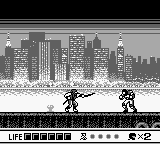
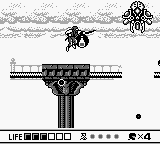
The Game Boy view stays side-on, keeping Ryu, the platforms above him, and the approaching enemies in the same immediate frame. Humans, cyborgs, and machines give the opposition some visual variety, while the scrolling layouts make the grappling and climbing sections easy to place within the action.
Story
This is set in 1985, three years before the events of Ninja Gaiden. Jaquio has not yet been awakened, leaving Emperor Garuda as the central threat: an evil dictator menacing New York City.
That setup does not overcomplicate the mission. Ryu Hayabusa is sent into a city under threat, and the game turns that premise into a straight line of hostile stages, escalating opposition, and bosses. It is the kind of prequel framing that works because it gives the action a clear reason to exist without slowing it down.
Garuda’s threat and the New York setting provide a useful backdrop, but the storytelling stays tied to forward momentum. You are here to stop the dictator, and every screen reinforces that simple objective. Fans interested in seeing an earlier Ryu conflict will get the most out of the premise.
Overall Experience
Ninja Gaiden Shadow is a brisk, demanding slice of portable action that understands the value of a strong basic loop. Run, jump, slash, grapple, climb, preserve your stronger attack, and face the boss. Its best moments come when the hook turns a familiar side-scroller into a quick bit of vertical navigation without interrupting the flow.
It will suit you if you enjoy compact arcade-style games that ask for concentration rather than a huge time commitment. The five-stage length means the payoff comes from mastering a focused route and managing limited health and Fire Wheel charges, not from uncovering a broad world. That compactness can leave you wanting more, but it also keeps the game from wearing out its welcome.
At its best, it feels like a concise Ninja Gaiden offshoot made for repeatable bursts: tough enemies, purposeful platforming, and bosses that make your supplies matter. Give it a chance if you want Ryu in a no-nonsense Game Boy action game where the grappling hook supplies the key twist and every stage is pushing you toward one more hard-fought finish.


Reviews
There are no reviews yet.