 Retro Replay Retro Gaming History, Reviews & Emulation


Retro Replay Review
Gameplay
Budokan feels less like an arcade brawl than a sparring exercise where impatience is the opponent you keep bringing into the ring. You have a broad range of attacks across four martial arts, but throwing moves carelessly is a bad habit the game punishes quickly. Ki drains on every action, successful or not, while stamina also needs attention. That means a missed attack is more than a harmless whiff. It is energy you may desperately need a few seconds later.
The system can be frustrating before it becomes satisfying. If you arrive expecting fast, free-flowing combos, the deliberate rhythm may feel stiff and unforgiving. Spend time practicing alone or sparring with instructors before entering the championship tournament. You need to learn when to commit rather than simply trying to overwhelm an opponent, and the game is much more enjoyable once you accept that its fights are built around restraint.
Switching between karate, kendo, nunchaku, and bo keeps that discipline from becoming too one-note. The weapons change the flavor of a bout and make practice worthwhile, while the option to spar with a friend adds a welcome human test of your timing. Budokan has the harsh edge of an early simulation: it asks a lot, explains its philosophy through losses, and will not flatter you. Still, its victories feel earned precisely because you cannot coast on aggression.

Graphics
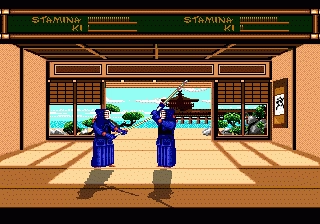
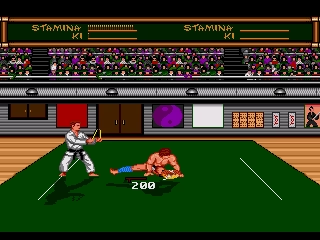
The Genesis version uses colorful side-view arenas with green mats, crowded spectator stands, and wooden dojo interiors. The strongest scenes are the indoor sparring rooms, where sliding doors open onto bright garden views and the floor throws long, blocky shadows beneath the fighters.
Characters are small but distinct enough to separate a white karate gi from the deep blue kendo armor, and a downed fighter gives a clean visual punctuation to a successful exchange. The crowd and room details are pixel-dense rather than elegant, but the bright colors and clear silhouettes make the action easy to read.

Story
This is not a martial arts game with a dramatic plot or a cast of personalities to carry you from match to match. Its story is the simple path from student to contender: train, test yourself against instructors or friends, then travel to the Budokan world championship when you think you are ready.
That spare setup fits the game’s priorities. Progress is framed as personal improvement, not revenge, rivalry, or spectacle. Your most memorable moments come from recognizing that you have stopped wasting Ki, preserved your stamina, and finally beaten someone who had been punishing your earlier mistakes.
The tournament gives your practice a destination, even if it does not provide much narrative reward beyond the challenge itself. If you need cutscenes and character drama, Budokan will feel thin. If the idea of earning a place in a championship through repeated training appeals to you, its no-frills structure works.
Overall Experience
Budokan: The Martial Spirit is an interesting, demanding martial arts game that gets better once you stop treating it like a button masher. Its central Ki system gives each fight genuine tension, and the four disciplines provide enough variety to make the learning process feel purposeful.
Its biggest weakness is also its point of distinction. The same caution that makes a well-timed strike satisfying can make early sessions feel slow, rigid, and punishing. You have to be willing to lose, practice, and reconsider your habits rather than expecting immediate power.
Give it a chance if you enjoy old-school games that turn limited resources into real pressure and let skill emerge through repetition. Skip it if you want a breezy arcade fighter. For patient players, Budokan offers a focused tournament climb with more tactical bite than its straightforward premise suggests.


Reviews
There are no reviews yet.