 Retro Replay Retro Gaming History, Reviews & Emulation

Retro Replay Review
Gameplay
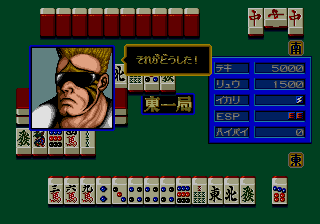
Mahjong Cop Ryū makes no attempt to separate its detective work from its card-table confrontation: progression means winning one-on-one Japanese mahjong. That gives each encounter more purpose than a detached exhibition match. You are not merely clearing another round; you are trying to shake loose the next piece of Ryū’s investigation.
The adventure side is deliberately simple. Dialogue scenes are extended, but Ryū’s choices boil down to speaking, showing something, or threatening someone. Do not come in expecting dense case-solving or a branching detective game. These commands mainly pace the investigation and point you toward the match that matters, while the mahjong remains the real test.
That test is largely traditional Japanese mahjong, which is both the game’s strength and its barrier. If you know the basics, the familiar rules give the duels a solid foundation, and the special techniques add a welcome way to press an advantage. If you do not know Japanese mahjong, the story cannot carry you past repeated losses; this is a game that expects you to meet it at the table.
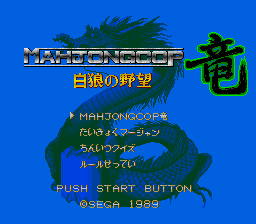
Free battle mode is the sensible place to sharpen your game without waiting through dialogue, while the quiz mode offers another way to engage with mahjong knowledge. Rule options are an especially good inclusion for a game built around repeated matches, letting you tune the conditions instead of accepting one fixed version of the contest.
Graphics
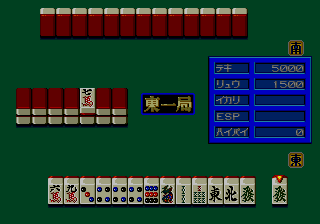
The game moves between extended dialogue scenes and one-on-one mahjong play. That structure keeps the focus tight: faces and conversation set up the confrontation, then the tile table takes over when it is time to prove Ryū’s case.
Story
This sequel starts after the destruction of the Janrōkai and immediately raises the stakes by putting Ryū on the trail of a larger threat that has taken its place. It is a clean, pulpy setup for a mahjong game: every new opponent can feel like another obstacle between the investigator and the people pulling the strings.
Ryū is an investigator, but the writing framework is more linear than the premise may suggest. The limited conversation options mean you are following the case rather than shaping it. That can be frustrating if you want to interrogate every angle of a mystery, yet it also keeps the game from pretending its dialogue system is deeper than it is.
The colorful roster of opponents does important work here. Since each one has to be defeated to continue, the story needs them to make the next duel feel like more than a rules exercise. The central mystery gives those matches a useful thread, even when the route through the dialogue is straightforward.
Overall Experience
Mahjong Cop Ryū is a strange and specific blend that knows exactly where its priorities lie. The investigation gives the matches stakes, but the matches decide whether you will have a good time. A capable mahjong player can enjoy the escalating parade of rivals and the small tactical edge offered by special techniques; a newcomer may find the same structure punishingly closed off.
Its strongest quality is commitment. Instead of turning mahjong into a light minigame inside an adventure, it lets traditional play occupy the center of the experience. The detective framing is there to give you a reason to care about the next duel, not to replace the game’s strategic core.
Give it a chance if you want Japanese mahjong with a linear detective wrapper and enough side modes to practice or vary the rules. Skip it if your interest begins and ends with adventure-game investigation, because Ryū’s case only moves when you can win at the table. For the right audience, that hard line is the payoff rather than the problem.


Reviews
There are no reviews yet.