 Retro Replay Retro Replay gaming reviews, news, emulation, geek stuff and more!


Retro Replay Review
Gameplay
The first few at-bats tell you exactly what kind of baseball game this is. Batting uses a behind-the-hitter view and asks for timing rather than elaborate input: choose contact, normal, or power, then commit. It is immediately understandable, but not mindless. Power is tempting, especially when you want a quick highlight, while contact becomes the sensible choice when simply putting the ball in play matters. That push and pull gives even exhibition games some tension.
Pitching is similarly direct. You work with a fastball, slider, and splitter, placing the ball inside a targeting rectangle or trying to tempt a batter with something wide. The batter’s statistics affect that accuracy, which is a welcome touch; a pitch outside the target is not automatically a clever masterpiece. Three pitches is a narrow arsenal by modern standards, so games can start to feel familiar if you play for long stretches, but placement and changing speeds still give you room to set up an at-bat.
You can let the computer handle fielding or take control yourself, a useful choice depending on whether you want a relaxed game or responsibility for every play. Base running also asks you to stay awake: runners can advance, retreat, or slide, with hook, pop-up, and head-first options. It can become hectic when the ball is in play, yet that is part of the fun. If you are learning, automated fielding lets you focus on hitting and pitching before adding another layer.
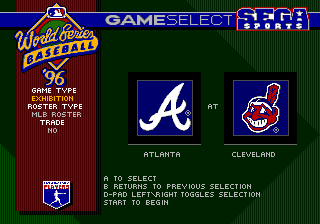
There is plenty to do beyond a one-off game. Exhibition, League, Playoffs, Batting Practice, Homerun Derby, Classic Homerun Derby, and an All-Star game give the cartridge real range. League settings allow 13, 26, 52, 104, or 162 games, and you can enable or disable trading. The battery-backed save is particularly important here: a longer league does not have to be finished in a single heroic sitting.

Graphics
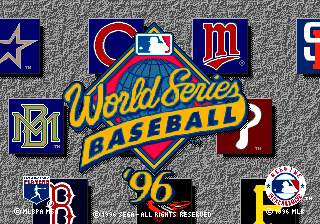
The batting camera puts you behind the plate, while the game also uses a diagonal-down angle during play. With 28 stadiums represented and a full set of teams, it has the broad MLB backdrop you want from a licensed Genesis baseball game. The visuals closely follow the earlier games in the series rather than trying to reinvent their look.

Story
There is no authored story to follow, and that is the right fit for this kind of sports game. Its sense of progression comes from a league schedule, standings pressure, playoff games, and the gradual accumulation of results.
The 1995 MLB rosters and statistics give a season a specific historical frame, while the 1996 schedule lets the campaign feel structured rather than like a loose collection of exhibition matches. All 700 players are part of that scope, so roster decisions and lineups have weight.
If you want context around the game’s place in the series, this history of World Series Baseball ’96 is useful. In the game itself, though, the drama is self-made: a tight playoff, a trade you regret, or a slugger who finally connects in the derby.
Overall Experience
World Series Baseball ’96 is strongest when you meet it on its own straightforward terms. It does not bury you in complicated systems before the first pitch; you can start an exhibition, understand the batting and pitching choices, and have a competitive game quickly. Then the lineup, strategy, running, and season options give you reasons to stay.
The limitations are easy to feel. The three-pitch selection is basic, and familiar gameplay inherited from earlier entries means it lacks the sense of a major leap forward. Still, the core timing duel at the plate works, and the option to scale from batting practice to a saved 162-game league makes it far more than a quick novelty.
Give it a chance if you enjoy Genesis-era sports games and want a licensed baseball game with a proper season structure rather than only arcade-style matches. Start with Batting Practice or an Exhibition, use computer fielding until the pace feels natural, and save the long league for when the fundamentals click. For a look at a later related entry, see World Series Baseball.

Reviews
There are no reviews yet.