 Retro Replay Retro Gaming History, Reviews & Emulation
Retro Replay Review
Gameplay
The first few minutes are all about adjusting to the fact that you only directly control one skater at a time. Your active player is marked by a lighter color, so you can quickly tell who is yours, but hockey still moves fast enough that a missed switch in attention can turn into an open lane for the other side. Once you settle into it, the small three-player teams make for a stripped-down, direct kind of rink battle: win the puck, find space, and get a shot away.
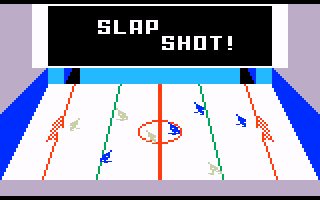
The slap shot button is the game’s clearest bit of personality. It gives you a more deliberate attacking option than simply carrying the puck around, and it makes the approach to goal feel more urgent. Face-offs and interceptions help break the match into recognizable hockey moments rather than a constant scramble, while computer-controlled goalies leave you focused on the skaters and the puck.
Tripping brings the most interesting risk-reward decision. Knocking down the puck carrier is legal, making it a tempting defensive answer, but tripping somebody without the puck can put one of your three skaters in the penalty box. That short-handed defense can be tense precisely because the teams are already so small. The referee only calls a penalty on roughly one out of three trips, which makes reckless play viable enough to be funny in a couch match and annoying enough when the call finally goes against you.
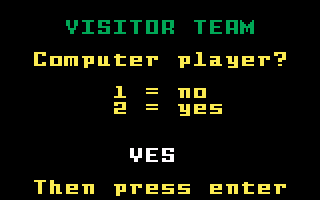
Choose your skill level with some care. Amateur moves at a lower speed, while Super Pro accelerates the action considerably. That is a straightforward handicap system rather than a deeper change in how the game works, but it is useful: start slower if you want time to learn positioning, then move up when the basic chase for possession becomes too comfortable. Two-player games are where the cheap trips, quick steals, and slap-shot chances have the most spark; solo play gives you a computer opponent when nobody is around.
Graphics
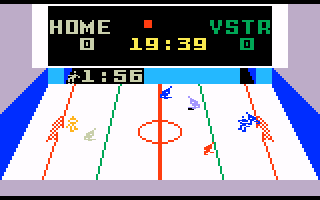
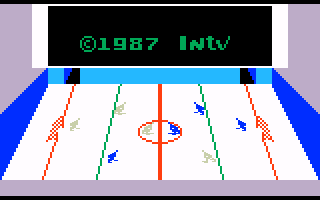
The rink action is easy to parse in its simple color scheme. Home wears tan, Visitor wears green, and the currently controlled skater appears lighter than the rest of the team. Score, penalty time, remaining time, and period status sit at the top of the screen, with one, two, or three bars marking the period instead of printed numbers.

Story
There is no narrative detour between the opening face-off and the final score. Slap Shot: Super Pro Hockey treats every game as its own small sporting story, built from possession swings, penalties, and whatever you manage to do with a shot opportunity.
That works better than it might sound because a penalty creates an immediate change in the match’s stakes. A careless trip can force your side to protect a lead with fewer skaters, while a legal knockdown of the puck carrier can feel like a hard, timely defensive stand.
The lack of named teams keeps the drama abstract: tan Home against green Visitor. You are not chasing a season arc or a club identity here; you are trying to win the next face-off, survive the next short-handed spell, and finish ahead when time runs out. For a quick competitive sports game, that directness is enough. For anyone wanting a richer hockey context, it will feel thin fast.
Overall Experience
Slap Shot: Super Pro Hockey is most enjoyable when you accept its narrow focus. It is a compact hockey contest with a few sharp wrinkles, not a game that keeps unveiling new layers over a long evening. The basic rhythm of skating, stealing, tripping, and firing a slap shot clicks quickly, and that immediacy is its strongest argument.
Its biggest limitation is also hard to ignore: the game is very close in spirit to the earlier Intellivision NHL Hockey formula, with single-player availability standing as the main addition. There are no distinct teams beyond Home and Visitor, so repeated sessions rest on the competition itself rather than variety in opponents or identities. If the central match feels good to you, that simplicity is refreshing; if it does not, there is little else waiting behind it.
Give it a chance if you enjoy old-school sports games that make a lot from a small rule set, especially with another person on the other controller. Start on Amateur or Rookie, learn when a trip is worth the risk, and let the faster levels earn their way into the rotation. The payoff is a brisk, occasionally scrappy hockey game with real head-to-head tension, even if it falls short of being a substantial step forward for the series.


Reviews
There are no reviews yet.