 Retro Replay Retro Gaming History, Reviews & Emulation
Retro Replay Review
Gameplay
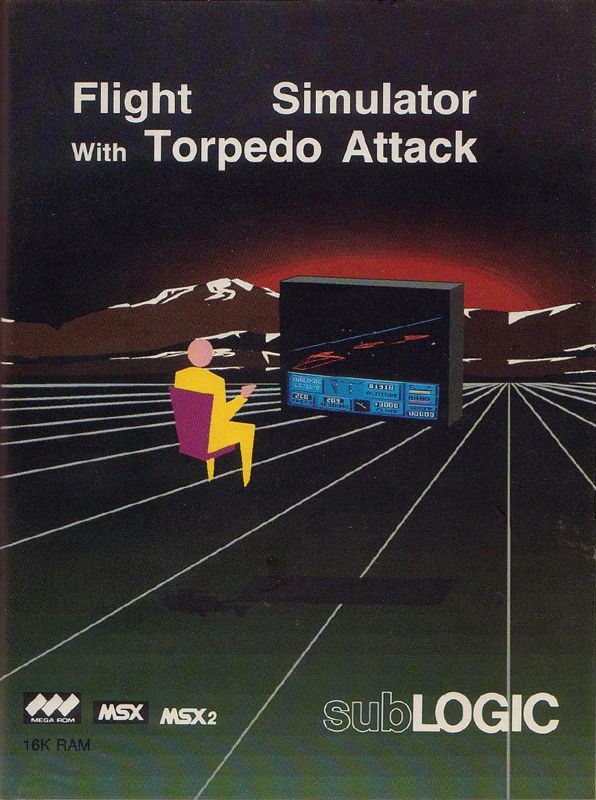
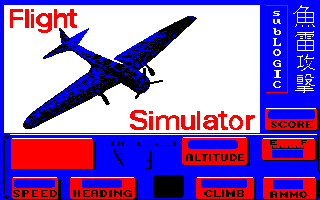
The first few minutes put you in an unusually specific fantasy: not just flying, but flying a Japanese Nakajima B6N Tenzan on a wartime strike. That focus gives Flight Simulator with Torpedo Attack more urgency than a free-flight program. You have ten missions to work through, and their mix of ship attacks, airfield bombing, and dogfights asks you to use the same aircraft in different ways.
The torpedo missions are the strongest fit for the game’s deliberate pace. A run against a ship naturally asks for a controlled approach and a clean line rather than blind aggression, and that makes success feel earned. Bombing enemy airfields changes the target from a moving vessel to a fixed objective, while hostile-aircraft encounters break up the routine with direct aerial combat. It is a modest mission set, but it is sensibly varied.
What will test your patience is the era and the austerity. You are navigating a sparse 3D wireframe world with only a few islands and airfields, backed by simplified digital instruments. That means much of the satisfaction comes from settling into its limited cockpit view, understanding the situation, and executing an approach with care. If you want instant arcade feedback, this can feel dry; if you enjoy old simulations that make a simple mission feel technical, its concentration is refreshing.

Graphics
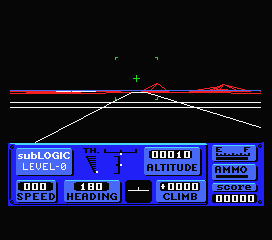
The 3D world is drawn in wireframe, with a handful of islands and airfields standing out from the open space around them. It is bare-bones, but that sparseness suits a game built around finding a route, locating a target, and committing to an attack run.
The cockpit uses simplified digital readouts rather than a richly illustrated instrument panel. That makes the view functional and distinctly early-simulator in character, even when the scenery offers very little to look at.
Story
There is no need for a sprawling campaign tale here: the game’s story is the sequence of wartime sorties flown from the cockpit of the Tenzan. You move through ten assigned missions, each framed by a clear military task—strike ships with torpedoes, bomb an enemy airbase, or fight hostile planes.
That direct structure works because it keeps the stakes practical. A ship is not merely scenery when it is the target of your torpedo run, and an airfield becomes a destination with a reason to reach it. The game puts the emphasis on the sortie itself instead of dressing every assignment in elaborate context.
As a result, the narrative payoff is modest but coherent: you are completing a compact set of increasingly varied combat duties in one aircraft. It is enough to give each mission direction, though the real drama comes from whether you can carry out the job in the air.
Overall Experience
Flight Simulator with Torpedo Attack is a small but appealing branch of early home-computer flight simulation. Its best idea is narrowing the usual flying exercise into a set of combat jobs, especially torpedo attacks, without abandoning the measured feel of a simulator. The mission variety keeps the ten-scenario run from becoming a single repeated exercise.
You should try it if wireframe aviation games make you curious rather than impatient, and if the thought of carefully approaching a naval target sounds more appealing than nonstop shooting. The MSX format is undeniably spare, yet that simplicity gives the game a clean focus: fly the bomber, read the instruments, find the objective, and make the run count.
It will not convert anyone who needs lush scenery or immediate action, but it has real period charm and a clear sense of purpose. For a patient retro aviation fan, the payoff is in mastering its restrained missions rather than in spectacle.


Reviews
There are no reviews yet.