 Retro Replay Retro Gaming History, Reviews & Emulation
Retro Replay Review
Gameplay
The immediate pleasure of Nazoler Land Dai-3 Gō is picking an activity and getting straight to it. This is a grab-bag disk rather than a single campaign, so your experience depends heavily on which section catches you. Sugoro Quiz turns correct answers into movement on a board, with two to four people racing pieces toward the finish. That is a clean structure for a group session: get the answer, roll, advance, and hope the board breaks your way.
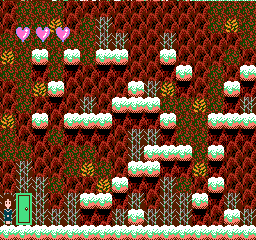
For solo play, Tomo-chan Bakuso has the sharpest arcade-like premise. Across four puzzle-platform stages, you steer Tomo through arrangements of blocks, choosing when to jump and when to duck, while avoiding arrow-marked platforms that hurt her. With only three hits available before death and an exit door waiting at each stage’s end, it sounds simple but asks you to pay attention to the route rather than charge ahead. The limited stage count also means it is a compact test, not the kind of platformer you settle into for an entire evening.
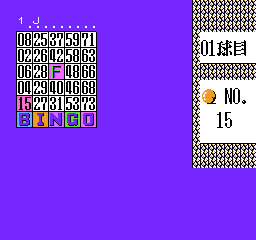
Tanteidan Boy Nazoler changes the pace completely. You control a doctor trapped in a locked room, select objects to manipulate, and see successful actions depicted graphically. It is the section for anyone who enjoys poking at an enclosed puzzle space and trying possibilities until the room gives something back. Bingo is much plainer—a bingo simulator, full stop—but it fits the disk’s playful magazine-page rhythm. The downside to this variety is that no one mode gets much room to grow; the upside is that a disappointing choice never traps you for long.
Graphics
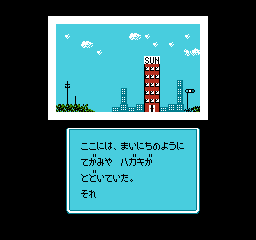
The clearest visual hook is Tanteidan Boy Nazoler’s use of graphic feedback when an object interaction succeeds, giving its locked-room problem more presence than a purely text-driven puzzle. Tomo-chan Bakuso is built around visible blocks, hazards, and a door at the end of each stage, so you can quickly understand what needs to be crossed and where you are trying to go.
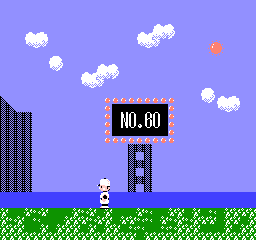
The Nazoler Box sections lean on character appearances and pictures: Tomo introduces information about the disk series, while the Miss Nazoler Contest displays the winning entries from the previous installment.
Story
Story is not the reason to load this disk, and that is fine. Its pieces are largely self-contained: Tomo needs to reach the door, the doctor needs to escape a locked room, and the quiz and bingo modes exist for immediate play rather than narrative momentum.
There is still a small sense of a shared Sunsoft world in the Nazoler Box material. Tomo returns to discuss the series, and Kirk from Dead Zone appears alongside her. Carry from Dead Zone and Kyle from Ripple Island also show up in the contest feature, making these extras feel like a little reward for anyone already familiar with the company’s characters.
That connective tissue will not transform the compilation into a story game, but it gives the disk more personality than a totally anonymous menu of minigames. If you enjoy old game curiosities where a publisher lets its recurring cast drift through side material, these brief cameos are part of the charm. The earlier Nazo no Magazine Disk: Nazoler Land Dai-2 Gō matters most here because its contest winners are the subject of one included feature.
Overall Experience
Nazoler Land Dai-3 Gō is easy to respect more than to recommend broadly. It has enough variety to make its short-form format feel intentional, and the shift from quiz competition to platforming to object-based escape-room puzzling gives it a genuine “what is this disk going to do next?” pull. Yet it is also an uneven package whose simplest modes are unlikely to hold your attention by themselves.
Give it a chance if you like Famicom compilations that feel like artifacts from a time when a single disk could be part game collection, part contest bulletin, and part crossover showcase. Start with Tomo-chan Bakuso if you want immediate action, move to Tanteidan Boy Nazoler when you want a slower puzzle, and save Sugoro Quiz for company. That order gets you to the strongest reasons to explore it without asking bingo to carry more weight than it can.
The payoff is modest but real: a few distinct diversions, a pair of more engaging solo modes, and a pleasantly peculiar bit of series history. It is not a deep collection, but its odd mix is memorable enough for retro explorers who value curiosity over polish and length.


Reviews
There are no reviews yet.