 Retro Replay Retro Gaming History, Reviews & Emulation
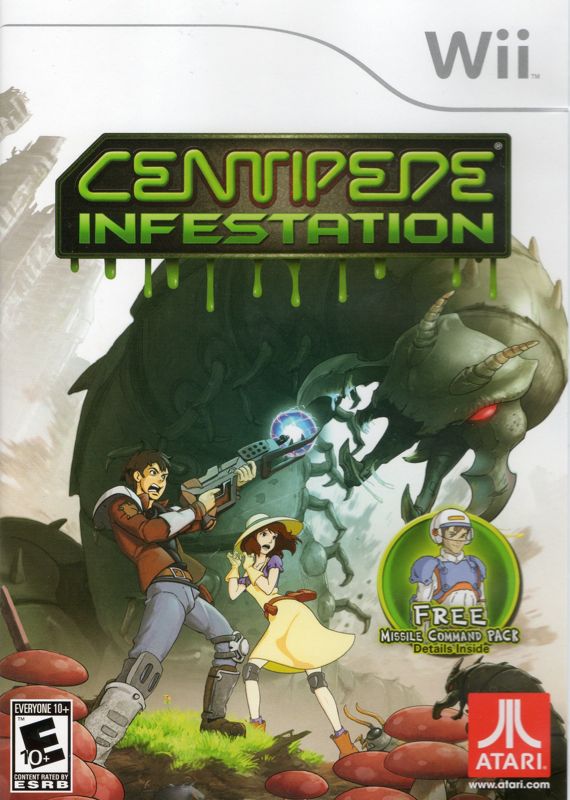
Retro Replay Review
Gameplay
Centipede: Infestation starts with a simple pleasure: you move around a compact arena while firing at a rush of mutated insects, and the pressure builds quickly. It is closer to a twin-stick-style action game than an attempt to modernize the original arcade game one rule at a time. On Wii, the Nunchuk and Wii Remote split movement and aiming; on 3DS, movement uses the Circle Pad while aiming is handled on the touch screen. The Wii Classic Controller offers the most straightforward dual-analog setup. Once the swarms begin arriving from several directions, that separation between where you run and where you shoot is the foundation of the whole game.
Enemy variety keeps the basic shooting from going completely flat. Ants follow paths instead of constantly charging you, aphids demand quick kills before they release babies, and Bomb Spiders add the obvious but effective problem of explosions. Seeds can also leave defensive plants behind, including Gun Turrets and Bomb Plants, giving you a little automated backup in the middle of a crowded arena. That is a satisfying layer because it lets you turn a good drop into a temporary foothold rather than merely another thing to collect.
Its strongest idea is the weapon system, though it is also where the game can irritate. You can hold four weapons, upgrade one by collecting a duplicate, and deploy options such as flamethrowers, freeze throwers, lasers, machine guns, and lightning guns for limited bursts. Saving them for a dangerous moment creates welcome tension. But none carry to the next stage, so every new level starts you back on the Pea Shooter. That keeps you from coasting, yet it also makes the campaign feel segmented; just when a loadout becomes interesting, it is gone.
Centipedes themselves are the payoff. They arrive as stage bosses and retain the old game’s recognizable back-and-forth movement, with individual body segments available as targets. That direct nod to the arcade original gives these fights more character than the routine swarm clearing. Objectives beyond extermination—such as hitting switches or prioritizing certain targets—help the 40 stages vary their demands, although the core loop remains very much about surviving crowded rooms and shooting bugs efficiently.
Graphics
The game’s top-down view keeps its small battle areas easy to parse when bugs pour in. Giant centipedes, spiders, aphids, grubs, wasps, caterpillars, scorpions, and defensive plants give the wasteland a deliberately creature-heavy look, and the segmented centipedes are especially easy to read as moving boss targets.
Story
This is a post-apocalyptic Earth where war has wiped out much of the plant and animal life, while the insects left behind have mutated into monsters. It is a useful excuse for the bug-blasting, but the campaign does make room for an actual through line: Maisy may hold the answer to bringing plant life back, and protagonist Max travels with her through the stages.
Most of the narrative arrives in cutscenes between missions, largely through dialogue between Max and Maisy. Rivet, Max’s brother, appears early and doubles as the second character for co-op. The story does not need to be the reason you pick this up, but it gives the sequence of arenas a little more direction than a bare score chase would.
Character and costume unlocks, alongside galleries, movies, and music, offer extra reasons to push onward. The Accomplishments system also calls out completed goals after stages. None of that transforms the plot into a major draw, but it makes the campaign feel like a complete package rather than a single arcade mode stretched thin.
Overall Experience
Centipede: Infestation is at its best when it lets you improvise under pressure: dodge a swarm, grab a dropped weapon, plant a turret, and save a stronger gun for the moment a centipede takes over the arena. WayForward’s take has enough enemy and weapon variety to justify the re-imagining, and it understands that a modern Centipede should be fast, messy, and mobile.
The tradeoff is that the game’s temporary arsenal can feel more restrictive than tactical. Starting every stage with the Pea Shooter makes each arena a fresh scramble, but it also denies you the satisfaction of building a favorite setup across the campaign. If you enjoy score-attack-style action where adapting to immediate drops matters more than long-term character growth, that friction is easier to forgive.
Bring a co-op partner if you can; Rivet’s presence makes two-player shooting a natural fit, and the packed arenas should be more entertaining with someone else sharing the panic. Solo, the game remains a decent mid-tier arcade shooter with a few sharp ideas and a strong use of its famous enemy. It is worth a look for Centipede fans open to a major genre shift, or for anyone who wants compact top-down stages full of oversized bugs and temporary firepower rather than a faithful arcade revival.


Reviews
There are no reviews yet.