 Retro Replay Retro Gaming History, Reviews & Emulation



Retro Replay Review
Gameplay
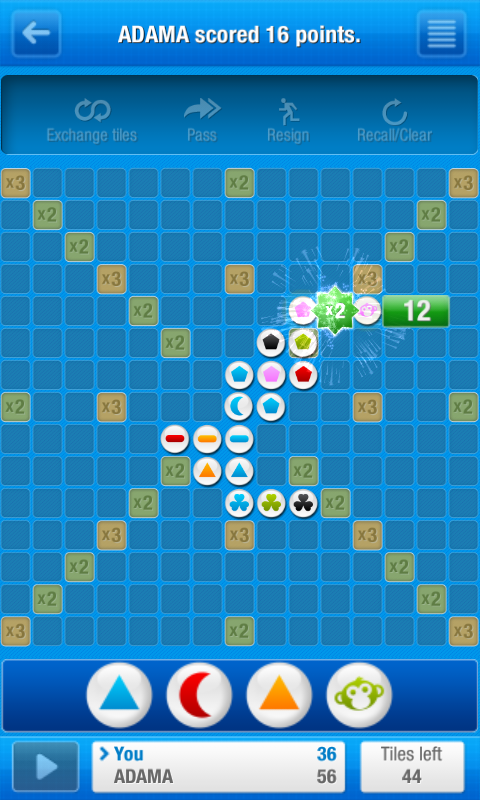
MindFeud starts with the kind of rule you can explain in seconds, then spends the rest of the match proving you have not mastered it yet. Every tile has both a color and a symbol, and neighboring tiles must match on exactly one of those traits. You are constantly scanning your six-tile hand for a move that fits, then trying to extend it into something that earns more than a modest single-line score.
The best turns come when several constraints line up at once. A legal row can create new vertical rows, so one placement can score across multiple directions. That makes the board feel increasingly tense as it fills: an innocent-looking gap may be a route to a huge turn, especially when 2x and 3x spaces enter the calculation. Align all six colors or all six symbols and the doubling bonus gives you a concrete reason to plan beyond the immediate points.
There is frustration here, but it is the productive kind associated with good abstract board games. You may hold tiles that refuse to fit the current board, forcing a swap or a pass while your opponent gets room to build. Randomized multiplier layouts can keep familiar tactics from becoming too automatic, while the default layout is a better starting point if you want to learn where the high-value fights tend to happen.
The choice of 36, 72, or 144 tiles is more important than it looks. Short games make MindFeud a brisk tactical contest; longer games give your early placements more consequences and leave more time for a comeback. Solo sessions against ADAMA are a sensible place to practice, and the three difficulty settings should help you find a level before taking the game online against a friend or a random opponent.
Graphics
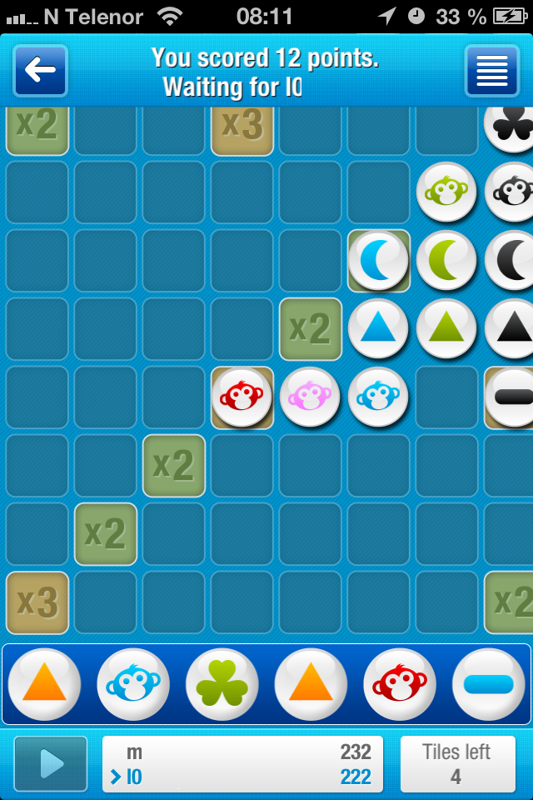
The board is built around colored symbol tiles, and that clear visual language matters because you need to identify both properties at a glance. It is a clean fit for a game where the important drama is in how tiles connect across rows and columns.
Story
MindFeud tells its story through the state of the board rather than through characters or plot. At the beginning, you are simply looking for legal placements; later, every open edge feels like a possible invitation for the other side to score.
A strong match develops a satisfying little arc. One player finds space, the other tries to limit it, and a multiplier or six-tile alignment can turn a quiet position into a swingy finish. The narrative is entirely competitive, but it is easy to read the momentum from the tiles.
That stripped-back approach suits the game. You are not asked to care about anything beyond the next move, your dwindling options, and whether you can turn an awkward hand into a scoring sequence before your opponent does.
Overall Experience
MindFeud is a smart variation on the word-game board format, replacing spelling knowledge with pattern recognition and spatial planning. The central rule creates enough tension that each turn feels deliberate, but it remains approachable because every decision comes back to color, symbol, and adjacency.
You will get the most from it if you enjoy abstract games that reward looking two or three placements ahead. It is less likely to win over anyone who wants a lively theme or constant surprises outside the board itself; its pleasures are in calculation, positioning, and finding the one move that makes several lines work at once.
The payoff is worth it for a patient tactics fan. Start with a shorter match against ADAMA, learn to spot moves that score in both directions, then move up to longer boards and randomized multipliers once the basic patterns click. MindFeud has a narrow focus, but it uses that focus well.


Reviews
There are no reviews yet.