 Retro Replay Retro Gaming History, Reviews & Emulation
Retro Replay Review
Gameplay
The first few turns of Diamond Trust of London can feel colder than you might expect from a Nintendo DS game. You place three purchasing agents among six Angolan locations, choose how hard to bid for a local guide, and try not to burn through a limited bankroll. Then the game starts asking the good questions: Is your opponent committing to that area, faking interest, or saving money to bring an agent home with a haul?
That pressure is the point. You do not win by sitting on the most cash, but by holding the most diamonds after nine turns, so every conservative choice risks letting an opening slip away. Recalling an agent to deposit diamonds is sensible, but it also removes a body from the competition. Spending enough to outbid a rival can secure a payoff, yet the same money may be desperately needed for another region a turn later. The rules are abstract, but the decisions are not.
Bribes give the contest its nastier edge. Learning what an opposing agent is up to can puncture a bluff, while influencing the UN inspector lets you interfere with the other side’s plans. Against a human, these tools turn a small board into a tense information war. You begin watching not only where someone goes, but what they are willing to spend and what they conspicuously leave alone.
Solo play has seven computer difficulty settings, which makes it useful for learning the board and finding a suitable challenge. Still, the computer cannot reproduce the uneasy pleasure of knowing another person may be feeding you bad information or anticipating your bid. If you have a regular opponent who likes compact strategy games, local two-player is where this game earns its keep.
Graphics
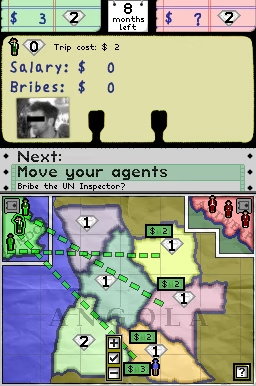
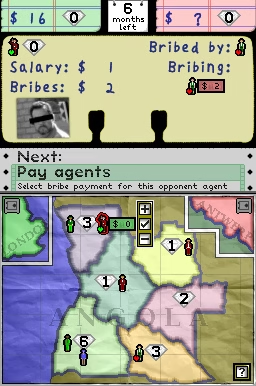
The action sits on a pastel regional map divided into pale green, yellow, gray, and pink territories, with blue rivers cutting through thick dark borders. Blocky green, blue, and red agent figures stand at locations beside small diamond markers, giving the board a handmade paper-map feel. It is functional but rough: the coarse pixel textures, tiny figures, and similar green and gray areas can blur together when you are trying to parse the board quickly.
Story
There is not a character-driven tale here. The setup puts two competing diamond companies in Angola shortly before the Kimberley Process Certification Scheme takes effect, with each trying to collect the most diamonds before the nine-turn contest ends.
That premise gives the bidding and espionage a little bite, but the game wisely lives or dies on competitive tension rather than dramatic plotting. Your agents are pieces in a ruthless market contest, and the UN inspector functions as another source of pressure on the board.
The subject matter is inherently grim, and the game treats it as an abstract strategy framework rather than a detailed historical drama. That distance may make its bribery and diamond-trading theme easier to process for some people, while others may find the fictional business race too dry or uncomfortable to enjoy. Jason Rohrer’s Passage offers useful context for the developer’s range, but it is a very different, reflective game rather than a companion to this competitive duel.
Overall Experience
Diamond Trust of London is a focused strategy game that asks you to become comfortable with uncertainty. It does not flood you with units, maps, or a long campaign. Instead, it makes a handful of bids, movements, recalls, and bribes matter because there are only nine turns to recover from a bad read.
The tradeoff is accessibility. Its abstract rules, small tokens, and dry board-game atmosphere do not create the instant pull of a more characterful DS strategy title. Early sessions can feel like you are doing accounting with colored pieces. Give it enough time for the budget constraints and hidden intentions to connect, though, and the apparent simplicity becomes a strength.
Recommended for head-to-head strategists who enjoy bluffing, constrained resources, and games where a single overbid can haunt the rest of the match. It is less persuasive as a solo-first purchase, even with adjustable AI, because the real payoff comes from the psychological contest across the table. For the right pair of players, it is a lean, unusually tense little game.


Reviews
There are no reviews yet.