 Retro Replay Retro Gaming History, Reviews & Emulation
Retro Replay Review
Gameplay
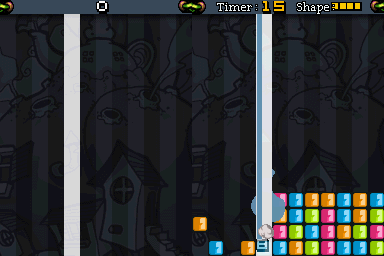
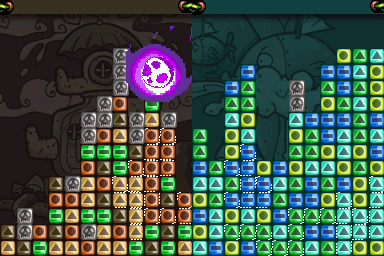
Dropcast starts with a simple, immediately understandable rhythm: tap groups of at least two matching blocks on the right-hand board before the rising pile reaches the top. The twist is that clearing a group of six or more sends a shaped block falling on the left. You must then make complete horizontal rows there, Tetris-style, and lose if either board fills up. It is an unusually direct way to make two familiar puzzle formats depend on each other.
For the first hour, it is easy to treat the left board as a bonus and concentrate on keeping the right side clean. That stops working quickly. The position of your cleared group determines where the piece lands on the left, so every big pop becomes a placement decision. You are not merely hunting the largest cluster; you are asking whether its location will wreck a nearly completed row, create a useful gap, or bury you under an awkward shape. That push and pull is where Dropcast becomes properly absorbing.
Ingrid’s Curse rewards planning with higher scores for multi-row clears and single-colour rows, but its constant rising pressure can become punishing when both boards are close to the ceiling. That is intentional tension rather than a leisurely puzzle pace. If you enjoy recovering from a messy board and turning a risky clear into a big row combo, the pressure feels exciting. If you want time to study every option, the real-time escalation may wear on you.
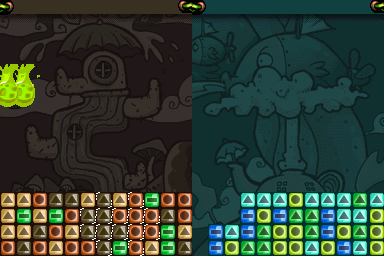
Battle Royale makes the same basic system nastier in a good way. Clearing colours casts different spells, including attacks that send blocks to an opponent or leave their blocks dead or inactive and therefore uncleareable. Timing the counter spell against incoming attacks adds a welcome reactive layer, while large clusters unlock a special attack. Against another person, this has the ingredients for sharp, spiteful back-and-forth; against AI, it gives the puzzle rules a more combative reason to master them.
Graphics
The DS is held like a book, placing the two playfields side by side rather than one above the other. That layout suits the game well: your coloured block groups sit on the right, while the falling shapes and row-building action remain visible on the left, making the relationship between a clear and its consequence easy to track.
Dropcast is built around coloured blocks and changing shapes, so its look is functional and clear rather than elaborate. The strongest visual idea is simply seeing both puzzle problems at once and being forced to split your attention between them.
Story
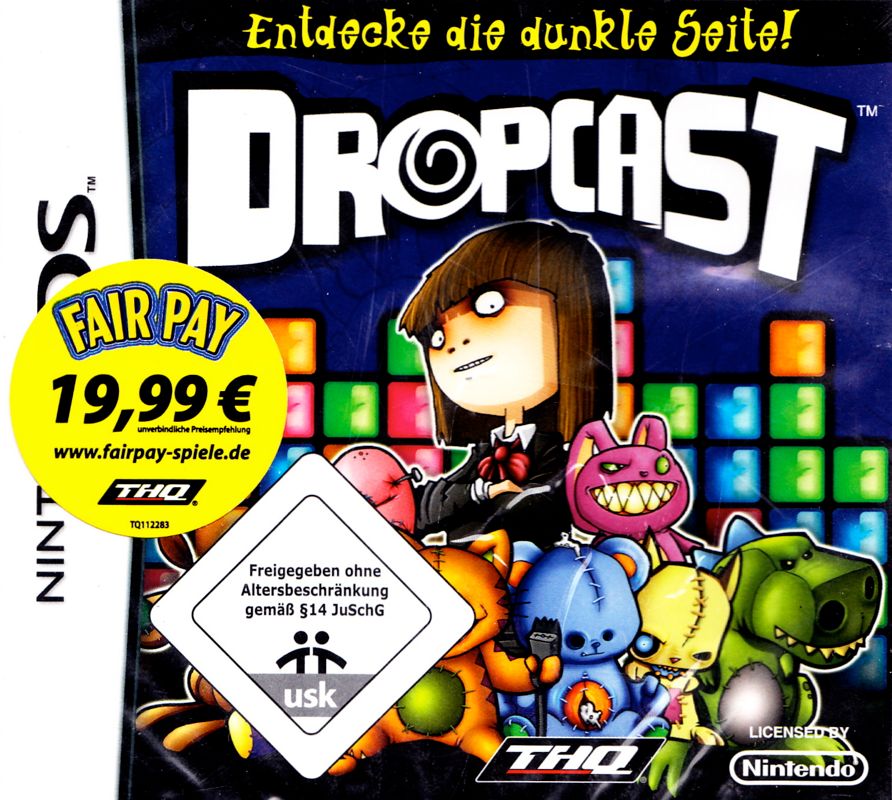
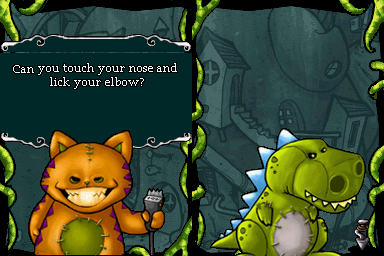
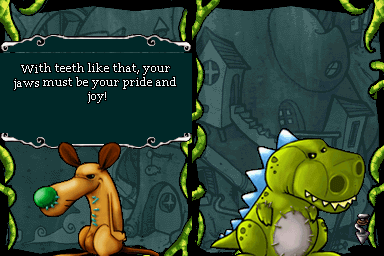
Battle Royale includes the story mode, centred on a young girl who does horrible things to her stuffed animals. It is a strange, darkly comic premise for a competitive block puzzler, and it gives the game a horror-tinged edge that separates it from a purely abstract score attack.
Do not come to Dropcast for a sprawling narrative. The story’s real value is its odd framing: it makes the clashes and spellcasting feel more mischievous than a standard head-to-head puzzle mode, with an unsettling toy-box flavour around the action.
That tone will either amuse you or leave you cold, but it is at least more distinctive than bolting a generic tournament ladder onto the competitive mode. If the idea of cute objects meeting nasty treatment sounds entertaining, it adds personality; if not, the core puzzle play stands on its own.
Overall Experience
Dropcast is a smart fusion rather than a lazy mash-up. Its two boards genuinely affect one another, and that means the moments where you clear a huge right-side cluster only to save or sabotage your left-side setup have real consequences. Once that interdependence clicks, the game can be hard to put down.
It also asks a lot from you. Monitoring two rising stacks, placing shapes, chasing score bonuses, and reacting to spells can turn a relaxed puzzle session into an anxious scramble. That is the point, but it narrows the recommendation: this is for you if you like active, high-pressure puzzle games that punish tunnel vision.
For the right player, the payoff is worth the frustration. Ingrid’s Curse offers a demanding solo loop, and Battle Royale gives the concept a competitive bite that makes every colour clear matter. Dropcast may begin as a curiosity—Collapse!-style popping on one screen, Tetris-like rows on the other—but it earns its own identity through how tightly it ties those actions together.


Reviews
There are no reviews yet.