 Retro Replay Retro Gaming History, Reviews & Emulation
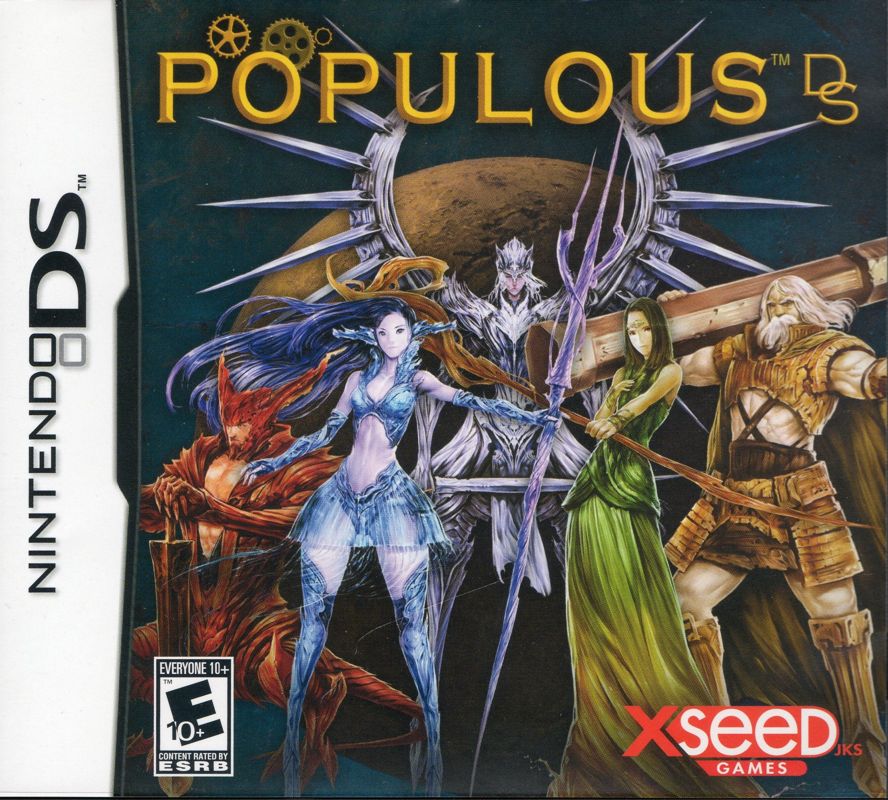
Retro Replay Review
Gameplay
The best moments in Populous DS come when a messy little landscape starts obeying your plan. You are not simply directing units from point A to point B; you are changing the ground beneath them, managing worshipers, issuing orders, and deciding when divine intervention is worth spending. That mix gives each stage a satisfying sense of escalation. A small advantage in terrain or population can become the opening you need to pressure the opposing demon.
The DS hardware is a natural fit for the land-shaping work. Raising and lowering terrain through the touch screen is more direct than wrestling with a traditional controller, and double-tapping houses to send worshipers out cuts down on fiddly selection. The bottom screen’s simple map is where you handle the practical business, while holding L lets you move the landscape manually with the stylus. It is a smart control scheme for a game built around constant adjustment, though the number of tools and decisions can still be a lot to absorb at once.
Challenge mode is where you should start, even if it asks for patience. Its tutorial is lengthy because Populous DS has a lot to teach: the gods, their miracles, orders, maps, and the rhythm of preparing for Armageddon. Stages grow harder in sequence, and the Extra menu pushes that difficulty further. Frustration can set in when you want to experiment but are still untangling the game’s many moving parts; this is not a strategy game that explains itself in a quick ten-minute match.
There is real longevity once the fundamentals click. Free Play lets you alter victory conditions, landscape range, permitted miracles, and god choices, making it the place to tailor matches to your taste. Warrior Hunt changes the focus to finding hidden warriors around a map, while medal-earning mini-games unlock bonuses. Four-player multiplayer also benefits from customizable rules, so Populous DS has more to offer than a straight sequence of challenges.
Graphics
The two-screen setup is functional rather than lavish. The top screen shows the detailed version of the world, including worshipers, deities, and buildings, while the bottom uses basic colored geometry for hands-on map control. That split is useful: you can look up for the fuller battlefield and down when you need to manipulate the terrain precisely.
Miracles get brief pre-rendered animations on the top screen, giving divine intervention a little extra punctuation. Otherwise, the game favors clear strategic information over decorative detail, which suits a portable real-time strategy game even if it lacks much visual flair.
Story
Populous DS uses a clean mythic conflict rather than a character-driven tale. You choose from the gods of Earth, Wind, Water, Fire, and Harvest, each facing an associated demon. The point is less to follow a dramatic plot than to give each set of challenges a divine rivalry and a clear opponent to overthrow.
That sparse setup works with the game’s structure. You spend your time making strategic decisions on the ground, then stages end in Armageddon, when the gods battle as their worshipers fight below. It gives the final showdown a strong thematic payoff: all the shaping, ordering, and miracle use leads to a direct clash between the powers behind each side.
Do not come looking for a richly told campaign. The narrative is mostly a frame for environments, challenges, and god selection, and the game’s lengthy tutorial carries more weight than any story development. Still, the god-versus-demon premise is easy to understand and fits the broad, toy-box strategy of the series.
Overall Experience
Populous DS is most rewarding when you enjoy learning a system slowly and then bending it to your will. Its core interaction—touching the map and physically remaking the routes your people use—remains distinctive, and the game offers enough modes to make that central idea last. Free Play in particular turns the rules into something you can meaningfully customize rather than merely endure.
Its weaknesses are tied to that ambition. There are many systems, a lengthy instructional on-ramp, increasingly stern challenges, and no guarantee that the early hours will feel smooth if you are new to this kind of real-time god strategy. The stylus reduces friction, but it cannot make the game’s strategic density disappear.
Give it a chance if you like deliberate handheld strategy, enjoy tinkering with match rules, and can accept a learning process before the payoff arrives. Skip it if you want a fast, story-led campaign or simple pick-up-and-play tactics. Populous DS is a thoughtful portable adaptation with a genuinely enjoyable control idea, but it asks enough from you that its uneven accessibility keeps it from feeling essential.


Reviews
There are no reviews yet.