 Retro Replay Retro Gaming History, Reviews & Emulation
Retro Replay Review
Gameplay
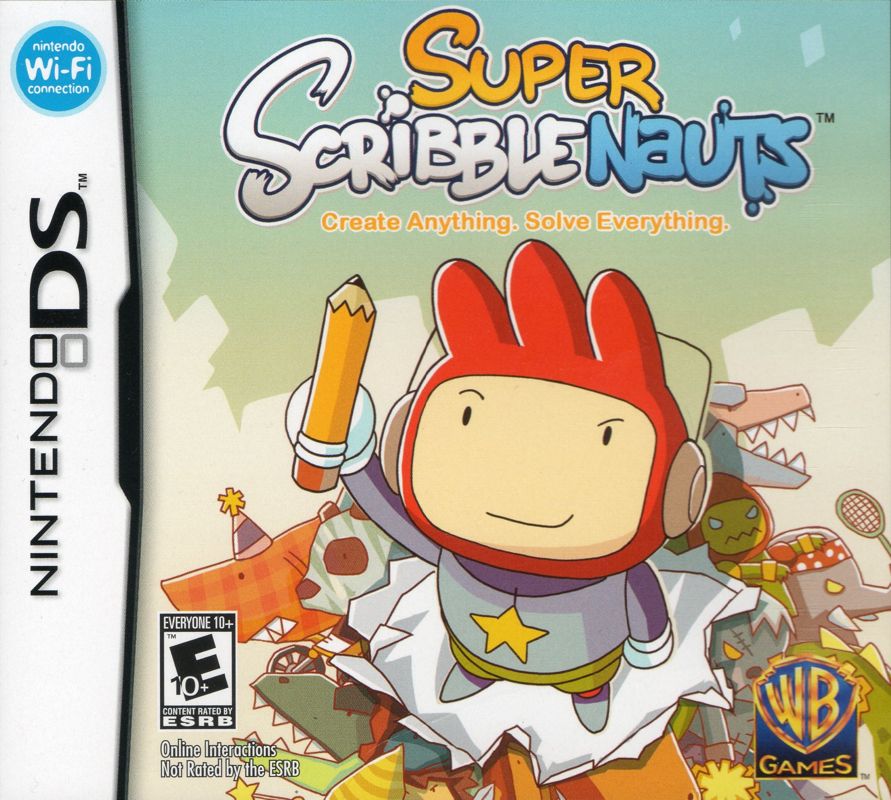
The first few puzzles put you in the right frame of mind quickly: don’t ask what item the designer expects; ask what strange thing you want to try first. Super Scribblenauts still revolves around typing a noun into Maxwell’s notebook and dropping the resulting object into a situation. That freedom gives even simple problems a playful energy. You may solve something sensibly with a tool, or create a ridiculous chain of objects because you want to see whether it works.
Adjectives are the sequel’s important upgrade, not a disposable gimmick. Being able to specify a color, size, or state makes your ideas more precise and opens up answers that a plain noun cannot cover. It also changes the rhythm of problem solving. Instead of cycling through unrelated objects, you start modifying one useful idea: make it bigger, smaller, a different color, or put it into another state. When that extra word turns a failed attempt into a solution, the game feels genuinely clever.
The added D-pad movement helps Maxwell feel less stranded at the mercy of touchscreen input. You can still use the touch screen for the notebook and object placement, while direct movement gives you more control when positioning matters. It is a practical change, but it smooths out a central frustration from the first game: you are no longer relying on one input method for every part of a busy puzzle.
That openness can also be demanding. Thousands of possible words invite experimentation, but they can encourage you to throw ideas at a problem rather than read the situation carefully. The best approach is to pause, identify what needs changing, then use the adjective system with intent. Treat every failure as information instead of a reason to keep typing random nouns, and the puzzles become far more satisfying.

Graphics
Super Scribblenauts uses a side-view perspective built around Maxwell, the objects you summon, and the puzzle space around them. The most entertaining visual moments come from seeing your written ideas become on-screen things, especially once adjectives let you alter their size, color, or condition. That direct link between a word in the notebook and an object in the level remains the game’s strongest visual trick.
Story
Maxwell returns as the protagonist, but this is not a game driven by a long narrative arc. Its real hook is the succession of self-contained situations that ask you to intervene with whatever the notebook can produce. That light framing works because it gets you to the puzzle quickly.
The sequel’s sense of personality comes less from plot than from the kinds of solutions you invent. A straightforward answer may clear a situation, while a bizarre adjective-and-noun combination can make the same solution feel like your own little story. The game is at its most memorable when you create that kind of miniature nonsense for yourself.
If you want character development or a dramatic tale, Super Scribblenauts is unlikely to be the reason you keep playing. Maxwell is the consistent face tying the challenges together, while the notebook does the heavy lifting as the source of surprise. That is enough for a puzzle game whose main pleasure is creative problem solving.
Overall Experience
Super Scribblenauts is a better fit for you if you enjoy poking at a system to see where its limits are. Its puzzles are entertaining because the solution space feels unusually broad, and the adjective feature gives that freedom more purpose than the original’s noun-only approach. You are not merely selecting an inventory item; you are shaping the item you want to use.
The game can frustrate when imagination outruns precision. A huge vocabulary is exciting, but it means your first idea is not always the one that resolves the situation cleanly. Still, the moment you reframe a problem and find the right modified object usually makes the detour feel worthwhile. The strongest sessions are a mix of deliberate reasoning and gleeful experimentation.
At a 7.9, this lands as a very good sequel rather than a total reinvention. The core Scribblenauts formula remains intact, which is exactly why the new adjective system and improved direct movement matter so much: they refine what was already special. Give it a chance if you want a DS puzzle game that rewards odd ideas, patient tinkering, and the occasional spectacularly overcomplicated answer.


Reviews
There are no reviews yet.