 Retro Replay Retro Replay gaming reviews, news, emulation, geek stuff and more!


Retro Replay Review
Gameplay
The first few minutes of Bit.Trip Core feel almost disarmingly straightforward. Dots approach from four directions, you point the Wii Remote sideways, hit the matching D-pad direction, and fire a beam to catch them. Then the patterns start arriving close together and the whole thing turns into a brisk test of whether your hands can keep pace with your ears. Since you can only fire in one direction at once, every choice briefly closes off three others.
That limitation is the game’s best idea. You are not merely reacting to dots; you are learning the rhythm well enough to prepare for the next direction before it becomes urgent. When that timing starts to click, Core has a terrific locked-in feeling. A clean combo turns what initially seemed like frantic button pressing into a controlled musical performance.
Misses hurt, and that is where the game can become frustrating. Drop too many dots and you fall into a slower monochrome state, where you need to collect enough incoming notes to climb back to normal. Fail there and the run ends. The bomb, which clears every dot currently on screen, offers a valuable escape hatch, but deciding when a pattern is bad enough to spend it is part of the pressure rather than a free reset.
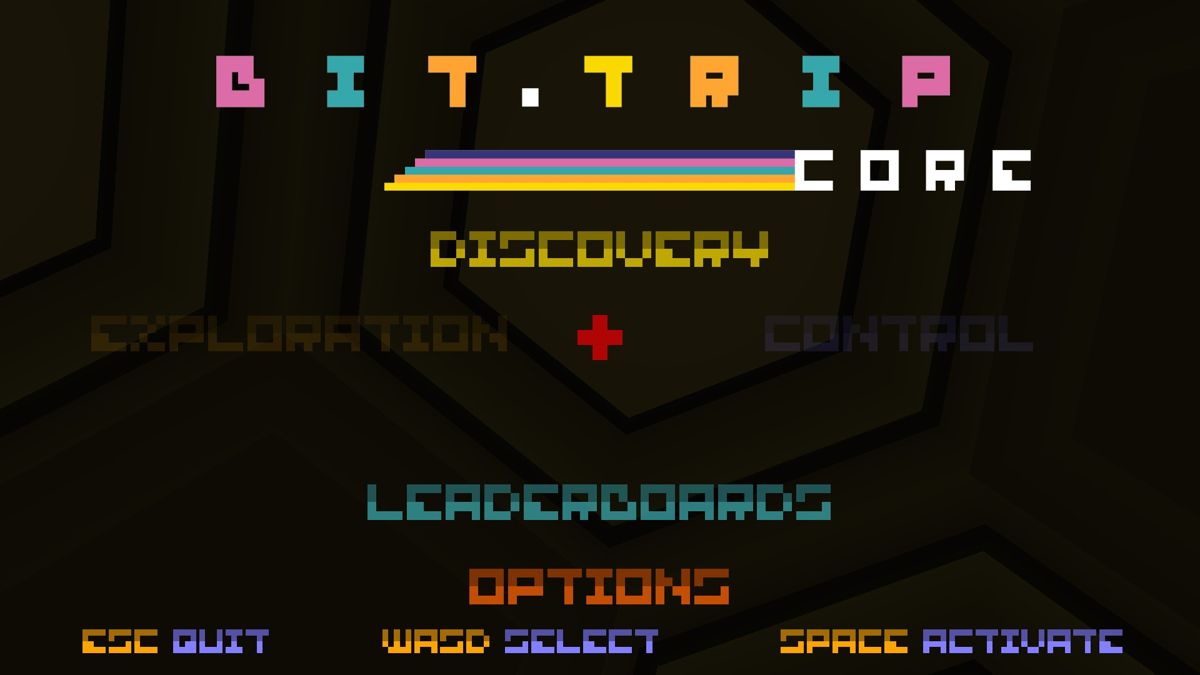
The three scenarios—Discovery, Exploration, and Control—last around fifteen minutes apiece and are split into smaller sections, making the structure easier to return to than one long endurance track. Cooperative play with a second player can also turn the tension into shared scrambling. Solo, though, the game is at its strongest when you treat each scenario as something to rehearse, fail, and gradually internalize.
Graphics
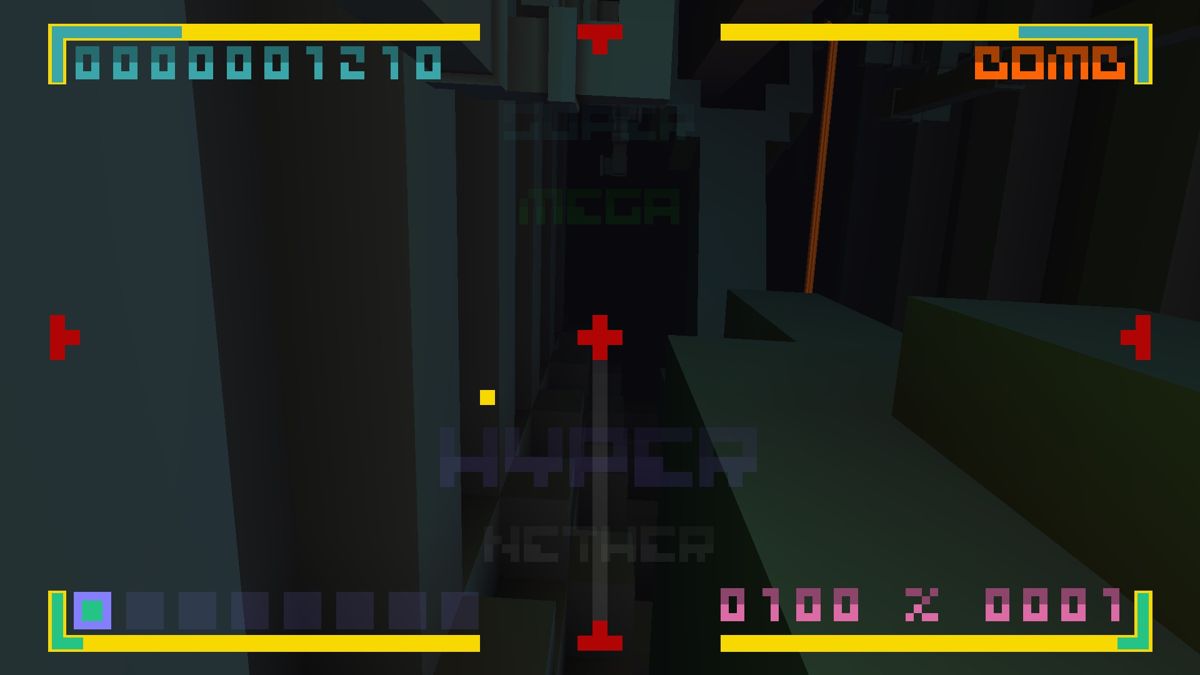
The action stays centered on the stationary core and the streams of incoming dots, so your attention remains fixed on the directions that matter. Super and Mega modes change the visuals alongside the music, giving a successful combo a noticeable lift, while the penalty state strips the screen into monochrome.
Story
Bit.Trip Core does not lean on a conventional story. Its sense of progression comes from moving through Discovery, Exploration, and Control, with each scenario functioning more like a musical challenge than a chapter in a plot.
That puts all the emotional weight on performance. A long combo feels like momentum; slipping into monochrome feels like a comeback attempt; a game over lands as the end of a failed set. If you need characters or narrative hooks to carry you forward, this is a thin package.
For rhythm-game fans, that sparseness is not necessarily a flaw. The music-driven escalation gives each run its own small arc, and the absence of story distractions keeps you focused on the next beat and the next direction.
Overall Experience
Bit.Trip Core is a compact, tough rhythm-action game built around a smart restriction: one beam, four directions, no time to hesitate. It earns its best moments when your inputs sync to the chiptune track and a difficult sequence suddenly feels manageable.
The downside is that its pressure never really lets up. You will miss notes, lose a run, and occasionally feel as though the screen got ahead of you before your hands could respond. That severity is central to the game, so it is less likely to win over anyone looking for a relaxed music game.
Still, the payoff is real if you enjoy chasing improvement. With short scenarios, escalating combo states, and an optional co-op mode, Core is easy to revisit for another attempt. It is not broad or forgiving, but it is sharply made for the kind of player who likes a rhythm game to push back.


Reviews
There are no reviews yet.