 Retro Replay Retro Gaming History, Reviews & Emulation



Retro Replay Review
Gameplay
The first hour asks you to meet Conquest of the World on its own terms. You pick a homeland from 43 countries, deal with a world shaped around early-1980s military strength and diplomatic relationships, and then split your attention between a physical gameboard and the Odyssey 2. That is more hands-on than it sounds: outcomes on one side have to be recorded and carried over to the other. For the right mood, it feels like you are running a compact tabletop war game with a console handling the fighting.
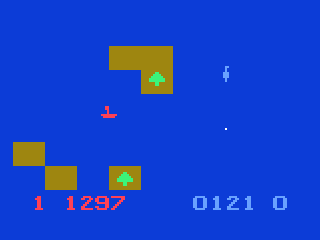
Combat has a smart, restrictive hook. In air, land, and sea battles, you control a jet, tank, or submarine against the opposing vehicle, but movement and firing both consume energy units. You cannot simply chase the other side forever or spray shots around without consequence. The battle ends once the energy is exhausted, so conserving resources matters as much as landing attacks. That gives each encounter a little tactical tension even when the broader campaign is about accumulating power.
The catch is the administration. You need to keep the gameboard, power-base indicators, homeland marker, alliance markers, and console entries in agreement. Some gamers will love physically seeing the geopolitical situation change and recording the consequences of a battle. Others will find that the repeated handoff interrupts the momentum. Give it a chance if the board-game layer sounds like part of the fun, not an obstacle standing between you and the action.

Graphics
Conquest of the World puts its military conflict into direct vehicle matchups: jets for air force battles, tanks for army battles, and submarines for naval battles. The physical board and its markers carry much of the larger-world view, while the Odyssey 2 concentrates on those smaller confrontations.

Story
There is no authored campaign story pulling you from one dramatic scene to the next. Instead, the game builds its conflict from a recognizable early-1980s international frame: countries begin with real-world-inspired military and diplomatic power, and their relationships reflect that period as well.
Your story is the one created by expansion and negotiation. An alliance can raise your country’s power, and each victory adds to that climb toward first place. Choosing a homeland therefore has more flavor than choosing a color or faction; it places you into an already uneven world and asks you to make something of its position.
That framing works better as a competitive what-if than as historical simulation. The end goal is straightforward—have the most power when the game ends—but the path can involve diplomacy, combat, and the changing state of the board. If you enjoy making your own narrative out of shifting alliances and military results, it offers enough context to make the score chase feel purposeful.
Overall Experience
Conquest of the World is a fascinatingly ambitious blend for its platform. It wants you to think globally, bargain locally, and then personally pilot the weapon of the moment. The combination is distinctive because the strategic layer is not just a menu wrapped around action; the gameboard is an active part of play, and the power race ties every result together.
Its limitations are also easy to feel. The energy rules make battles finite and tactical, but the need to record results and enter new information can turn a quick session into a commitment. This is not a game to load up when you want uninterrupted arcade speed. It is much more rewarding when you have room to spread out the board, follow the markers, and treat each exchange as part of a longer contest.
Give it a chance if you like old board games, alternate-history competition, or unusual console designs that ask you to participate beyond the controller. If you mainly want immediate action, the bookkeeping will likely wear thin before the diplomacy pays off. For patient strategy-minded gamers, though, its odd marriage of physical map play and energy-limited vehicle combat remains memorable.


Reviews
There are no reviews yet.