 Retro Replay Retro Gaming History, Reviews & Emulation
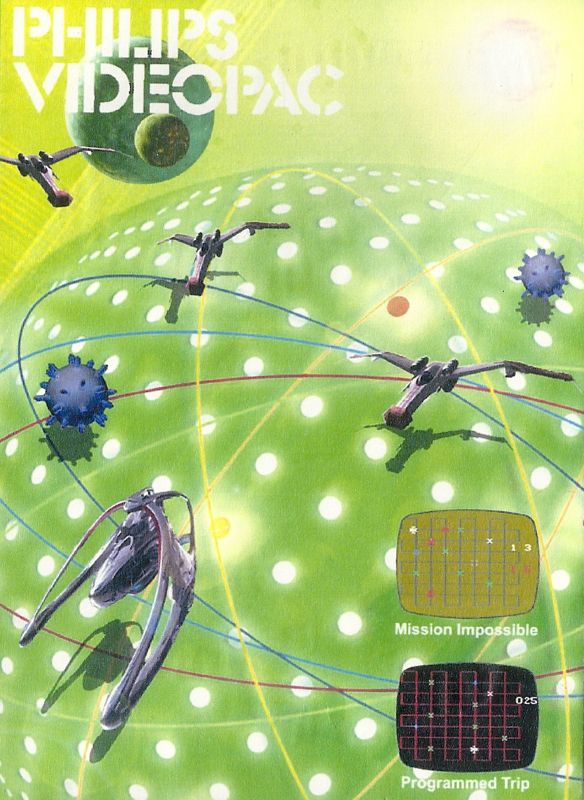


Retro Replay Review
Gameplay
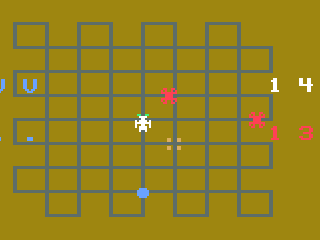
The immediate hook is watching a white cargo ship commit to a route while red bounty hunters threaten to cut it off. Mission Impossible makes you think like an air-traffic controller with very few tools: you have seven replaceable NGR bots, and each one changes a ship’s direction according to how it enters the intersection. That rule is simple enough to grasp quickly, but its consequences are not. One redirect can save the cargo ship, steer a hunter into a mine, or accidentally open a path straight into danger.
What gives the action game its edge is that the board is full of exceptions worth exploiting. Red mushroom power-ups let the cargo ship destroy hunters, white X marks reverse a ship’s path, mines kill anything crossing them, and blue dots give hunters extra lives. The 15-life count on each side means you are not merely trying to survive one clean trip; you are trying to manage a long, messy battle of routes and attrition. When a plan works and a bounty hunter gets sent into a hazard you arranged, the cart earns its name.
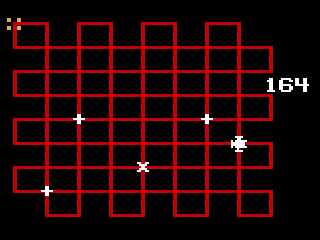
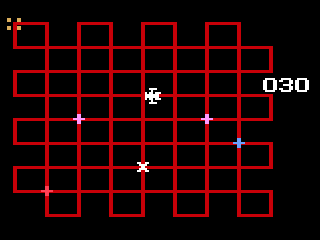
Programmed Trip is the more deliberate half, and arguably the sharper puzzle. Instead of reacting to hunters, you arrange NGR bots before releasing the cargo ship, then try to collect the colored plus symbols in the required lilac-red-blue sequence. Every wrong pickup or collision with another object costs 10 points from a starting total of 30, so careless experimentation is punished quickly. It is satisfying when the whole route clicks into place, though its strict scoring will frustrate you if you prefer to improvise after the ship starts moving.
The two games complement each other well. Mission Impossible has more immediate pressure and more moving parts to juggle, while Programmed Trip asks you to slow down and solve the board before committing. Neither sounds complicated on paper, yet both squeeze a lot from directional rules and a small set of map objects. Give it a chance if you like old-school games that make a single routing mistake matter.
Graphics
The top-down screens are built from bold, functional symbols: the cargo ship is white, bounty hunters are red, NGR bots are green Xs, mines are lilac squares, and power-ups are red mushrooms. That color coding makes the important hazards easy to spot while you track paths across the fixed playfield. It is a spare look, but the board stays understandable when several objects matter at once.
Story
Mission Impossible offers a direct sci-fi setup rather than a developed narrative: protect the cargo ship from bounty hunters trying to destroy it. That is all the motivation the action game needs, because every route decision feeds directly back into that pursuit.
Programmed Trip strips things down further. Its premise is the task itself—program the cargo ship to hit the colored pickup points in the correct order. There are no detours from that goal, which suits a puzzle built around precision.
The lack of story is a strength here, not a gap that needs filling. These are rule-driven games, and the tension comes from whether your planned route survives contact with the board.
Overall Experience
This is a smart little two-game cart with a more thoughtful core than its basic symbols suggest. Mission Impossible provides the better snap decisions, especially once hazards, reversers, and hunters are all competing for your attention. Programmed Trip delivers the stronger pure-puzzle payoff, because success comes from setting a route correctly before the ship is released.
Expect friction at first. The NGR bot direction rule is the heart of both games, so you need to internalize it before your choices stop feeling arbitrary. Once it clicks, the limitations become the point: you are not overpowering the board, just finding a precise way through it with a handful of redirects.
The payoff is worthwhile for patient retro puzzle fans and anyone who enjoys manipulating movement rather than directly controlling a vehicle or character. If the title has you thinking of the broader name, the related Mission: Impossible game is a separate point of comparison; this Odyssey 2 cart stands on its own as a compact battle of routes, traps, and timing.


Reviews
There are no reviews yet.