 Retro Replay Retro Gaming History, Reviews & Emulation
Retro Replay Review
Gameplay
The first few minutes are comfort food if you know falling-block puzzles: guide tetrads across the well, turn them into place, fill horizontal lines, and try not to leave yourself a doomed stack. Puzzle Piece Panic! is straightforward enough to understand immediately, but it earns its name once bad gaps begin to pile up and the pace starts rising.
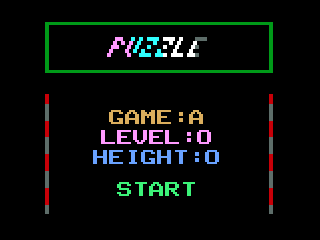
Its best idea is the split between collapsing and non-collapsing line clears. In A and B, blocks above a cleared row fall down, so you can recover from awkward construction and chase cascading cleanups. C and D deny you that rescue; cleared rows leave the pieces above in place, making holes and vertical planning much more dangerous. That distinction gives the same basic rules a noticeably different rhythm rather than merely changing a number on a menu.
The mode goals are well chosen, too. A and C are endurance runs, increasing difficulty after every ten lines, so you can measure how long your concentration holds. B and D instead ask for 25 lines without a difficulty increase. If escalating speed is what turns a fun puzzle into panic, these are the modes to start with; if you want the hard, repeatable score-chasing pressure, the survival options have more bite.
Controls sound sensibly direct: horizontal movement, a fast drop with down, and rotation in either direction through the action button and up. That second rotation direction matters more than it first seems, because it lets you correct a hurried placement without cycling through every orientation. The frustration comes from the genre’s usual cruel arithmetic: one poorly placed piece can turn a stable board into a long, increasingly frantic repair job.
Graphics
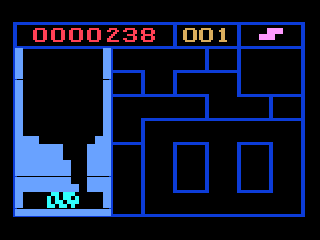
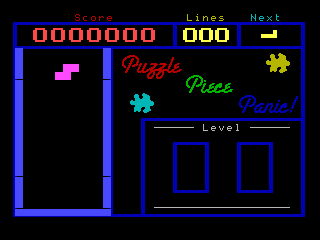
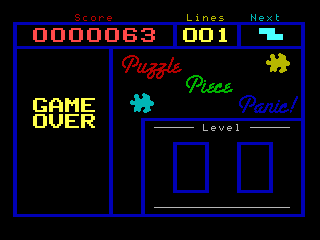
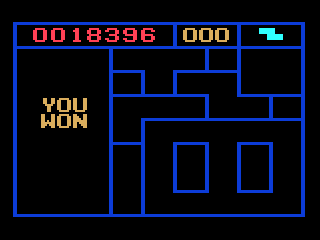
The action is confined to a single well filled by falling tetrad pieces, keeping your attention on the stack and the rows you need to finish. That stripped-down view suits a game where every square matters.
Story
There is no narrative detour here, and that is the right call. Puzzle Piece Panic! treats the rising stack as its drama: you make a plan, an inconvenient shape arrives, and suddenly the board is asking whether you really meant it.
The 25-line modes create a small arc of their own. You begin building comfortably, settle into a clearing rhythm, then find yourself counting down the remaining lines while protecting the board from one avoidable mistake.
Survival is more open-ended and more personal. The story of a run is the shape of your eventual collapse—or the tidy recovery that lets you survive another difficulty jump.
Overall Experience
Puzzle Piece Panic! does not try to reinvent the falling-block formula; it makes a smart case for how much mileage a few meaningful rule variations can get from it. The collapse versus no-collapse choice is the reason to return, since it changes your priorities without asking you to relearn the fundamentals.
Give it a chance if you enjoy compact puzzle games built around clean rules and repeated improvement. Start with B to learn the board under a fixed difficulty, then move to D when you want stricter consequences for every hole you leave behind. A and C are where the tension ramps up.
The polyphonic music that plays when you win or lose is a charming historical flourish for Odyssey², and it gives each conclusion a little extra punctuation. More importantly, the game understands the core pleasure of the genre: clearing one line buys relief, clearing several feels brilliant, and the next falling piece immediately asks you to earn that feeling again.


Reviews
There are no reviews yet.