 Retro Replay Retro Gaming History, Reviews & Emulation



RETRO REPLAY EDITORIAL REVIEW
GTA: Vice City at 24 — The 1980s I Always Wanted to Explore
By gameswithgalt · October 29, 2026
I love the 1980s. I love Miami Vice. And I love Grand Theft Auto.
Retro Replay Review
Retro Replay Verdict
The setting, characters, and radio stations give Vice City an identity that remains difficult to resist.
So when Rockstar announced that its next game would take the GTA formula and drop it into a sun-soaked, neon-drenched version of 1980s Miami, how could I NOT love it?
On 29 October 2002, Grand Theft Auto: Vice City arrived in North America for PlayStation 2, just one year after GTA III had revolutionized the series.

And what a follow-up it was.
The pastel suits, the sports cars, the beaches, the music, the outrageous characters, and the wonderfully excessive atmosphere of the decade were all there.
It was practically a love letter to the 1980s.
Well, a love letter filled with cocaine, corruption, carjackings, and organized crime.
But you get the idea.
From Liberty City to Paradise
I’d absolutely loved Grand Theft Auto III.
My roommate and I had spent months exploring Liberty City, discovering everything that enormous three-dimensional playground had to offer.
It was a groundbreaking experience, and one that left a lasting impression on me.
So naturally, I was looking forward to seeing where Rockstar would take the series next.
As much as I was anticipating Vice City, I didn’t preorder this one. My roommate was already planning to pick it up, and just as we’d done with GTA III, we spent the next several months parked in front of the television a few nights a week, exploring everything the new city had to offer.
And what a city it was.
Where GTA III presented a gritty, industrial metropolis inspired by New York, Vice City offered palm trees, sunny beaches, Art Deco buildings, glamorous nightclubs, and a skyline glowing with neon lights.
The streets were filled with sports cars, motorcycles, and pedestrians dressed in the kind of fashions that could only have come from the decade of big hair and regrettable wardrobe decisions.
We spent countless evenings exploring its dark alleys and even darker stories, discovering new characters, taking on missions, and occasionally abandoning whatever we were supposed to be doing just to see what trouble we could find.
And I loved every bit of it.
I’ve always enjoyed the pop culture of the 1980s. The movies, television shows, music, fashion, and wonderfully over-the-top personalities.
And few shows captured that atmosphere quite like Miami Vice.
The expensive cars, pastel jackets, spectacular waterfront scenery, and slick presentation made it one of the most recognizable shows of the decade.
Rockstar understood that appeal.
In fact, the developers drew inspiration from Miami Vice, along with crime films such as Scarface and Carlito’s Way.

And it showed.
Vice City didn’t simply recreate the look of the decade. It embraced the entire attitude.
Everything was bigger, brighter, louder, and more excessive.
And somewhere underneath all that glamour was a thoroughly rotten criminal underworld.
Perfect.
Say Hello to Tommy Vercetti
Another major change from GTA III was the protagonist.
Claude, the hero of the previous game, had been a silent character who allowed the supporting cast to do most of the talking.
Vice City gave us Tommy Vercetti.
Voiced by Ray Liotta, Tommy was a former mob enforcer who had recently been released from prison after serving fifteen years.
His old boss, Sonny Forelli, sends him to Vice City to establish a foothold in the city’s growing drug trade.
Naturally, things go horribly wrong.
A deal is ambushed, the money and merchandise disappear, and Tommy suddenly finds himself caught between an angry Mafia boss and a city full of criminals who would happily kill him for considerably less.
The solution?
Find out who was responsible, eliminate the competition, and take over the city.
Seems reasonable enough.
I liked Tommy.
Giving the protagonist a voice was a significant change, and I thought it worked particularly well here. Tommy had a personality, a temper, and a presence that made him feel like an active participant in the story rather than simply the guy who showed up to complete everyone else’s dirty work.
I’ve never been convinced that voiced protagonists belong in every open-world RPG. Fallout 4, for example, is one where I think the approach works against some of the roleplaying freedom.
But in Vice City? Absolutely.
Tommy was a character with an established history, motivations, and a specific role in the narrative. Giving him a voice helped sell the entire experience.
And the late Mr Liotta was a fantastic choice.
The supporting cast was just as entertaining.
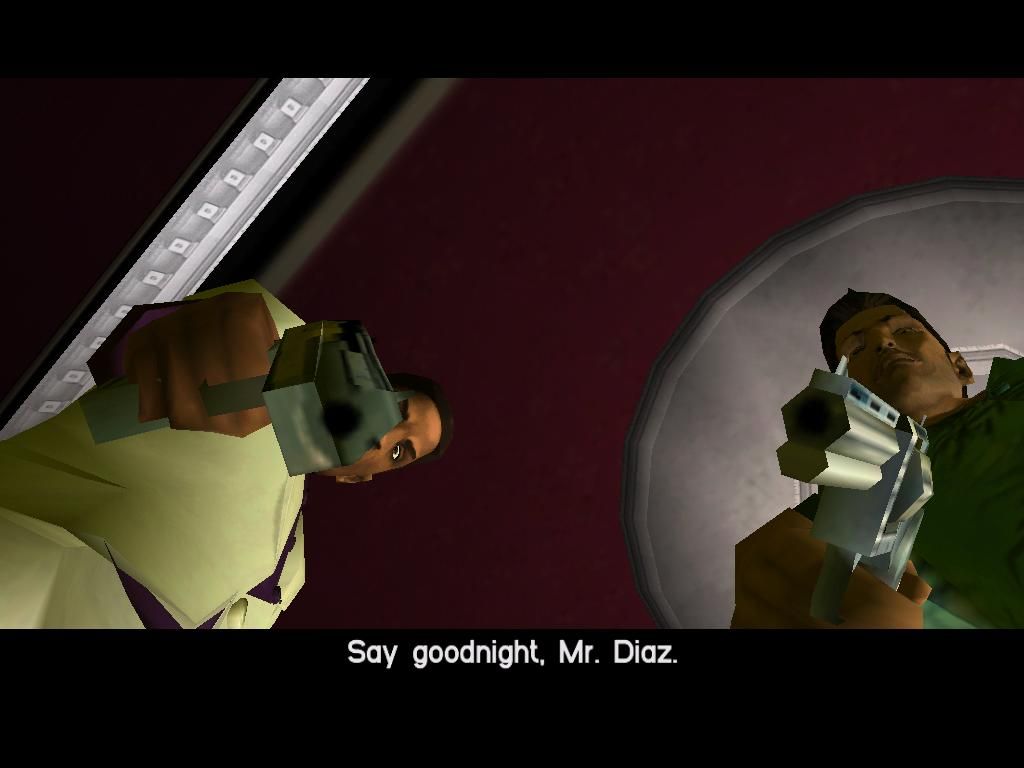
There was Ken Rosenberg, the perpetually nervous lawyer; Lance Vance, voiced by Miami Vice star Philip Michael Thomas; the explosive Ricardo Diaz; and an assortment of gangsters, politicians, entertainers, and other assorted lunatics.
They were exaggerated, ridiculous, and frequently hilarious.
In other words, exactly what I’d come to expect from Rockstar.
The Soundtrack to My 1980s
Now, I couldn’t possibly write about Vice City without spending some time talking about the music.
I love 1980s pop music.
And this soundtrack remains one of my favorites in the entire GTA franchise.
Rockstar filled the radio stations with hits spanning pop, new wave, hard rock, heavy metal, hip-hop, soul, and more.
Flash FM, Wave 103, V-Rock, Emotion 98.3, Fever 105, and the other stations each had their own personality.
You could cruise through Vice City listening to Hall & Oates, Laura Branigan, Michael Jackson, or any number of other artists who helped define the decade.
And, of course, there was Jan Hammer’s “Crockett’s Theme” from Miami Vice.
How perfect was that?
Now, the soundtrack certainly wasn’t a complete collection of everything I loved about 1980s music.
There were plenty of staples and personal favorites missing.
But what Rockstar did include was a fantastic mixture of recognizable hits, great B-sides, and songs that fit the setting perfectly.
And that’s something I appreciate.
I liked it so much, in fact, that I bought the boxed CD soundtrack for the game, complete with songs and radio bits, advertisements, and everyting.
 You don’t necessarily need every chart-topping hit from a decade to recreate its atmosphere. Sometimes the lesser-known tracks do just as much to establish a particular time and place.
For the record: Rockstar didn’t simply license a bunch of familiar songs. The developers also created fictional DJs, outrageous commercials, and talk radio programming that parodied the culture of the decade.
The result was something that felt like a living, breathing 1980s radio experience.
And sometimes, just driving around listening to the music was entertainment enough.
That’s one of the things I appreciate about games that really commit to a particular setting.
The soundtrack doesn’t simply accompany the world.
It helps create it.
And Vice City absolutely nailed that.
More Than Just GTA III in a Hawaiian Shirt
Of course, all the pastel colors and fantastic music in the world wouldn’t have mattered if the game itself hadn’t been fun.
Fortunately, Rockstar didn’t simply take GTA III, change the scenery, and call it a day.
The familiar open-world formula returned, but with a number of improvements and additions.
Motorcycles made their return, offering new ways to weave through traffic and perform ridiculous stunts.
Helicopters gave players the opportunity to explore the city from above, while boats and other vehicles made use of the waterfront setting.
There were more weapons, additional interiors, new missions, and plenty of opportunities to cause trouble.
And perhaps most importantly, there was a greater sense of progression beyond simply completing assignments for various criminals.
Tommy could eventually purchase properties and businesses throughout Vice City.
Some served as safehouses, while others opened up new missions and eventually generated income.
The Malibu Club, the movie studio, the taxi company, and other properties became part of Tommy’s growing criminal empire.
And I think this was one of the game’s cleverest additions.
 In GTA III, you worked your way through the criminal underworld, taking jobs from increasingly powerful people.
In Vice City, you were eventually building something of your own.
You weren’t simply working for the bosses anymore.
You were becoming one.
It gave the adventure a different sense of direction, and it made the city feel like something you could gradually take over rather than simply explore.
The Miami I Always Imagined
I think this is where Vice City really captured my imagination.
I’d always loved the romanticized version of Miami presented in movies and television. The waterfront nightlife, the expensive cars, the stylish criminals, the neon-lit streets, and the sense that something exciting—or incredibly dangerous—might be happening just around the next corner.
And Miami Vice had certainly helped establish that image in my mind.
Of course, I understood that the real Miami wasn’t some endless parade of glamorous criminals, beautiful beaches, and dramatic nighttime car chases.
But that fictional version of the city?
That’s the one I wanted to explore.
And Vice City gave me the opportunity.
It took that romanticized vision of 1980s Miami nightlife and the criminal underworld and turned it into a place I could actually wander around.
We could cruise the streets, visit nightclubs, explore neighborhoods, discover strange characters, and get caught up in increasingly ridiculous criminal schemes.
Sometimes we’d follow the story. Other times we’d simply explore.
I think that’s what made Vice City so memorable.
It wasn’t simply another open-world crime game.
It was an opportunity to step inside a fictional world inspired by movies, television, and music I’d loved for years.
And Rockstar brought that fantasy to life.
Which GTA Is My Favorite? That’s Complicated.
People love ranking video games.
What’s the best Grand Theft Auto? Which one has the greatest story? The best characters? The most interesting world?

And I understand the appeal.
But I’ve always had a difficult time ranking the games in this particular franchise.
Because, like several of my favorite series, whichever GTA I’m currently playing tends to be the one I like best.
When I was playing GTA III, it was my favorite.
When I moved on to Vice City, suddenly that was my favorite.
And the pattern continued with the games that followed.
Each brought something new to the experience, whether it was a bigger world, improved mechanics, more interesting characters, or another memorable story.
But they also offered something different.
GTA III gave me that first incredible experience of stepping into a fully realized, three-dimensional city and discovering just how much freedom a video game could offer.
That was magic.
Vice City took that freedom and wrapped it in an atmosphere that seemed tailor-made for me.
The 1980s. The music. The fashion. The nightlife. The criminal underworld.
Everything I’d loved about those old movies and television shows was suddenly part of an interactive adventure.
It was a different kind of magic.
And I’m not sure I need to decide which one was better.
Twenty-Four Years Later
Looking back, I think Grand Theft Auto: Vice City remains one of the most distinctive games in the franchise.
Not because it had the biggest map, the most sophisticated gameplay, or the most elaborate story.
But because it had such a strong identity.
The music, the characters, the setting, the humor, and the gameplay all worked together to create an experience that celebrated and satirized the excesses of the 1980s.
The GTA games that followed have continued to build on the formula, and I’ve enjoyed every one of them.
But there’s something special about a game that lets you step inside a world you’ve already spent years imagining.
Vice City didn’t just give me another place to explore.
It gave me the 1980s Miami of my imagination.
And I couldn’t have asked for much more than that.
What about you? Is Vice City your favorite GTA? And which radio station would you tune into first if you could cruise those neon-lit streets again?
#GamesWithGalt #GTAViceCity #GrandTheftAuto #RockstarGames #PlayStation2 #PS2 #RetroGaming #GamingHistory #80sNostalgia #OpenWorldGames



Reviews
There are no reviews yet.