 Retro Replay Retro Gaming History, Reviews & Emulation
Retro Replay Review
Gameplay
The first hour asks you to settle into Yo-Jin-Bo’s rhythm rather than conquer it. This is an adventure driven mostly by reading English subtitles and listening to Japanese voice-over, so you spend far more time following Sayori’s strange displacement into Hatsume’s life than actively directing her. If you enjoy visual novels, that quiet commitment to character scenes and steadily unfolding danger is likely the point. If you need constant interaction, it will feel passive almost immediately.
The choices arrive only a few times per chapter, but they are not decorative. You must make them under a time limit, and hesitating does not preserve neutrality: the game picks a default response for you. That pressure gives even simple selections some nervous energy, particularly once you understand that the wrong call can bring the story to a sudden stop.
That abrupt failure structure is the game’s most divisive trait. Save regularly, especially before decision points, because an unexpected ending can mean loading an older file or starting again. For patient players, the threat of failure makes the routes and multiple endings more compelling; your choices have consequences rather than merely changing a line or two. For anyone who dislikes replaying long stretches of dialogue after one poor answer, it can become a stubborn source of frustration.
Graphics
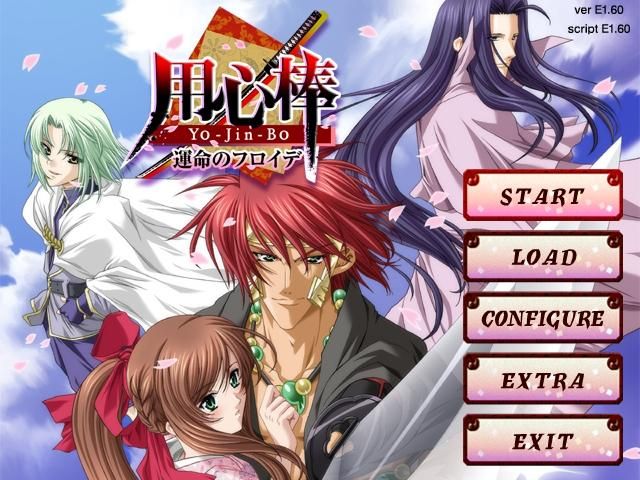
Yo-Jin-Bo uses a Japanese-style anime look for its time-traveling medieval Japan story. Sayori’s modern-schoolgirl starting point and the world of a princess, castle, bodyguards, and ninja assassins give the character art a broad contrast to work with, fitting the game’s mix of danger and playful relationship comedy.
Story
The central setup is delightfully direct: a jade pendant draws Sayori into a ghostly plea for help, then deposits her in Princess Hatsume’s body just before an assassination attempt. Chief Inspector Harumoto’s pursuit and his ninja assassins give the escape story an immediate enemy, so the narrative does not take long to establish why everyone needs to move.
What distinguishes the premise from a straight historical chase is Sayori herself. She is not simply visiting the past; she is trapped in another person’s body, trying to survive beside Hatsume’s faithful guard Muneshige and the others hired to rescue the princess. That puts the story in a useful space between identity confusion, courtly peril, and a group-on-the-run adventure.
The tone also makes room for humour in the relationships among the central cast. That is important, because the story’s assassins and forced escape could otherwise become one-note. Yo-Jin-Bo is a good fit if you like romantic-comedy-adjacent character friction woven into a dangerous period-fantasy plot, rather than a severe historical drama.
Overall Experience
Yo-Jin-Bo: The Bodyguards is an easy recommendation for a visual-novel fan who wants Japanese voice acting, subtitles, branching conclusions, and a time-slip story with bodyguards and assassins. Its best quality is the way its high-stakes escape plot leaves room for amusing character dynamics. You are here to spend time with this group as much as to reach an ending.
Its limitations are equally clear. Interaction is sparse, timed decisions are infrequent, and the punishment for a wrong answer can be severe. The game wants you to read carefully, save often, and accept that a route may end sooner than you expected. That is effective tension for some, but it is not a substitute for more active adventure-game play.
Meet Yo-Jin-Bo on its own terms and the payoff is a compact, choice-driven anime adventure with enough consequence to make repeat paths worthwhile. Skip it if you want exploration, frequent puzzles, or forgiving failure. Give it a chance if a princess-in-peril chase, a displaced heroine, and a talkative group of protectors sounds like exactly the sort of melodramatic detour you want to take.


Reviews
There are no reviews yet.