 Retro Replay Retro Replay gaming reviews, news, emulation, geek stuff and more!


Retro Replay Review
Gameplay
The first hour has a wonderfully mischievous energy. You are a twelve-year-old wandering through your uncle’s mansion, so ordinary objects loom over you and even basic tasks feel like playground experiments. At first, Quantum Conundrum keeps things grounded: walk, jump, pick things up, drag them around, and throw them. That limited start matters because it teaches you to look at each room as a physical space rather than a set of abstract switches.
Once the Interdimensional Shift Device arrives, the puzzles become much more interesting. Fluffy makes objects light enough to toss around, Heavy turns them into destructive or laser-blocking weights, Slow reduces time to a tenth of its usual pace, and Reverse Gravity flips the room’s rules. Your own movement stays unchanged, which is a smart constraint. You are not becoming more powerful; you are changing the behavior of everything you need to manipulate.
Quantum Conundrum is at its best when it asks you to chain those ideas together under pressure. Throwing an object while it is Fluffy and switching it to Heavy before it lands is the kind of solution that feels clever rather than arbitrary. Slow can let you jump onto a thrown object and ride it, too. The later emphasis on rapid shifts and precise platforming can be frustrating, particularly if you have the right plan but miss a jump, yet the game’s best rooms make the effort worthwhile.
Graphics
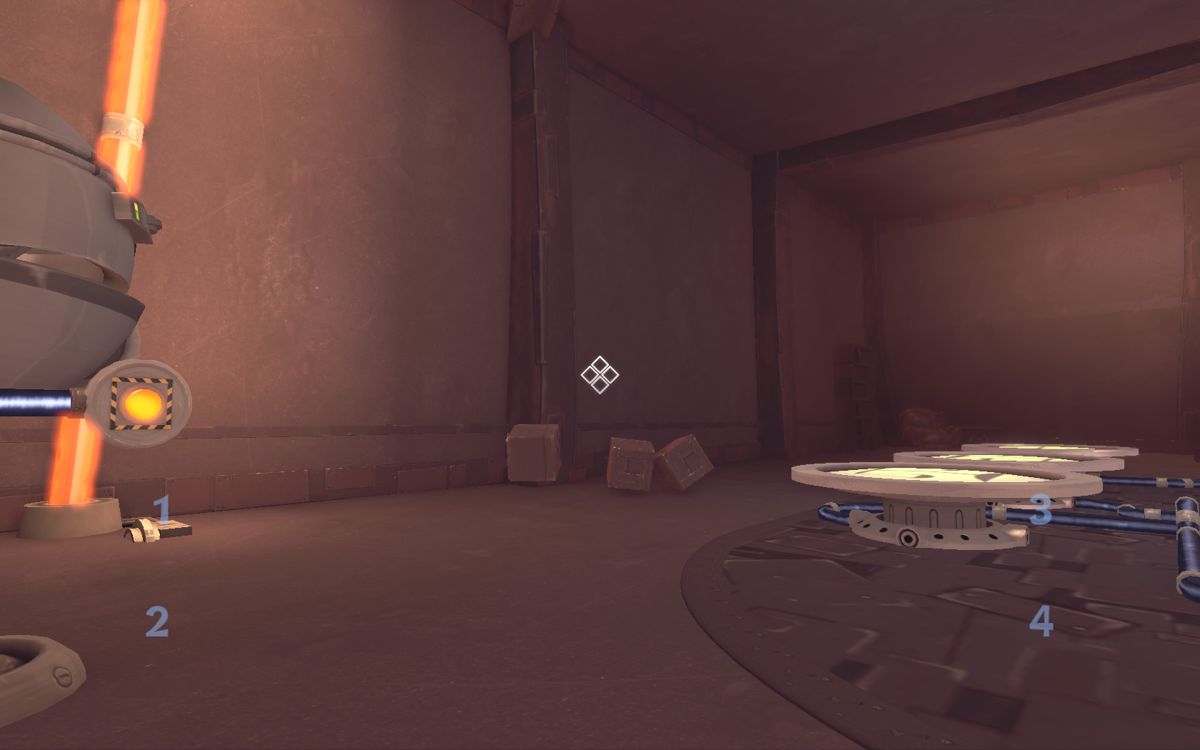
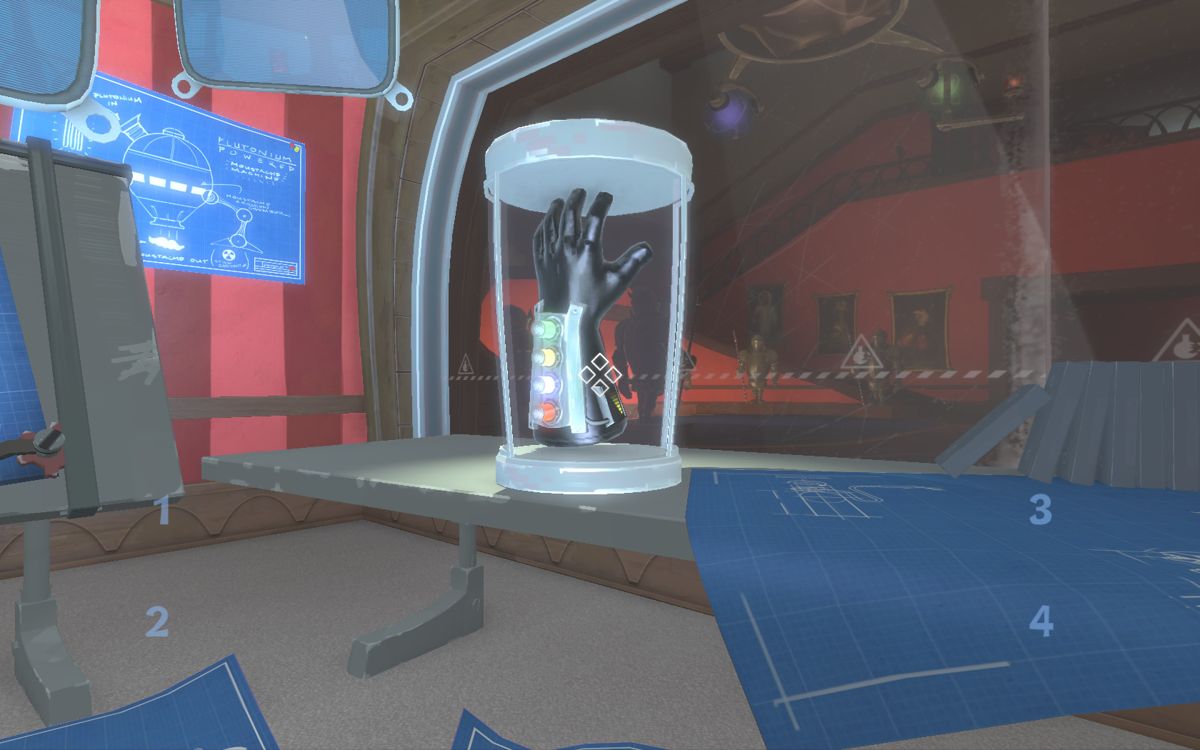
The first-person view sits low to the ground, so the mansion’s rooms and everyday objects look huge from the boy’s perspective. That exaggerated scale gives the puzzle spaces a playful sense of size and makes hauling, throwing, and navigating around objects easy to understand at a glance.

Story
The setup is light and functional: the boy visits the mansion of his eccentric uncle, Professor Fitz Quadwrangle, only for an experiment to trap the professor in a pocket dimension. Quadwrangle can still watch and communicate, leaving you to handle the actual rescue.
It is a good excuse for the mansion-spanning adventure because it puts you in the role of the kid who has to make sense of an adult’s ridiculous scientific mess. The professor’s distant guidance also keeps the premise present without pulling focus from the rooms in front of you.
Do not come in expecting a dramatic narrative with elaborate turns. The story mainly gives personality to the puzzle-solving and a reason to keep moving deeper into the mansion. For game-specific release and background information, the Quantum Conundrum history page is useful context.
Overall Experience
Quantum Conundrum earns its reputation through escalation. It does not dump every dimension on you at once; it starts with familiar object handling, then steadily teaches you how radically weight, time, and gravity can alter a room. When that progression clicks, you start spotting possibilities before the game spells them out.
The trade-off is that it asks for real platforming accuracy alongside its logic puzzles. If you enjoy first-person puzzle games but dislike lining up jumps, some later stretches may test your patience. Still, the dimension combinations are distinctive enough that a failed attempt usually feels like a problem to refine, not a dead end.
Give it a chance if you like puzzlers that let you experiment with physical objects and reward quick thinking. Its mansion is a strong stage for a compact, increasingly demanding set of spatial challenges, and the moments when you combine dimensions on the fly are genuinely satisfying.


Reviews
There are no reviews yet.