 Retro Replay Retro Gaming History, Reviews & Emulation
Retro Replay Review
Gameplay
The first hour of Ratchet & Clank: Full Frontal Assault has a pleasingly hectic rhythm. You are not simply clearing enemies from a path; you are trying to keep the QForce base alive while getting the level’s objectives done. That split focus gives even a familiar blast of shooter action some urgency. Leave the base unattended too long and the whole plan can unravel.
The tower-defense elements are straightforward enough to click quickly. Missile turrets and plasma mines help thin out invaders, while barriers make enemies stop and break through before advancing. The best moments come when you place defenses with a purpose, then jump into the fight yourself to cover the weak point they cannot handle alone. It is less about building an elaborate maze than staying alert and using your limited breathing room well.
There is a trade-off: this structure narrows the kind of Ratchet & Clank experience on offer. If you want a broad platforming adventure, the repeated duty of guarding the base can feel restrictive. Five levels across three planets is a lean package, too. But the focused format has its own value when you want a brisk action game where each objective has consequences beyond simply reaching the finish line.
Co-op is the strongest argument for revisiting it. Online and offline multiplayer let two people divide attention between objectives, enemy pressure, and the base, and that cooperation suits the design naturally. Playing solo asks you to constantly switch priorities; with a partner, you can actually form a plan instead of perpetually putting out fires.
Graphics
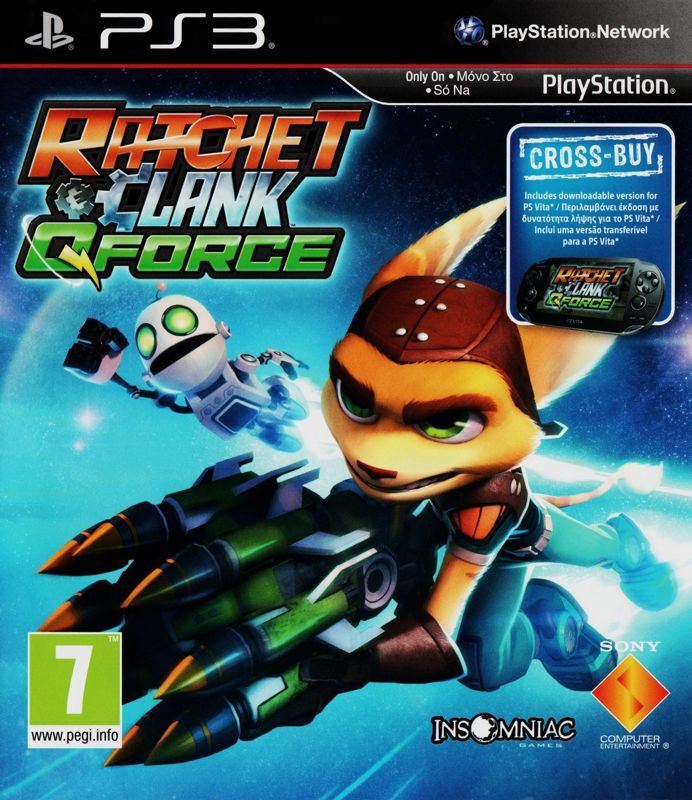
The behind-the-back view keeps the action close, with Ratchet, Clank, or Captain Qwark in the foreground and invading enemies pressing toward the QForce base. The three-planet structure gives the game a few distinct locations to move through, while the fixed defensive gear—turrets, mines, and barriers—makes the battlefield easy to read during a busy attack.
Story
The story is a light framework for the action: Ratchet, Clank, and Captain Qwark are up against a sneaky villain from Qwark’s past, with the QForce base under repeated threat. It gives Qwark a personal connection to the conflict, but the game’s energy is directed toward the next defense rather than toward a sprawling plot.
That is not a flaw if you are here for an efficient sci-fi shooter with familiar heroes. Just do not expect the narrative to carry the experience between missions. Its job is to keep the trio moving, and it does so without getting in the way.
For game-specific background and release history, the Ratchet & Clank: Full Frontal Assault overview is useful context. In the game itself, the story works best as a reason to put Qwark, Ratchet, and Clank into another escalating defensive bind.
Overall Experience
Full Frontal Assault is an interesting detour for Ratchet & Clank rather than an essential full-scale entry. Its shooting and base defense create real tension, especially when a barrier is about to fall and you have to decide whether to chase an objective or sprint back to defend home. That immediate pressure is the game’s best idea.
The limitations are equally clear. The campaign is short, and the small set of levels means the central loop must carry a lot of weight. If tower defense tends to make you feel tethered to one spot, the format may become frustrating before it becomes satisfying. The payoff is strongest when you enjoy juggling defense placement with direct combat rather than treating the building portion as an interruption.
Give it a chance if you want a compact cooperative action game and are open to seeing this series bend toward defense strategy. Skip it if your ideal Ratchet & Clank game is primarily a long platforming adventure. At its best, it is a lively two-player firefight with just enough tactical responsibility to make every incoming wave matter.


Reviews
There are no reviews yet.