 Retro Replay Retro Gaming History, Reviews & Emulation
Retro Replay Review
Gameplay
Assassin’s Creed Chronicles: Russia is at its strongest when you stop trying to rush it. Nikolai moves through 2.5D spaces built around cover, alcoves, patrol routes, and small hazards, so the satisfying moments come from noticing a safe opening that initially looked impossible. A smoke bomb, a well-chosen distraction shot, or a quiet takedown can turn a crowded checkpoint into a clean escape. The levels are compact, but they ask you to look closely at the space in front of you.
The rifle changes the rhythm from the earlier Chronicles games. Its bayonet still supports close-range stealth and direct attacks, but the firearm gives Nikolai a more flexible way to manipulate guards from afar. Sniper nests shift the camera into first person and put more emphasis on picking targets, while ricochet distractions let you pull enemies away from a route. The winch is another smart addition: it opens locks and gates, and its electrical discharge can disable traps. These tools make the best encounters feel like short, practical infiltration puzzles rather than simple platforming stretches.
That said, this is not a miniature open-world Assassin’s Creed. Progress is tightly directed, and the stealth-focused structure can become frustrating when a route does not suit your preferred approach or an alarm forces a riskier recovery. Elite guards also demand that you read their protection rather than lean on one solution, since gas masks resist smoke and armor stops bullets. If you enjoy careful route planning, that pressure gives the game bite. If you want wide freedom to improvise, it can feel confining. For a look at an earlier, separate side-view Assassin’s Creed experiment, Assassin’s Creed II: Discovery makes an interesting format comparison, though it is not a Chronicles episode.
Graphics
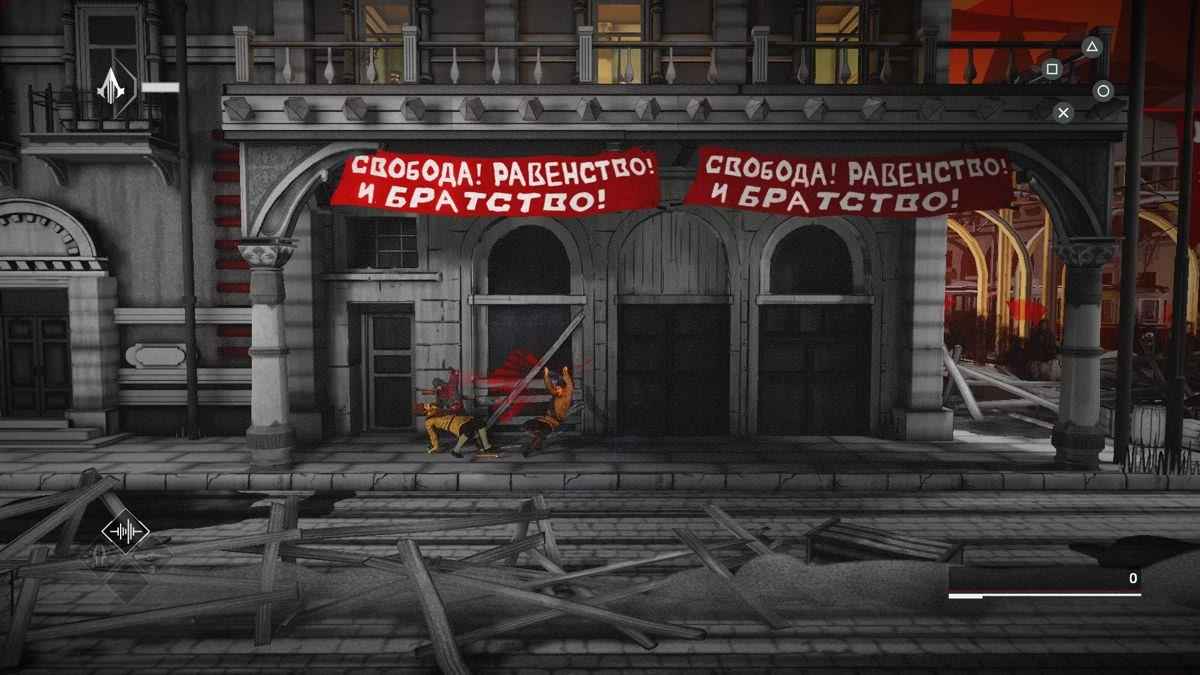
The side-view stages have a sharp, graphic look. Nikolai’s dark red coat stands out against brown and ochre military uniforms, gray stone buildings, and muted city streets. Bright red banners with white Cyrillic lettering cut across balconies and columns, while red skies, crimson attack streaks, and warm yellow windows give the Russian setting a welcome punch of color.
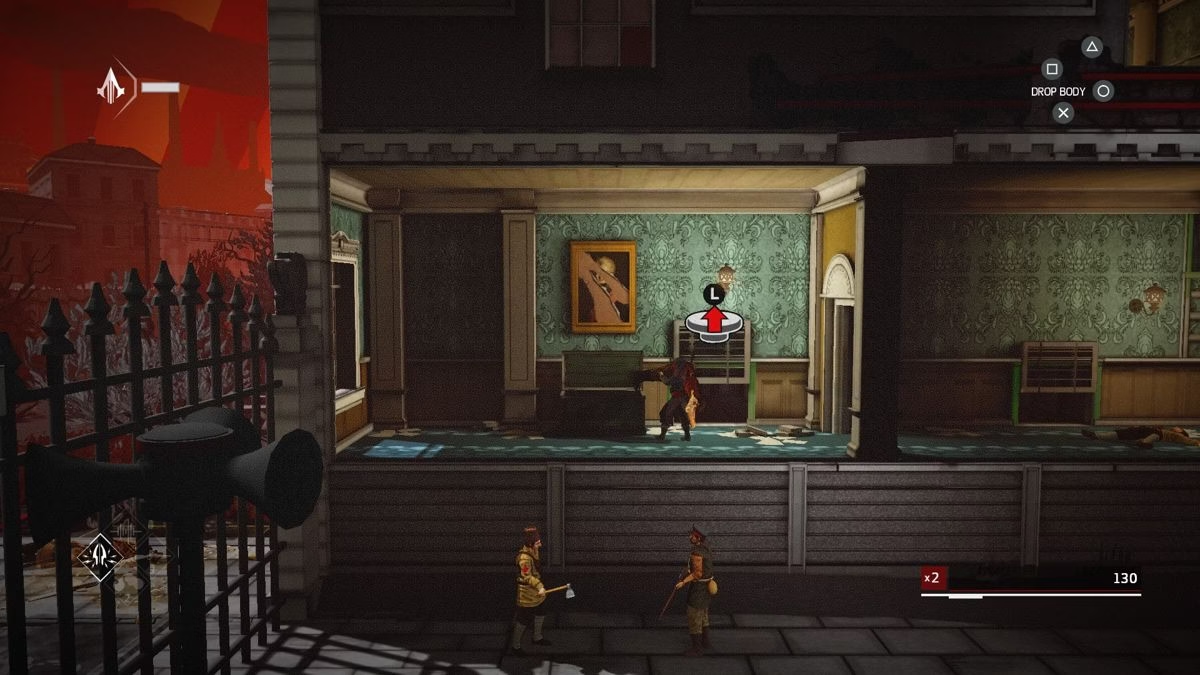
Interior cutaway rooms add green ornate wallpaper, wood paneling, portraits, and small wall lamps, and exterior scenes layer rail tracks, barricades, arched windows, and black iron fences into the foreground. The tradeoff is that characters can look small and get swallowed by the busy, shadowed architecture. The bold red-and-gray contrast still gives the action a distinctive image.
Story
Set in fictionalized 1918 Russia, the story follows Nikolai Orelov as he is sent to recover a mysterious box from the captive Tsar’s family. When he saves the young Anastasia, the assignment becomes a personal conflict: protecting her puts him at odds with the forces pursuing them and challenges his loyalty to the Brotherhood. It is a solid setup for a story about an assassin whose orders no longer sit comfortably with his conscience.
Anastasia is more than a passenger in Nikolai’s escape. The box and Nikolai’s necklace trigger a strange connection that intermittently changes her into a dangerous assassin, and the campaign alternates control between the two characters at set points. You cannot switch freely, but their contrasting roles keep the plot and the missions from staying in one gear too long.
The story works best as a brisk chapter built around its central moral problem, not as a deep historical drama. Its Russia is an Assassin’s Creed interpretation rather than a history lesson, and the mystery surrounding Anastasia gives it a slightly stranger tone than the series’ usual conspiratorial chase. Ubisoft’s launch announcement for the standalone Russia episode captures that basic premise, but the game earns its best moments by putting Nikolai’s duty and protectiveness in conflict.
Overall Experience
This is a focused stealth-platformer with more good ideas than its modest scale might suggest. The rifle, winch, electrical traps, mines, and sniping add enough tactical variation that you are regularly reconsidering how to cross a room. When a plan comes together without raising suspicion, the game delivers the concise assassin fantasy that its side-on format is chasing.
The compromises are equally clear. Restricted routes and high-risk alerts can make the experience feel less forgiving than the mainline games, and the small-scale viewpoint cannot offer their sense of travel or exploration. That is not automatically a flaw, but it means your patience for repeated observation and deliberate movement matters more than your affection for the Assassin’s Creed name.
Give it a chance if you want a compact, methodical stealth game with a striking Russian backdrop and a story that gives its two leads a useful tension. Skip it if you mainly want open maps, broad player choice, or a combat-first action game. It is an uneven finale, yet its best missions have enough clever route planning and gadget play to make the trip worthwhile.

Reviews
There are no reviews yet.