 Retro Replay Retro Gaming History, Reviews & Emulation
Retro Replay Review
Gameplay
The first hour of Shutokō Battle ’94: Drift King is about getting comfortable with its particular idea of speed. You begin with a stock car in the scenario campaign, enter races, and gradually work toward better performance through tuning. That progression gives each win a practical value: you are not only clearing another event, but building toward a car that can better handle what comes next.
Drifting is the key ingredient. Hard corners are meant to be attacked sideways, and that changes the rhythm of the driving. Instead of treating every bend as a place to brake heavily and crawl through, you are encouraged to preserve momentum with a controlled slide. When you start judging corners well, the game’s racing becomes more engaging than its basic win-the-race objective suggests.
The changing road types help. Highways invite speed, racing tracks provide a more familiar circuit-racing structure, and mountain roads put greater pressure on your cornering. That variety keeps the campaign from feeling like the same contest repeated with different opponents. Still, this is an older simulation-minded racer, not a forgiving pick-up-and-play arcade game; the payoff comes from accepting the learning curve and improving your driving line.
Graphics
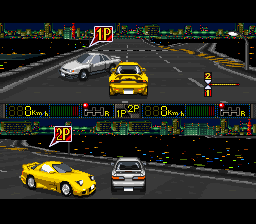
The driving view leans hard on the SNES perspective effect: the road is a huge textured plane rushing toward you, while cars and other track objects sit on top as sprites. It is a familiar look for the system, but it fits the highway and track racing well enough, especially when the road starts bending and you need to set up for a drift.
Cars and roadside objects are necessarily sprite-based rather than richly detailed 3D models. The important visual information remains clear: where the road is going, where the corners are tightening, and where the other cars sit in relation to you.
Story
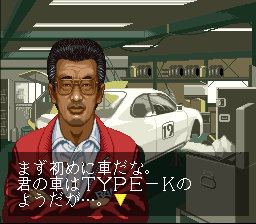
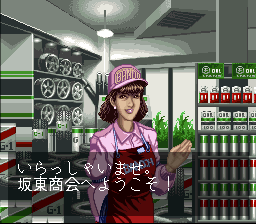
There is no elaborate narrative pulling you through Shutokō Battle ’94: Drift King. The scenario campaign supplies the framework instead: start with a stock car, race across several types of roads, tune the machine, and keep advancing.
That light touch suits the game. You are here for the feeling of developing a car and becoming more capable at managing fast, difficult corners, not for dramatic stakes between races.
If you want a racer with a strong cast or a plot full of turns, this will feel sparse. If a campaign only needs to give your upgrades and victories a sense of direction, it does its job without getting in the way.
Overall Experience
Shutokō Battle ’94: Drift King is interesting because it already points toward the road-racing identity associated with the Shutokō Battle and Tokyo Xtreme Racer line, while remaining firmly rooted in 16-bit hardware. The car-tuning campaign and drift-centered cornering give it more personality than a straightforward SNES race-to-the-finish game.
Its limitations are part of the bargain. The perspective road effect is functional rather than luxurious, and the game asks you to meet its older driving feel on its own terms. Frustration can set in if you want instant precision or a more lavish sense of speed, but persistence makes the different road settings and car development more rewarding.
Give it a chance if you enjoy retro racers that reward course familiarity, momentum management, and gradual mechanical improvement. It is not a broad recommendation for every racing fan, but it has a focused hook: learn to drift, tune your car, and make the next difficult stretch of road feel less impossible than it did five races ago.


Reviews
There are no reviews yet.