 Retro Replay Retro Gaming History, Reviews & Emulation

Retro Replay Review
Gameplay
The first hour of Yū Yū Hakusho 2: Kakutō no Shō asks for more patience than you might expect from a licensed 1994 fighter. It adopts a Street Fighter-style, side-view fighting format, but it initially holds special moves at arm’s length. That means the early fights are about getting comfortable with ordinary attacks and surviving without immediately leaning on flashy commands. If you come in expecting every character’s full arsenal from match one, the opening can feel unnecessarily stingy.
Stick with it through the third fight, though, and the structure begins to make sense. You can gain the knowledge needed to perform special moves, turning command sequences into a real part of the match rather than an inaccessible curiosity. Training Mode is especially valuable here: use it before jumping back into Story or a competitive match, because this is plainly a game that expects you to learn its inputs rather than mash your way to the interesting stuff.
The low-health blue bar is the game’s best pressure point. Once it flashes, special moves can be unleashed, so a match can change character late instead of simply limping toward a foregone conclusion. That comeback potential gives the limited ten-character roster more energy than the number suggests. Story Mode supplies the manga-based progression, while Tournament and Versus are the sensible choices once you want straightforward fights with a friend or against the game.
Graphics
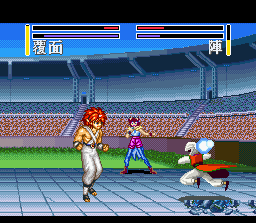
This is a 2D, side-view Super Famicom fighter built around ten selectable characters from Yū Yū Hakusho. The action stays focused on the two combatants in the usual Street Fighter-style layout, which makes the changing health situation and those flashing blue low-energy bars easy to track during a close round.

Story
Story Mode follows the manga rather than inventing a detached fighting-game premise, covering the material through the fight with Toguro Ani. That gives the solo mode a useful sense of direction: you are not merely clearing an arbitrary ladder, but moving through a defined slice of the series.
Its scope is also firmly mid-story. The game stops at that point rather than presenting the entire manga, so the narrative payoff depends a great deal on how much you already care about Yū Yū Hakusho. Fans will appreciate having that run of material represented in a fighting game; newcomers may find the competitive modes more immediately rewarding than the story context.
Because the story is carried through battles, it works best as a reason to keep pushing through the early limitations and learn the command sequences. The adaptation gives those matches more purpose, but the fighting still has to hold your attention—and it does more convincingly after special moves enter the equation.
Overall Experience
Yū Yū Hakusho 2: Kakutō no Shō is a better fit for a patient fan than for someone hunting for instant arcade fireworks. Its early withholding of special moves is a real hurdle, not a charming quirk. Yet the game improves once you understand why Training Mode matters and get past the third fight, when its Street Fighter-inspired foundation can finally stretch out.
The four modes give you a sensible package: Story for the manga material, Tournament for structured competition, Versus for direct matches, and Training for drilling commands. Ten fighters is not a huge selection, but the low-health special-move trigger helps rounds avoid feeling flat, particularly when both sides are nearing defeat.
Give it a chance if you enjoy retro 2D fighters and want a Yū Yū Hakusho adaptation with a gradual learning curve. Go straight to Training Mode if the commands do not click, then return to Story with a little muscle memory. The payoff is modest but genuine: a focused licensed fighter that becomes more engaging precisely when it stops keeping its special attacks out of reach.


Reviews
There are no reviews yet.