 Retro Replay Retro Gaming History, Reviews & Emulation


Retro Replay Review
Gameplay
The first few fights in Bullfight: Ring no Hasha are about getting comfortable with a deliberately small set of tools. You have left and right swings, an uppercut, and a dodge, so the fun comes from choosing your moment rather than sorting through a huge move list. Hits matter twice: they drain energy and build the points that can decide a bout when neither boxer goes down for good.
That scoring rule gives the matches a useful layer of pressure. You cannot simply wait around hoping for a knockout, because a cautious fight can still slip away on points. Conversely, an early lead has value, which makes each clean hit feel like progress even before the opponent’s energy bar is near empty.
The count system is where the game finds its most immediate arcade drama. Emptying an opponent’s energy does not automatically end everything; rapid button presses can get a boxer back to their feet with some energy restored. That turns knockdowns into frantic momentum swings, though it also means you need to be ready to mash when your own fighter is on the canvas.
Between fights, training lets you improve strength, agility, and endurance. That is a simple but meaningful reason to care about surviving the bracket, especially since the eight boxers begin with different strengths. The separate side-scrolling martial-arts mode is an unexpected change of pace, trading the ring for left-to-right melee encounters. It does not replace the tournament’s strategic hook, but it gives the cartridge a welcome extra mode when you want something more direct.

Graphics
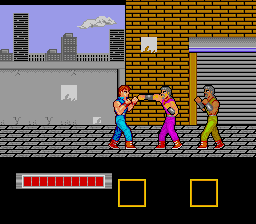
The action is built around side-view 2D fighting, both in the boxing ring and the scrolling martial-arts mode. That perspective keeps the distance between combatants easy to judge, which matters when your entire fight depends on landing one of a handful of moves or slipping away with a dodge.

Story
This is a tournament story in the oldest arcade sense: choose a boxer, survive four fights, and reach the finale. The bracket supplies the motivation without getting in the way of the matches.
Different fighter statistics give that climb a little personality. A strong boxer, an agile boxer, and one built to endure naturally ask for slightly different priorities as you prepare between bouts.
The more memorable narrative moments come from the fights themselves: losing on points after failing to press an advantage, or clawing back to your feet during a count. It is lean, but the tournament format gives your victories and losses enough context to matter.
Overall Experience
Bullfight: Ring no Hasha is most enjoyable when you meet it on its own compact terms. Its boxing is not built around a massive technique list; it asks you to understand four moves, watch energy and scoring, and make training choices that carry into the next fight. Once that starts clicking, the short tournament has real replay value through its eight selectable boxers.
Frustration can set in if you want every exchange to be settled by a knockout. Points can decide the result, and the button-mashing recovery sequence can abruptly extend a fight you thought you had won. Still, those rules also create the game’s best tension: a bout remains alive until the final decision or the final failed count.
The side-scrolling martial-arts mode makes this feel less single-minded than a standard boxing release, even if the ring remains the main attraction. Give it a chance if you enjoy early fighting games with clear rules, short sessions, and a little stat management between rounds. If you need deep move lists or elaborate tournament storytelling, its stripped-down approach will likely feel too limited.


Reviews
There are no reviews yet.